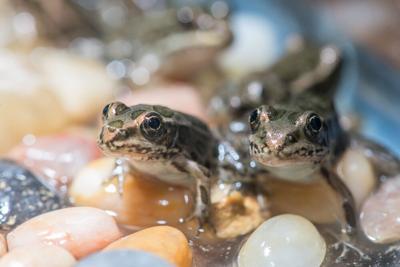
Hundreds of northern leopard froglets are growing fast at the Oregon Zoo. The threatened amphibians, which are getting a head start as part of a cooperative species recovery effort, will be released into the wild this summer.
Photo by Michael Durham, courtesy of the Oregon Zoo
Hundreds of northern leopard froglets are growing fast at the Oregon Zoo. The threatened amphibians, which are getting a head start as part of a cooperative species recovery effort, will be released into the wild this summer.
Photo by Michael Durham, courtesy of the Oregon Zoo
PORTLAND — Hundreds of imperiled northern leopard frogs will be hopping back into the wild soon, thanks to a recovery program at the Oregon Zoo. The newly hatched frogs, called froglets, were brought to the zoo as eggs earlier this spring by the Washington Department of Fish and Wildlife.
“They’re growing bigger every day,” said Jen Osburn Eliot, who oversees the zoo’s Great Northwest area. “They’ll be ready to hop back to the wild before we know it.”
Once abundant throughout North America, northern leopard frogs are rapidly disappearing from their native ranges in Washington, Oregon and western Canada. In Washington, where the zoo-reared froglets will be released, the species has been listed as endangered since 1999.
“We received the eggs earlier this month, and the froglets started hatching right away,” Osburn Eliot said. “We’ll keep them safe and fed until later this summer, when they have a better chance of surviving on their own.”
Though the reason for northern leopard frogs’ decline in the Pacific Northwest is unknown, they are threatened by habitat loss, disease, pollution, climate change and competition from non-native species. By head-starting frogs at the zoo, animal care staff are hoping to combat these threats and grow the population of northern leopard frogs in the region.
“Every froglet counts,” said Osburn Eliot. “There’s only one known population of northern leopard frogs left in Washington State, and we want to do everything we can to help bring them back.”
According to wildlife officials, northern leopard frogs are an important foundation species in natural ecosystems, an indicator of water quality, predator and prey, and a source of inspiration for kids and new naturalists around the world.
Funding for the northern leopard frog reintroduction is provided through a competitive state wildlife grant awarded to WDFW from USFWS’s Wildlife and Sport Fish Restoration program.



Commented