
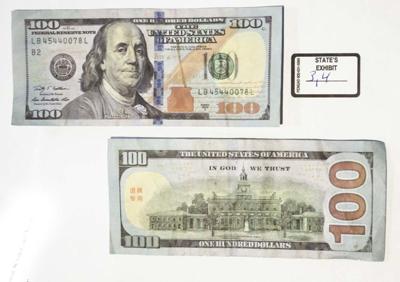

Chinese printing on back and missing security features flagged these bills as fakes.
A The Dalles man who passed four fake $100 bills in May was sentenced to 18 months in prison following a two-day trial earlier this month.
His attorney said he intends to appeal the sentence.
Justin Casey McClour, 36, was sentenced July 17 by Wasco County Circuit Court Judge Janet Stauffer on three counts of first-degree forgery, a felony, and one count of third-degree theft, a misdemeanor.
Wasco County District Attorney Eric Nisley had asked for two more months of confinement than McClour was ultimately sentenced to, “but the judge gave him what I thought was a fair sentence.”
McClour maintained he found the four bills on the ground by the Shilo Inn. He went on to use them on May 13 and 14 to pay bills at Aaron’s, a rental center, at Bi-Mart Pharmacy, and to pay a taxi driver, who gave him $90 in change.
Nisley described at the sentencing how McClour used a fake $100 at Aaron’s for a TV rental and then went to Bi-Mart to pay for prescriptions. While he was at Bi-Mart, where a pharmacist told him the two $100 bills he handed over were fake, Aaron’s had called him and told him the $100 bill he gave them was fake.
All the victims were repaid for the money they lost, but the taxi driver had to wait months before he got his money back, Nisley said.
Nisley said the defense argued that the victims “weren’t out any money, so they were not victims. That is not the case. That is not what a victim is.”
The defense was trying to get the charges considered as one criminal incident. Nisley argued McClour had time between each crime to decide whether to do it again. A police officer testified that it took nine minutes for him to drive from Aaron’s to Bi-Mart.
“The defendant had plenty of opportunity to say, ‘I’m going to throw these bills away,’ and he didn’t,” Nisley said.
Nisley and McClour’s attorney, Thomas Freedman of Portland, clashed often during the sentencing hearing, with Nisley at one point repeatedly saying “objection” as Freedman “testified” to the judge, which is impermissible, Nisley said.
Stauffer cut Freedman off, saying, “You don’t need to testify.”
Nisley told the judge that Freedman “called and started arguing with me on the facts of the case” before he even represented McClour.
Nisley said that before McClour went to trial he had offered a plea agreement that would have seen him get probation and credit for time served in jail.
Freedman argued in a sentencing brief that probation was appropriate and would serve public safety.
Freedman listed a number of certificates McClour had earned for completing various programs as evidence that probation would be suitable, but Nisley said that could be viewed the opposite way: that McClour had completed a number of programs, but committed new crimes anyway.
Nisley said the classes had no effect and did not deter McClour “one iota” from committing new crimes.
Nisley said McClour was already on probation for coercion, a felony, “and he wants to argue he should be put on probation again.”
Nisley was dismissive of the defense’s argument that McClour had the right to appropriate the found bills for himself. “Someone’s loss is his gain,” he said.
Nisley said the defense argued McClour’s crimes were minor, insignificant events. “I think most people think that’s a federal crime [to pass fake bills], in fact it is.”
A Secret Service agent testified at the trial that six things on the bill showed it was fake, including Chinese symbols on the reverse side of the bill.
Freedman argued that McClour went on “sort of a mini shoplifting spree” where everything got repaid.
In arguing against prison time, Freedman said McClour had a job and family locally, and he cited the connection between serving prison time and re-offending.
Freedman said McClour had a domestic violence charge in 2012, a disorderly conduct charge and third-degree theft charges. “We’re not talking about someone with a lengthy history of property crimes,” which is what you typically see with Measure 57, a state law that increases sentences for certain property crimes.
Freedman emailed a statement to the Chronicle, saying McClour intends to appeal the sentencing ruling that found that he had committed three separate felonies.
“Mr. McClour’s sentence of 18-months prison underscores two of the most unfair aspects of the criminal justice system in Oregon: mandatory minimum sentences and non-unanimous juries,” Freedman wrote.
“Mr. McClour was eligible for a prison sentence solely because he was convicted of three felony property crimes, all from this case. Otherwise, he would have been sentenced to probation. The statute under which he was sentenced (ORS 137.717) was meant to apply to repeat property offenders, but it can mandate prison where there are three or more convictions in a single case if the court finds that the convictions arise out of separate episodes. The trial court found that Mr. McClour’s convictions arose out of separate episodes, but Mr. McClour intends to appeal that ruling.”
Freedman added, “Moreover, the verdict on one of Mr. McClour’s three felony convictions was non-unanimous. Oregon is the only jurisdiction where a person can be convicted of a felony by a non-unanimous jury (either 10-2 or 11-1). Mr. McClour was sent to prison based on a verdict that is not lawful in any other state or under federal law. Indeed, the law in Oregon permitting non-unanimous juries was the result of xenophobic and racist views from the early 1900s meant to chill minority votes on juries. (The only other state to allow non-unanimous convictions in felony cases was Louisiana, which banned that practice in 2018.)
“The United States Supreme Court recently accepted a case challenging the constitutionality of non-unanimous juries. If the Supreme Court holds that non-unanimous juries are unconstitutional, I expect Mr. McClour’s conviction to be reversed on that ground as well.”
Freedman added, “Mr. McClour’s convictions resulted in no financial loss to the individuals and businesses involved. Two of the business rejected the bills, and Mr. McClour repaid the cab driver prior to trial. This is not the kind of case where an individual should be sent to prison, and it highlights the need for major prison reform and for Oregon to finally ban the unconstitutional practice of trial by non-unanimous jury.”
Carrie Rasmussen is a prosecutor in Hood River County, and said McClour was due in circuit court there on July 30, though she said his attorney may seek an extension.
She said McClour is on probation in Hood River for felony coercion and has a DA diversion for the felony crime of first-degree attempted sexual abuse.
If the court revokes his probation for the coercion, Oregon sentencing guidelines recommend 13-14 months of prison, she said.
If his diversion is revoked, he would be sentenced on that charge as well. “He would receive credit towards that sentence for the in-custody time that he served prior to the resolution of the case, which was approximately 26 months” at the regional jail in The Dalles.
He would be sentenced to 24 months of post-prison supervision for the felonies, but it all depends on whether or not the court revokes his probation, Rasmussen said.
If the court does revoke probation, she said the district attorney’s office would likely seek a sentence commensurate with sentencing guidelines.


Commented