
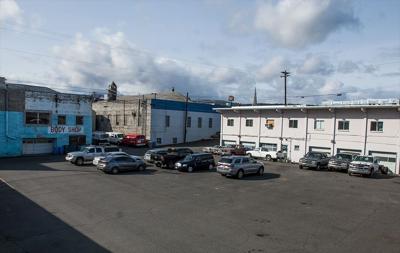
The Columbia Gateway Urban Renewal Agency’s narrow vote to move ahead with negotiations on an agreement for development of a national brand hotel at First and Union streets will be revisited Tuesday, Feb. 20, due to a technicality.
The body of appointed and elected officials meets at 5:30 p.m. in city hall, 313 Court Street.
City Attorney Gene Parker said the 3-2 affirmative vote taken by the agency at its Jan. 30 special meeting is not valid under Oregon law.
Parker indicated the relevant law requires that the nine-member board have at least five yes votes on any decision to make it valid.
ORS 174.130 states that: “Any authority conferred by law upon three or more persons may be exercised by a majority of them unless expressly otherwise provided by law.”
Because the agency, which was restructured a little more than one year ago, does not yet have proposed bylaws in place that would allow a vote if a quorum, or five members, are present, Parker said state law prevails. A quorum is the minimum number of members of an appointed or elected body that must be present to make the proceedings of a meeting valid.
“The majority will need to tell us what they want to see happen,” Parker said of Tuesday’s possible revote.
He said the city charter specifies that three affirmative votes of the city council are needed for a decision, regardless of how many elected officials are present.
Steve Harris, city planning director and manager of urban renewal, brought forward a draft of agency bylaws in January, but they have not yet been adopted.
Harris’ proposal outlines that five board members, a simple majority, can take a binding vote.
The agency board had previously been comprised of city council members but was restructured last year. It now seats a citizen representative, business owner, three special district officials and four elected leaders.
The Dalles City Councilor Taner Elliott chairs the group, which also includes: Wasco County Commission Chair Steve Kramer; City Councilor Linda Miller; City Councilor Darcy Long-Curtiss; Scott Baker, director of the Northern Wasco County Parks and Recreation District; Staci Coburn, The Dalles Port Commission; John Fredrick, owner of ELF Property Management; Chuck Raleigh, a citizen; and Kathleen Schwartz, Mid-Columbia Fire & Rescue board. At issue at the Feb. 20 meeting is the split vote by Miller, Kramer, Coburn, Baker and Long-Curtiss that directed staff to enter into an exclusive negotiating agreement with Gorge Built Hotel Development (GBHD), LLC, for a mixed-use building on the entity’s First and Union street property.
Miller and Baker voted against the proposal and Kramer, Coburn and Long-Curtiss were in favor.
GBHD Principal Michael Leash brought forward his second set of plans last spring to develop a hotel and conference center downtown. He anticipates the business will create 100 new jobs and contribute more than $250,000 in property taxes and almost $245,000 in transient room taxes to the economy each year.
He’s asking for $1 million in contributions from the agency, which would take the form of discounted fees, a parking lot, a grant, and other reduced costs.
A similar plan brought forward by Leash through Rapoza Development group for the then-city owned Granada block was taken off the table in 2015. Leash was unable to meet conditions in the contract that was signed 29 months earlier, so the council denied his request to continue working toward completion of the $24 million project, despite Leash’s assurances that it was viable and making forward progress.
He said the Tokola Development Project for downtown housing has been granted five extensions of its development agreement and it has been 40 months since negotiations began.
“I was very pleased that a majority of the quorum present at the Jan. 30 urban renewal meeting approved the hotel proposal,” said Leash. “However, I was disappointed about the confusion that surrounded the legality of the vote, and the need for the agency to return to the issue for a second vote. During the first time around, there was a quorum present and the proposal was approved by a majority vote.
“Now I am being told I must re-present the proposal, and there will be a second vote. Like I said, this is confusing. Having the vote take place again is concerning for sure, especially because of the costs of delay.
“However, I believe the majority of the agency board would love to see this type of project in our downtown. This is what urban renewal is for. I hope those in the minority will reconsider their position and give the project a chance.”
Leash said that he now has a franchise agremeent signed with a national hotel chain.
In recent months, two of the urban renewal board members have openly questioned the vision of the agency. Long-Curtiss has publicly questioned Fredrick’s fitness to serve on the board and his “confrontational” attitude toward Leash and James Martin, owner of Sunshine Mill.
At the Jan. 30 meeting, Kramer questioned the lack of attendance when “a very important project for this community” was under consideration.
“This agency needs to have a work session, so we can figure out where we’re going — we’re fragmented,” he said.
Harris said at that meeting that the three priority projects given to staff were negotiating an agreement for Tokola to convert the old Tony’s building into housing units and retail space; completing the First Street beautification project; and working on Leash’s agreement.
“Those three projects are my marching orders,” he said. “These are critical investment opportunities and I want to make sure we do this right.”
Harris, who came onboard in 2016, said staff had been directed by the agency in December to work with Leash on the draft agreement that was under consideration, and that’s what they had done.
He expressed frustration with the time it took to make progress on some projects. He said the First Street work was classified as “high priority,” yet it had been 10 years in the making.
“In my work, 10 years is not a high priority,” said Harris. He said the existing urban renewal plan was almost 20 years old and he was working to update it, as well as to get bylaws in place to guide the new board.
At the Oct. 30 agency meeting, Fredrick said he could see no “method to the madness” for how urban renewal worked.
“We seem to be all over the place,” he said.
Harris told Fredrick that he “took exception” to the “method to the madness” comment and didn’t know what it meant, given that staff had been given direction.
In a follow-up statement, Harris said urban renewal was a complicated structure and it took a while for new members of the board to get up to speed on all the issues.
“It’s a heavy lift to get your hands round the financing and debt, what local law says and what’s taking place short and long-term,” he said.
Long-Curtiss told Mayor Steve Lawrence and the city council at the Jan. 8 meeting that Fredrick was of line to question Martin and Leash about their financial fitness during their respective appearances before the agency board in 2017.
She later explained that she knew what Fredrick was saying was false and, ironically, he was accusing both developers of something he himself had done, but she had been trying not to state that on the record.
She was referencing two bankruptcies filed by Fredrick that are public record, one in 2006 and the other in 2014. A tax lien on his property was also recorded with Wasco County in 2014.
“I feel like he’s made a lot of statements that are inflammatory and open the city up to liability,” she told Lawrence on Jan. 8.
In addition, Long-Curtiss said she believed that Fredrick had a conflict of interest when he was involved in decisions that benefitted the Granada Theater, where he had sometimes worked.
Multiple attempts to reach Fredrick for comment were unsuccessful.
He did not attend either urban renewal meeting held in January after Long-Curtiss made her remarks.
Lawrence and Councilor Linda Miller defended Fredrick at the Jan. 8 meeting where his re-appointment was contested.
“I totally disagree with you,” said Miller to Long-Curtiss. “I believe he has a positive viewpoint that may not be what everyone else’s is, but he’s seeing things with a different perspective than some of us are. I believe he is a good fit for urban renewal.”
Lawrence told Long-Curtiss that he had appointed Fredrick after reading minutes of past meetings and seeing that he asked very good questions, which he felt were positive.
“I tell you what, he doesn’t accept things at face value. If he thinks he needs more info, he asks the tough questions,” he said.
He said Long-Curtiss seemed to be the only councilor or agency board member who had problems with Fredrick.
The council then voted for him to continue service with the board.
In a follow-up interview, Long-Curtiss said she didn’t feel that Fredrick should be seated on urban renewal’s budget committee. She felt he exhibited a personal dislike for Leash and Martin and that his conduct was part of a concerted effort by some city officials to shut down their projects.
For example, she said the restructured debt agreement for Sunshine, the old grain silo property that Martin is operating as Copa Di Vino, a wine distribution company, sets the stage for a foreclosure if one payment is missed.
The conditions placed upon Sunshine have not been required of any other business, said Long-Curtiss, even though the company has 55 employees and is a valuable contributor to the economy.
Leash said it was “shocking” to have Fredrick ask, “Why should we trust you?” at the May 16, 2017, urban renewal meeting when his plans were under discussion.
“When he said that I left the city holding the bag on the Granada block project, I responded that I didn’t stop pursuing it, the city chose to kill it,” Leash said.
“I paid outstanding property taxes for the Recreation Building, paid all water, electrical and gas prior to our agreement ending, and left $10,000 of nonrefundable money with city per agreement.”
He added: “I have a difficult time understanding how Fredrick can question anyone else’s financial standing, it doesn’t make sense. If I want to continue to earn a living in my industry, filing bankruptcy is not an option; I would no longer be allowed to work or earn a living.”


Commented
Sorry, there are no recent results for popular commented articles.