
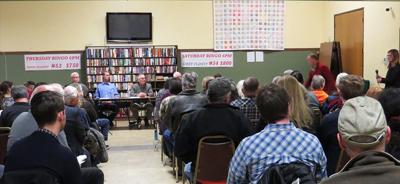
The Dalles City Council and Police Chief Pat Ashmore were told by numerous citizens and agency officials Monday that banning homeless people who engaged in bad behavior was “immoral” and “punitive.”
Barb Seatter, executive director of Mid-Columbia Center for Living, said her organization, which provides mental health services, was strongly opposed to the proposal for both philosophical and practical reasons.
She said some of the people who acted out in ways the city wanted to control had substance abuse or mental health issues. She said the rules being considered by the council would create an “Us versus Them” mindset.
Once that occurred, as it had in other locations, Seatter said people could end up being excluded from downtown “because someone doesn’t like the way they look, smell and behave.”
“I don’t think this will fix the problem, it just pushes them out into other neighborhoods,” she said.
She said Center for Living had a variety of programs that were successful, but it took time to get results. So, some of the homeless might exhibit problematic behavior while they were grappling with issues, but they were working to better their lives.
“Provide incentives rather than punishment,” she said.
Seatter recommended that the city develop funding to provide more public restrooms to eliminate the problem of people defecating and urinating in public places.
Ashmore started off the meeting by explaining that the city was seeking an efficient way to give his officers the tools they needed to stop 6-15 repeat offenders from creating safety concerns.
He said it probably would have been better to call the areas for added enforcement “safety zones” instead of “exclusion zones,” which had a negative connotation.
He said transients had joined the local homeless population who refused to follow any rules. He said taking action against their lawlessness would let others know that criminal behavior would not be tolerated.
“I’m just asking for something that will allow my officers to be freed up so they can go do the jobs they need to do,” said Ashmore. “This isn’t about being homeless and having a target on your back. It’s about being a citizen, whether you’re homeless or not.”
Julie Krueger, city manager, has recommended that homeless people accused of certain crimes be excluded from designated downtown areas.
That recommendation followed a meeting between Krueger, Ashmore and Councilor Tim McGlothlin in August to address numerous complaints from citizens and business owners, some frightened by harassment from the homeless.
McGlothlin reported to the council in November that the homeless population in the local area had spiked 315 percent in the last two years and that was concerning.
Krueger’s report to the council in November listed 24 crimes a person could commit to qualify for a 90-day ban from two zones. They would face arrest for trespassing if they returned within that time period.
The 24 listed crimes ranged from disorderly conduct and harassment to public indecency, littering, graffiti, theft and tobacco possession by minors to harassment, assault and strangulation.
Krueger also suggested the city look at enforcement action against “aggressive panhandling and loitering in tourist and shopping areas.”
The council is also considering an amendment to the municipal nuisance ordinance that will prohibit camping on public property within the city limits.
The two proposed civil exclusion zones are contiguous and take in all of downtown from Taylor Street on the east, to East Third Street on the south, and continues westward along West Second and West Sixth, ending at Webber on the west end. Its southerly border in that part of town is West Eighth Street.
“There is no pre-conceived agenda among the council, we’re here to take comments,” said Mayor Steve Lawrence after opening the meeting at the Mid-Columbia Senior Center that drew about 60 area residents and business owners.
John Hickox of Dufur, who has worked as a chaplain for the homeless, said there was no efficient way to deal with the problem. He told Ashmore that calling the ban areas “safety zones” instead of “exclusion zones,” might sound better, but was equally bad.
“If we do this we’re going to exclude these people who are children of God,” he said.
He said it was time for communities to quit trying to figure out ways to move the homeless down the road and figure out how to deal with the ongoing challenge.
“There’s no ‘efficient’ way to deal with this issue,” he said.
Megan Hoak, teen services coordinator for The Dalles/Wasco County Library, quoted former president Franklin Roosevelt to make her point: “The test of our progress is not whether we add to the abundance of those who have much. It is whether we provide enough to those who have little.”
“This ban would only serve those who have much and penalize those who have so, so little,” she said.
Hoak said she dealt with homeless youth through her job and believed that poverty should not be treated as a crime.
She and others advocated that community members work together to build a strong and compassionate safety net for the disadvantaged.
Jim Slusher of Mid-Columbia Community Action Council also expressed strong opposition to the city’s proposed plan.
“Homelessness and poverty are very complex problems and they don’t come easy to fix,” he said.
“We need a committee to look at a plan to end homelessness, [come up with] new ideas. “I think this is an issue we need to address but I don’t think this is the answer.”
Resident Jaime Paiser said she provided assistance to a homeless family, who felt like the city was poised to take action that would shove them out of town.
She said most people were only one paycheck away from ending up on the street, so they should think about how they would like to be treated.
“They are just like us and they need compassion,” she said.
Resident Joshua Farris told Lawrence and the council that it would be illegal to ban camping when the city had no place for the homeless to stay.
He said Los Angeles had tried that tactic and the Ninth Circuit Court of Appeals had determined that the city could not deny them the right to live there.
“We can call them homeless, but they are people who live in our city. It’s cruel and unusual punishment to deny people a right to live,” he said.
He said the exclusion zones were also illegal because people would be denied access to essential services.
“We are acting out of a place of fear instead of a place of compassion,” he said.
Farris said the U.S. had almost two million homeless people so it was a huge societal issue that needed to be addressed. He said other countries provided care for people in need and the city should pursue those positive things.
He accused Lawrence of “fear mongering” by accusing Portland of shipping its homeless to The Dalles.
“If you say it enough times, people will think it’s true,” he said.
In reality, Farris said The Dalles sent a lot of its homeless people to the metro area because it had more resources.
“You’ve got to take care of the least among you because one day it’s you that needs a hand,” he said.
Lawrence later responded by saying that it was strongly suspected that Portland was sending problematic people to other areas of the state. As an example, he said a woman with mental problems that required seven agencies to deal with her issues had been provided with transportation from Portland to The Dalles even though she had no known contacts here.
After that incident, he said local officials had attempted to track down what was happening in the metro area, but they ran into confidentiality laws that prevented them from learning exactly what protocols were being followed.
“Nobody’s lying,” he told Farris. “We are trying to find out what’s happening and to what extent.”
Mike Knopf, leader of The Dalles Outpost of Point Man International Ministries, said the group had been delivering food boxes to homeless camps in recent weeks. He said Operation Wrap-up was scheduled for Feb. 22 and would provide people living outdoors with blankets, coats and cold weather gear.
“There are services, we’re just one of many,” he said. “It takes a community to do this. I’m against the exclusion zones – we’re all people and we’re in this together.”
Donna Lawrence, the mayor’s wife, advocated for the zones.
“All of us in this room are expected to obey the law, all of us,” she said. “I get the feeling the homeless are given a get out of jail free card. If they break the law over and over again, there are repercussions for that.”
She added: “We want a safe, clean town and maybe the exclusion zone is the wrong thing, maybe it should include the whole town.”
John Fredrickson, a business owner in The Dalles, said it had become almost impossible to give people a hand up because regulations enacted by Oregon officials had made it too difficult to hire people with any type of disability.
“If you want to solve this problem, you’ve got to give people something to do, and our legislature is working against us,” he said.
Other speakers reiterated that The Dalles needed to be a community of compassion and caring. People called upon the city to exhibit leadership by organizing a task force to examine issues and encourage a dialogue that led to solutions.
Lawrence did not provide further information about what next steps the city would take regarding Krueger’s proposal.


Commented
Sorry, there are no recent results for popular commented articles.