
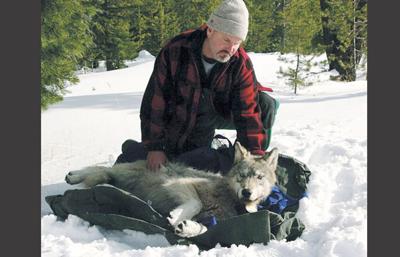
GRANTS PASS — Wolves in Oregon have hit the threshold for consideration of taking them off the state endangered species list.
The Oregon Department of Fish and Wildlife announced Tuesday the latest wolf census confirms at least seven breeding pairs — six in northeastern Oregon and one, led by the famous wanderer OR-7, in the southern Cascades.
The state wolf management plan calls for a status review once there have been four breeding pairs producing pups that survive a year for three years running. That review will be presented to the state Fish and Wildlife Commission when it meets April 24 in Bend. The earliest a decision could be made would be at the commission’s June 5 meeting in Salem.
Wasco County has prepared for the possibility of livestock kills by wolves with formation of a special committee. The advisory group, comprised of two ranchers, two conservationists and two business representatives, can apply for compensation from the state once a wolf kill is confirmed.
The state allocates $100,000 each year for compensation but local officials believe more funding needs to be set aside.
Wallowa County alone received over $60,000 last year and several other counties in Eastern Oregon are also experiencing a growing number of wolf kills.
U.S. Rep. Greg Walden, R-Ore., recently announced that $1 million in funding for wolf-related kills and/or institution of non-lethal deterrents, such as flagged fencing, was included in the 2015 federal budget.
Oregon’s milestone regarding breeding pairs was reached just seven years after wolves introduced in the Northern Rockies started moving into Oregon from Idaho. Wolves were extirpated from Oregon in1946. After being sued by conservation groups, the state adopted a policy emphasizing nonlethal protections for livestock over shooting problem wolves.
“This is an important milestone,” department wolf manager Russ Morgan said in a statement. “In the past seven years, Oregon has gone from no known wolves, to resident and reproducing wolves, and now to meeting our conservation objective for the eastern part of the state.”
Hitting that threshold also triggers greater flexibility in wolf management rules for the eastern two-thirds of the state. Nonlethal methods for protecting livestock are still emphasized, but ranchers can now shoot wolves in the rare instance they are caught attacking or chasing herds.
The threshold for confirmed wolf kills before the state can consider killing members of a problem pack drops from four in six months to two in any time.
Joseph rancher Todd Nash, chairman of the Oregon Cattlemen’s Association wolf committee, said he expected the department to recommend taking wolves off the state endangered species list, but federal protections still remain for the western two-thirds of the state. He added that moving to greater flexibility for wolf management under what is known as phase 2 of the wolf management plan was a welcome change.
“For us as cattlemen, we didn’t want wolves here to begin with, but if we are going to have wolves we need to have good controls over problem wolves and this is a step in that direction.”
Rob Klavins of the conservation group Oregon Wild said he hoped the state would hold off delisting wolves until they were more firmly established.
“This is a milestone, but it’s not mission accomplished,” he said.
“We’ve gotten signals that make a lot of us nervous. The agency remains under intense political pressure to delist wolves. That may be a predetermined outcome.” The department also announced that a second wolf has joined a wolf confirmed recently in Klamath County west of Keno. Morgan said the two wolves were probably a male and female planning to start their own pack.
If they have pups that survive a year, they would be the second pack in the southern Cascades, following in the footsteps of OR-7 and his mate. OR-7 left a pack in northeastern Oregon and traveled across the state into Northern California before returning to the headwaters of the Rogue River, where he met a mate and had pups, qualifying as a pack.
The full wolf census will be reported in March.


Commented
Sorry, there are no recent results for popular commented articles.