
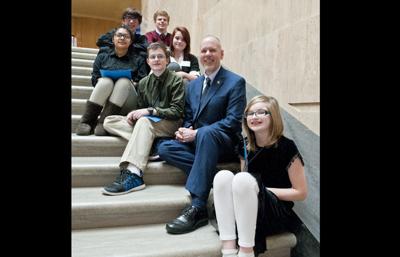
Six students from Sonrise Academy in The Dalles spent the day in Salem Monday serving legislators as honorary pages.
“I think it’s important for people to be involved in voting and government,” said Darlien France, office manager and board member at Sonrise, who organized the visit to the state capitol.
“This is an awesome way for students to learn about the importance of the political process and what elected officials do.”
France began working in January with Sen. Ted Ferrioli, R-John Day, and Rep. John Huffman, R-The Dalles, to get students into the special program during the short session of about 35 days.
The honorary page program is intended to provide youth, ages 12 to 18, with an opportunity to learn the decorum and protocols of the policy deliberation process.
The pages from Sonrise were: Chase Nagamatsu, a junior and current student body president; Sheldon Leigh, past president and a senior; Sarah Winters, a seventh grader; Mavi Bonfil, a sophomore; Summer Henricksen, a freshman; and Tyler Leigh, also in seventh grade.
Scott Winters, principal of Sonrise, accompanied the students, who were briefed about parliamentary procedures and basic courtesy customs that are expected of everyone conducting business on the House and Senate floors.
“This is just an excellent way for youth to learn more about what their elected representatives do,” said Huffman.
An assistant sergeant at arms in the Senate and the honorary page coordinator in the House ensured the students didn’t cross boundaries of decorum.
“We learned a lot, I was really impressed,” said Scott Winters.
Cecil L. Edwards, a legislative historian from 1977-93, said of the etiquette in government policy making: “Rules are basically protectoral and purposeful and not mere fluff. They reflect the observance of mutual respect and consideration for each other in an atmosphere of courtesy and friendliness. It is this behavior that is most favorable to achievement, to understanding and cooperation.”
Sheldon Leigh said the long-standing traditions made for a dignified process even when the legislators were debating opposing sides of an issue.
“I really noticed the formality and respect they had for one another even though they differed in opinions,” he said.
Leigh, who was a Senate page on Monday, said Sonrise students had been given information ahead of time so they could arrive with a rudimentary knowledge of their role.
The primary job of pages, he said, is to stand at the perimeter of the floor and be ready to run messages between the elected officials and staffers, or their peers.
“When the doors to the chamber close then everyone has to obey parliamentary protocol,” he said. “No one but the senators can walk on the middle aisle of the floor. And, when they are getting ready to vote, a page opens the door to the hallway and yells ‘Vote!’ so the senators outside know they need to come back in if they wanted to vote.”
There are 30 senators who verbally vote “Yea” or “Nay” one at a time, said Leigh. With 60 representatives, he said that would be too time-consuming, so they vote electronically.
Leigh said there are 18 Democrats now in the Senate and 12 Republicans. He said the process to debate bills flowed along smoothly because each legislator was given 10 minutes to make a case for his or her bill and opponents had five for remonstrance.
Because filibustering is not allowed at the state level, Leigh said bills cannot be held up for long
periods of time. However, he said a senator can give up time to a peer if they want to keep an argument going.
Leigh spent two years as Sonrise student body president and now serves as high school representative, a role not unlike a page. He has given comments at a city planning commission hearing and attended other government meetings, but he doesn’t foresee a career in the political realm.
“I’m planning on going into electrical engineering,” he said. “But you never know…”
Leigh would like to return to Salem in the near future with the knowledge he gained from his time as a page.
He said it would be interesting to sit in the gallery above the House or Senate floor and watch the flow of proceedings as a citizen.
The modern page program morphed from the role taken by young males from noble families during medieval times.
At the age of seven, these boys took on duties as messengers who served a nobleman or an apprentice knight.
The job of the page also included cleaning clothing and weapons and learning basic skills of combat. The page was also taught courtly manners, how to ride horses, hunt, hawk, read, write, and play instruments, all of which were considered essential skills for men of rank in society.
At age 14, the young noble would graduate to the role of squire and train to become a knight.
Pages were first associated with lawmaking bodies when they began appearing in royal courts. The term “honorary” is applied now to the name in recognition of the role’s heritage.
For more information about the honorary page program, call the Secretary of the Senate at 503-986-1851 or the Chief Clerk of the House at 503-986-1870.


Commented
Sorry, there are no recent results for popular commented articles.