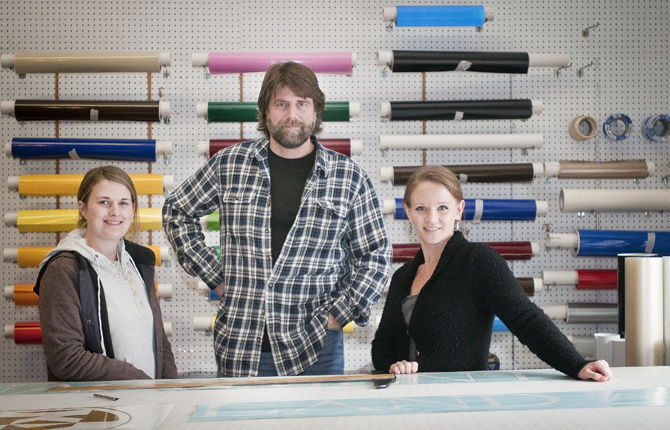
OPTIMIST PRINTERS is diversifying into new areas, taking advantage of increased space to create large signs and banners, above. Pictured are, left to right, Julie Johnson, owner Matt Herriges and April Sampson. The sign is for K and K Land and management.
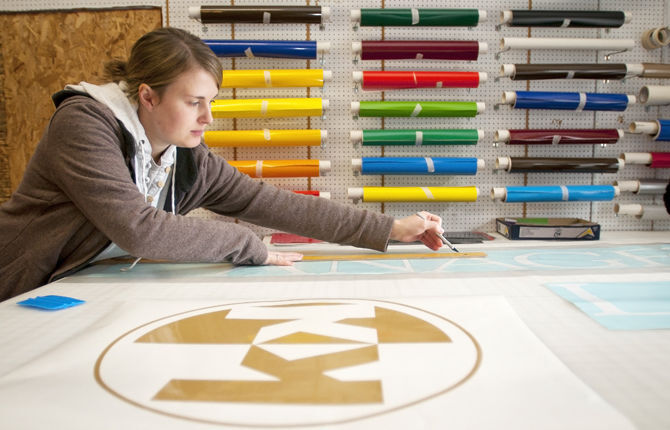
Julie Johnson uses a ruler and knife to cut things to size.
Mark Gibson
OPTIMIST PRINTERS is diversifying into new areas, taking advantage of increased space to create large signs and banners, above. Pictured are, left to right, Julie Johnson, owner Matt Herriges and April Sampson. The sign is for K and K Land and management.
Mark Gibson
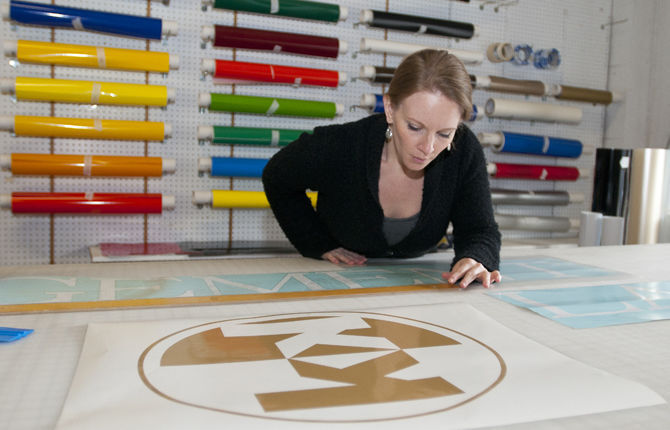
April Sampson, above, holds a vinyl sign in place during taping, part of the process used to transfer the vinyl to the actual sign.
As owner of Optimist Printers, Matt Herriges has been expanding his services beyond the offset press, moving quickly into areas that have not traditionally been part of the commercial printing world.
The most recent shift has been to vinyl, creating vinyl designs on signs, banners, car graphics and T-shirts. “We did signs a little bit at our old location, but we didn’t really have the space,” he said. That changed when he moved to his current location at 723 E. Third St., a move which more than doubled his square footage, opening the door for expansion. “We have the space now to do these large items.”
The equivalent of two fulltime employees now work in the sign division, although specific tasks are divided somewhat among the eight employees working at the shop, who are cross trained to work as where needed. “We’re all involved, one way or another,” he said.
Vinyl may seem a stretch for a business founded on paper and ink, but Herriges says it’s part of a natural shift. Software used in the printing industry today is capable of creating items in a wide range of media, not just print. The products are new, but the skills in design and color have long played a role in printing. “It’s all part of the graphics industry that we weren’t in before,” Herriges explained, but diversity is becoming more and more important to the industry.
The printing industry has changed a lot in the past few decades, he explained, as copy machines, digital printing, online services and electronic files cut into the market served traditionally by commercial printers. Copy machines had a huge impact on print shops a decade and a half ago, and the technology has continued to change. Online forms, for example, eliminate the need for printed forms, a print shop staple. “We still print forms, but that is going to go away,” Herriges said, looking to a future in which digital, online forms fully replace their printed counterpart.
Ink on paper will be finding a new role going forward, he said.
Take formal invitations, for example. Having recently received a wedding invitation via text on his cell phone, Herriges sees the printed invitation reinventing its role. “It’s going to be a little more of an art,” he predicted. “An invitation on paper is going to become more unique, not the standard as it is now.”
One aspect of today’s digital marketplace doesn’t seem to worry Herriges much, though. “The internet is never going to take the place of being able to touch something, to feel and see it, to communicate face-to-face,” he said. “People still like to talk to people, to be hands on, and they like accountability.”
“The customer service experience, people want that and you can’t get that online,” Herriges said.



Commented
Sorry, there are no recent results for popular commented articles.