
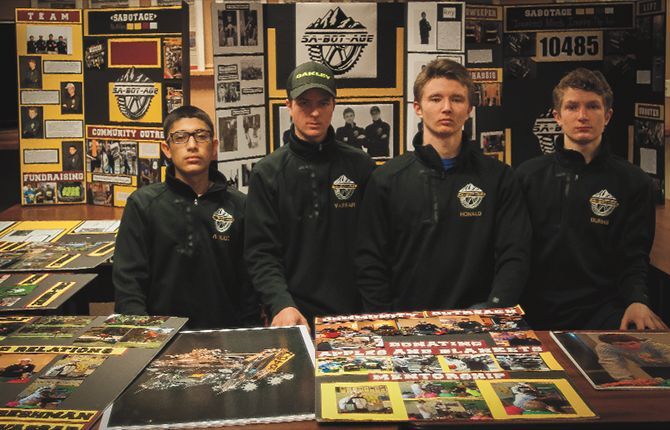
Robotics team Sa-BOT-age won state as rookies in 2016 and is striving to go even further this year.
“We are on track for a very successful season,” said Spencer Honald, a junior, gaining agreement from classmate Bill Burns.
“We’re doing much better than we were at this point last year. So, it’s setting up to be a good year — I think we’ll do well,” said Burns.
The four students at The Dalles High School who make up the team are also working to leave a legacy by fundraising for expensive software that will allow robots to be designed and tested before the investment of time and money.
“You will know where every nut and bolt goes before you even start building,” said Rey Aviluz, a sophomore, about what the program will do.
He is the newest member of Sa-BOT-age, which also includes sophomore Tyler Vassar.
Coaching the team is Dena Honald.
“I see the skills that they are learning as being really beneficial to moving on to school and a career path,” she said. “The neat thing about this program is that the opportunities for learning job skills are just amazing.”
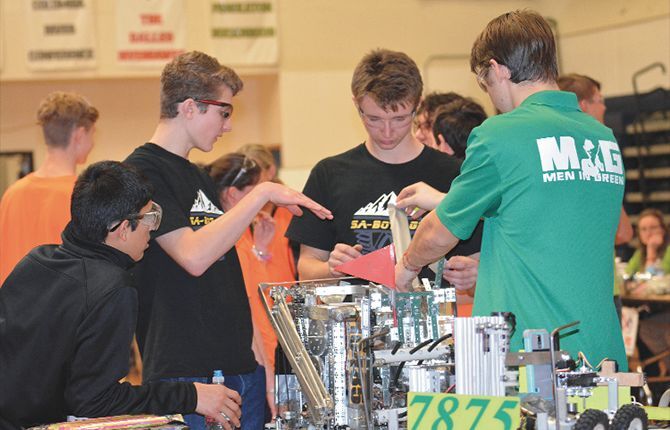
Aviluz and Spencer Honald “drive” the robot that was built with both model and original parts. Vassar and Burns take turns coaching the drivers while keeping an eye on the clock and what is happening with three other teams in the same 12-by-12 playing field.
Their strategy appears to be working. In January, Sa-BOT-age competed at the Hood River Qualifier Tournament and won all nine of their matches, taking Willing Alliance Captain, the first-place Think Award and second place Inspire Award.
Spencer, who is team captain, was announced as an Oregon Dean's List semi-finalist.
Sa-BOT-age joins three other teams from The Dalles at the Super Qualifier, which takes place next weekend in Hillsboro. Around 200 teams from across the state have been whittled down to about 96 that will participate in the event.
Robotics tournaments focus on “gracious professionalism” that encourages competition but rejects “trash talking and chest-thumping.” In addition, teams learn “coopertition,” the ability to cooperate and compete at the same time, according to event organizers.
The goal of the program is to inspire students to be science and technology leaders. Every year the challenge changes to keep competitions exciting and innovative.
About half of the teams that compete Feb. 11 and 12 will move on to state. From there, winners will advance to regionals, and then, if successful, to world. Team Sa-BOT-age intends to be one of them.
“When you become part of an alliance, you meet with that team to see what their robot can do,” said Spencer.
“You’ve kind of got to go with it,” said Aviluz.
The tasks for the robots seem simple – push team specific beacons, shoot balls the size of softballs into a basket as fast as possible and, for the end game, lift yoga balls 4 feet into the air and set them in a basket.
“Everyone has different approaches to the challenge,” said Spencer. “Everything has a point value to it.”
The scope of the competition is much larger than operating the robot; teams are graded on entries into an engineering notebook, their development of strategy, and even community outreach.
Toward that end, Sa-BOT-age donated 24 new blankets to the Salvation Army for homeless people or families in need.
Vassar said that every week summaries of team ideas are printed off, as well as an outline of how they are being applied.
“It’s a group effort, everyone writes in the engineering notebook,” he said.
He was on a First Lego League team in fifth grade and advanced from there into robotics at the urging of Spencer and Burns.
“I liked it a lot so I kept on going,” he said.
Spencer was recruited into trying out robotics by a seventh-grade teacher. Aviluz learned about robotics on a 4-H team and was talked into joining the school team by the upper classmen.
“Rey’s a programmer so we thought he would be valuable to the team,” said Spencer.
Burns wasn’t familiar with the robotics program until Spencer talked him into putting his math and science skills into a practical application.
Sa-BOT-age began building their 2017 robot in September —they have not given it a name —to prepare for competitions.
“We’ve been tweaking it ever since,” said Spencer. “It’s still not perfect and it will never be perfect — that’s just the challenge of life.”
The name Sa-BOT-age was suggested by a former team member.
“We liked it so we went with it,” said Spencer, who is surprised how often the name has been mispronounced since it is based on an existing word.
Dena Honald said the team has developed public speaking skills, strategizing know-how and even learned how to use a 3-D printer through their involvement with robotics.
“I love watching how much they are growing as individuals,” she said.
The team expressed gratitude for the support of Google and local businesses for supporting them and the school robotics program.
Anyone wanting to donate to the fund for new software is asked by the team to do so at the high school.


Commented
Sorry, there are no recent results for popular commented articles.