
The following narrative is the first in a series by John Young that will share his cultural experiences as a Peace Corps worker on Comoros, an island nation off the eastern coast of Africa:
We had all just sat down to our first dinner “in-country.” The trip had been long—some 60 hours of travel time involving four flights (two red-eyes) and three continents.
Moments after we began eating, the lights went out and things fell quiet across the capital city of Moroni.
Our Safety and Security Officer, a native Comoroian woman named Allaouia who had studied in the United States, shouted out into the deafening dark: “Welcome to Comoros!” There is electricity in the evenings here, most of the time. Fifteen years ago, I’m told, there used to be electricity all of the time. What happened? “Politics,” I’m told. The specifics? Those, I’m afraid, I am not.
Moroni is roughly the same size as The Dalles, in terms of geography and population. Unlike The Dalles, the majority of citizens live on less than $1.25 per day.
With my walk-around allowance of 2,000 Comorian Franks per day, about $2, I live in relative luxury.
Moroni, like all of the other towns and most of the other villages, sits next to the seashore. Here, the sun rises from and sets into the Indian Ocean. The Comoros Islands rest nearly on the equator. Daylight spans from 6 a.m. to 6 p.m.
“Forget about the four seasons,” one of the Peace Corps staff members told me just minutes after I had stepped off of the plane. Here there are only two: the dry and the wet. The dry season has just begun here. The wet season will start in December and we can expect it to “rain cats and dogs, day in and day out, sometimes for weeks at a time.”
The people that I have encountered here have been uniformly welcoming and friendly.
In addition to their native language, Shikamori, many Comoroians speak a second language. Most often they speak at least a little French — Comoros is a former French colony — and less often they speak a little Arabic.
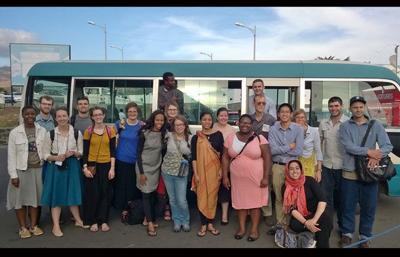
The nation is a Muslim nation, and some 98 percent of the county’s inhabitants practice Islam. Mygroup of 20 volunteers with the United States Peace Corps are here to teach English.
English is viewed by some as the way to a better life and a brighter future. Because English is so complex, with all of its rules and, more importantly, all of the bizarre and confusing exceptions to those rules, learning the language itself shows Comoroian employers that someone applying to a job is exceptionally dedicated and hard working.
Learning English also opens doors to the U.S. university system, skill training, and the wealth of English language technical materials freely available on the internet.
Comoroians who speak English can learn, and then bring back home, the skills and knowledge that they need to improve their lives on the island.
This can be as complicated as a Comoroian student attending Washington State University, as our Safety and Security Officer Allouia did many years ago (“Wah-Zoo!”), or as simple as a Comoran student using one of the new and inexpensive mass produced smart-phones to read a manual on sustainable agriculture over her 3G internet connection.
The Peace Corps has three goals. The first is “to help the people of interested countries meet their need for trained men and women.”
Put simply, we are helping people to help themselves.
Put proverbially, “give a man a fish, and you teach him for a day. Teach a man to fish, and you feed him for a lifetime.”
We are here to teach and to share. First and foremost, however, we are here to learn and to listen. Formal Peace Corps training runs Monday through Friday, 8 a.m. to 5 p.m. It doesn’t end there. In the coming days I will be placed with a Comoroian host family who will teach me about the life, culture, and language of the Comoros. And it does not end there, either.
While on the one hand we hope to bring our knowledge and skills to Comoros, on the other we also aim to bring the skills, wisdom, and knowledge of Comoros home to the U.S.
I’ll keep you posted. Marahaba!


Commented
Sorry, there are no recent results for popular commented articles.