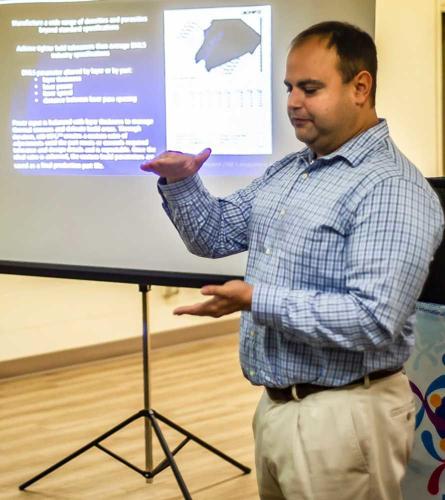
Greg Mercado, chief operations and quality officer at I3DMFG, a metal 3D printing manufacturing facility in The Dalles, uses his hands to sketch the size of the space in one of the company’s larger machines, in which parts are “printed” using metal dust and lasers at a The Dalles Rotary meeting Wednesday.
Greg Mercado, chief operations and quality officer at I3DMFG, a metal 3D printing manufacturing facility in The Dalles, uses his hands to sketch the size of the space in one of the company’s larger machines, in which parts are “printed” using metal dust and lasers at a The Dalles Rotary meeting Wednesday.
I3DMFG, a 3D metal printing company with corporate offices in Bend and a manufacturing facility at the Port of The Dalles continues to grow and is in the early stages of planning to expand or relocate its The Dalles plant, Greg Mercado, chief operations and quality officer in The Dalles, told members of The Dalles Rotary Wednesday.
Mercado said the company was considering moving its manufacturing to the Redmond/Bend area, closer to where the companies corporate offices are located, but it is much too early say if that would happen, and expansion of the plant in The Dalles is also under consideration.
The company currently has seven metal printing machines in operation, valued at around $1.5 million each. Six of the machines print within a 10 inch cube, and the newest within approximately a 16-inch cube.
“We do 3D metal printing in different materials using metal dust and direct lasers in a vacuum environment,” Mercado said. The printing of a single part can take three or four days. “We do a lot of space stuff, as well as firearms, high end bicycles and parts for medical devices,” he said.
Each printer is self-contained, resembling an office copy machine with a built in microwave. The process involves thin layers of dust, measured in microns, which are melted from powder into a solid by the lasers. They use primarily super-nickel, titanium and aluminum alloys. “We are doing some experimental things as well,” Mercado said. In the past, efforts were made to use copper, but that “didn’t work so well.”
The process is “additive,” each layer building onto the next. Parts are designed for “printability,” as the process is better suited for for printing some angles and shapes and not others. The threading of a hole to receive a bolt, for example, is better done after the printing is finished, as the printing process typically creates to tight a fit.
He said the main benefit of the process was the ability to create “microchannels” within the structure of a part. Cooling channels, for example, can be incorporated into a part while maintaining its strength, a technique that makes the process valuable in the space industry. Printing a part can also create a single piece that would have required several if made traditionally, which results in a stronger part. “Instead of multiple parts, a bike hub, for example, can be printed as one piece for greater strength,” Mercado explained.
Mercado said the entire manufacturing process is a closed loop, and excess powder is collected and re-used or recycled. Air filtering is also in use.
“The technology, and what can be done with it, is wide open,” Mercado said. Reusable rockets, gun components and other uses have grown. He said traditional metal working will continue into the future, however. “Traditional methods and 3D metal printing will continue together,” he predicted.
The I3DMFG factory in The Dalles was established in the Port of The Dalles in 2014.




Commented
Sorry, there are no recent results for popular commented articles.