
A man angrily pounds his hands on a desk, insisting he’s Jesus.
A confused elderly woman tries to get into a house that’s not hers.
A suicidal person is threatening to end it all.
Another man is fixated on eating his snack at precisely 2 p.m., causing a scene at a store.
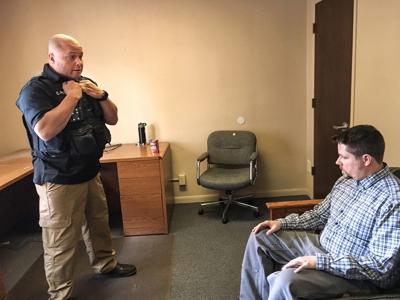
All are scenarios acted by role players who were positioned in various rooms at a downtown The Dalles building Nov. 8. It was the final segment of a weeklong class for over 20 area law officers on safely and effectively responding to people who are in a mental health crisis.
It was The Dalles Police Officer Chuck Parsons’ turn to be the responding officer in his group of three officers, and he read the scenario description taped to a closed door in an upstairs room. It describes a “strange” shoplifter in custody of store security, who took food off shelves and ate it. The shoplifter kept trying to leave, and store security believed he was high or intoxicated.
Parsons entered the room to find an agitated man holding a can of food who just wanted to leave and go home.
“Can you put that down?” Parsons asked, keeping his distance. “That’s my snack,” the man answered. “I have snack at 2 o’clock.”
Parsons asked if he could get a look at the label to see what kind of food it was. He offered to put it on a plate and get him some water too. “Wouldn’t that be nice?”
Having gotten the can from the man, Parsons asked if his mom was around, what his address was, or if there was someone he could call. The man repeatedly answered only that his house was 364 steps away.
So Parsons offered to walk the 364 steps with him.
The scenario lasted just five minutes—and all the officers agree that these types of calls never conclude in just five minutes—and then it was time for the actor and an observer to give feedback on how Parsons did.
The observer, Debbie Miller, a therapist who works at the regional jail, said, “I saw a lot of compassion. I saw a lot of respect in the way that you handled the scenario.”
She noted that, as a crisis counselor who responds to calls in the community for someone in a mental crisis, “you really hope the law enforcement that goes along with you isn’t going to do something to escalate the situation beyond repair.”
She said she felt safe having seen the way officers were handling themselves in the scenarios.
After the scenario, Parsons told a reporter he takes pride in responding compassionately to crisis calls. “It’s an issue we have in town. I learn from the people around me. Dan Nelson was a Superman to me,” he said of a sergeant who recently retired from The Dalles Police Department.
Miller told Parsons, “What you did was really good” because he identified where the actor was at and “got into his realm,” including offering to help with his food.
The actor played a person on the autism spectrum.
The actor, who had played the same scenario with other teams of officers during the session, told Parsons, “You were one of the only people who got me to put the can down.” He felt “buy-in” from Parsons on what his needs were. He also lauded Parsons for not getting too close to him.
The actor did say Parsons could’ve gotten down on his level, since he was seated, and that would’ve been less threatening. Parsons replied, “I was gonna sit in the chair and look out the window with you.”
The actor played a character who didn’t make eye contact with people.
The actor also said Parsons was one of the only people who was going to walk home with him. “I think you actually would’ve walked 364 steps with” the character, he said.
“Absolutely,” Parsons responded.
The actor said that in the instructions for his role, he was only given permission to be cooperative with being walked home.
In another scenario where Parsons was backup to the main officer, an elderly woman was in a room pounding on a window, her cane propped against it.
As quick as lightning, Parsons grabbed the cane while the woman was looking away. Later, the actress said every group of officers made a point of taking the cane. “You guys are really good. Everybody takes that.”
Pat Haskins, now a Seattle police officer but formerly with Wasco County Sheriff’s Office, said, “Chuck is like a ninja.”
In this scenario, Bingen-White Salmon Police Officer Katie Daniels was the lead officer, and had the tricky task of getting the elderly woman to stop trying to get into the home, which wasn’t hers.
Daniels said, “I think you may be confused with another house, and I would love to help you find your house.”
“This is my house!” the actress yelled. The actress came out of character to encourage Daniels to go along with what the woman was saying.
The actress said redirection would be helpful in such a scenario, such as asking the person how long they’ve been married. It would not be helpful to show a person that their house key doesn’t work at this house.
The actress said situations with frightened, agitated, confused elderly people can go sideways.
Miller said Daniels did well in saying she’d help the woman find her husband. The actress said it is very helpful with the confused, elderly population to offer reassurance. “That can immediately diffuse” a situation, she said.
In another scenario, Parsons talked down a suicidal subject, giving the actress a hug afterwards.
Miller lauded Parsons. “That was so good what you said: ‘I’m here.’”
She said when an officer says “‘I do care,’ you have to really mean that. You have to have it in your voice.”
She added, “You’re rescuing people from the jaws of death. That’s what you do.”
Haskins was the lead officer in a scenario with an angry man who believed he was Jesus and who was getting hostile with his mother.
Haskins walked in the room and addressed the actor by his name. “I’m not Killian!” the actor shouted in response. “Get out of here, devil!” and he slammed the table.
Haskins said, “What would you like to be called?”
Killian said he was Jesus, and Haskins replied, “I’ve never met Jesus, so this is a new experience for me.”
Killian said he needed to complete a miracle of turning water into wine.
Following training that advises officers not to feed into delusions, Haskins said, “I’m going to call you Killian.”
Killian’s “mother” interjected, which agitated Killian, and Haskins asked the woman to step back. Haskins then asked Killian about his counselor, Fred, and Killian said Fred was nice, but he wouldn’t be able to help turn water into wine.
Haskins asked Killian if he took any medications. Killian dismissed the idea, saying, “why would I take medication? That’s not going to help me with my miracle.”
Haskins asked Killian to sit down, and said to Miller, the counselor observing the scenario, that in a real situation, he would’ve managed it until a counselor arrived.
Haskins said the hardest part of the scenario was not calling Killian Jesus, because not doing so just fed Killian’s anger. But Miller said it was generally best not to continue a delusion “when you’re attempting to see if they can come back to a reality basis.”
Killian said it was hard to continue to rage against Haskins because “you were very calm, and it’s hard to rage against that because I’m not getting a reaction.”
Killian’s character was not homicidal or suicidal, but was just in active psychosis.
Haskins said that was the hardest thing: when someone is not suicidal or homicidal, “What do we do with them?”
He said his goal is to talk to someone long enough to get to a point where he does or doesn’t have enough information to take them somewhere else.


Commented
Sorry, there are no recent results for popular commented articles.