
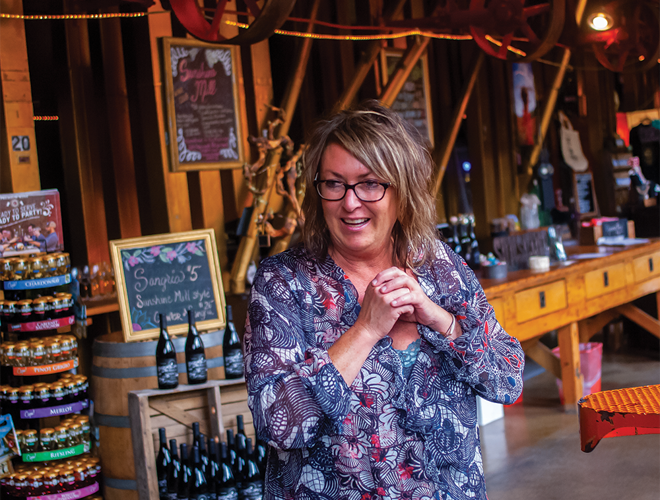
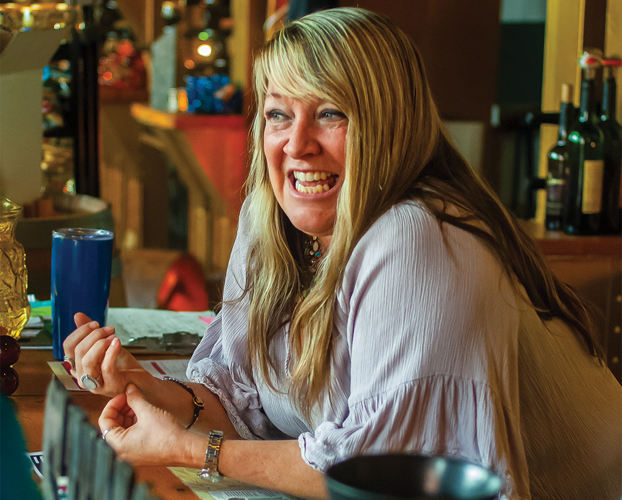
Molli Martin, co-owner of Sunshine Mill, prefers to work behind the scenes while her husband and daughter handle public presentations and media inquiries, but this year is different.
In March, the Martins paid off a nearly $540,000 land sale agreement after seven years and received title to the iconic property on the east end of town.
The achievement is cause for celebration, said Martin, who wants to share the family’s success with the community.
Toward that end, she has created an eight-minute video that provides a glimpse behind the scenes at the work done to convert the old flour mill into a bottling plant and winery.
“We brought this place back to life and I am so proud of all that has been accomplished,” said Martin. “We are so grateful for the opportunity the city and urban renewal gave us eight years ago.
“We took the investment of local tax dollars very seriously and have always striven to make the community proud. We’re also so thankful to our families, friends and employees who have continually supported us through all the challenges and successes of this project.”
This week, she and her daughter, Natasha Skov, marketing director for Sunshine, began making the rounds of civic organizations to present the local economic benefit of the project. They showed a video titled “A Family Story: And a Dream.”
The footage walks viewers through early days when the derelict property had to be renovated enough to be useful.
“We’ve kept it simple, this isn’t a pretty, clean new winery, it’s an old flour mill we converted,” said Molli.
She and husband, James, and their children, including sons Griffin and Ethan, are shown during the video in different phases of development since 2009.
From hauling away debris to replacing rotted flooring, the family’s goal has been to retain as many of the original features as possible, said Molli.
James and Molli were born and raised in The Dalles, so the risk of not having the mill as a monument to the town’s early history spurred them to action.
The facility called the Wasco Warehouse closed in 1978 and fell into disrepair after sitting empty for decades.
The Columbia Gateway Urban Renewal Agency acquired it in 2005 for $295,267 but had no developers step forward with plans for renovations. Discussions finally began about demolishing the concrete silos, an estimated $1 million expense.
Jim Wilcox, former mayor and city councilor, saw Molli’s presentation at The Dalles Lions Club meeting on Tuesday. He said it brought back the feeling of surprise he felt while reviewing the Martin family’s unusual proposal.
“We put out an RFP (Request for Proposals) and the Martins were the only ones who responded. Quite honestly, we didn’t know what to expect when we put out the request, whether it would be total demolition and redevelopment or if someone would want to work with what’s there,” said Wilcox.
Urban renewal officials decided to invest $500,000 in seed money to get the Martins started because they no longer had to cover demolition costs.
“We said, ‘Go ahead and do it (convert to winery) because that keeps us from tearing it down,” said Wilcox.
“Nothing gets better sitting vacant and the property just looked horrible. I remember that the Martins even found a huge oil tank between the building and railroad tracks at some point and that had to be removed. It’s pretty amazing that they were able to get one bottling line going in the warehouse during that first year because it had structural issues.”
Molli recalls the approach of urban renewal in the early days as very collaborative and supportive. “They said, ‘why don’t we do something together.”
The economy fell into the Great Recession about the time the Martins got to work, said Wilcox.
Although that would make it more difficult for the family to get the business off the ground, he said the timing of the project enabled the city to score $2.3 million in federal stimulus dollars for the roundabout. That project was undertaken to address traffic increases from the Martins’ enterprise.
In addition, because James and Molli thought shipping products might be a possibility, the city also received $900,000 to build a commercial dock at the foot of Union Street.
“That kind of industrial redevelopment was exactly what the federal government was looking to invest in at that time,” said Wilcox. He and the Martins credit Nolan Young, former city manager, and Dan Durow, retired planner, for figuring out how to score stimulus dollars.
“We definitely had our snout in the trough,” joked Wilcox.
When the Martins amped up production in 2010, Wilcox was mayor. He said it looked like the business would fold for a while due to a stalled economy, a major supply chain failure and some trial and error problems with production. Urban renewal was asked to give several extensions on loan payments, which Wilcox believed were approved because there was always progress despite setbacks.
“This is exactly the type of project that urban renewal was created to support,” he said. “They provided jobs and spurred economic development on the east end of town.”
Sunshine is the sole producer of seven varieties of Copa Di Vino — single servings of wine in a glass — in the United States. The family also operates a vineyard and bottles wine under the “Quenett” and “Oregon Mountain Estates” labels.
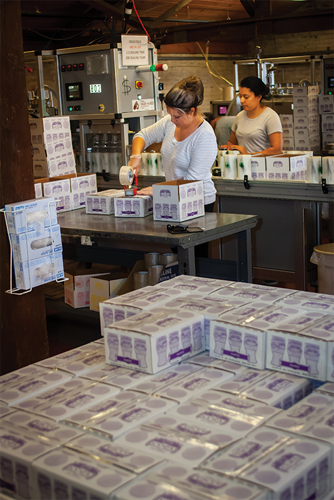
There were originally five employees bottling wine, but now there are 70 during the summer between the plant and vineyard. The local annual payroll now tops $2.3 million, said Molli, with a total payroll over the last eight years of $15,585,883.23. Being a traded sector company, 95 percent of their revenue comes from outside of the area but one third is invested in employees, she said.
Sunshine has contributed $121,656 in local property taxes plus $380,000 in federal taxes. The company paid $333,986 for the property and $205,112 in interest payments. Still owing is the $440,465 balance of the improvement loan from urban renewal, which Sunshine pays nearly $13,000 per month toward at an interest rate of 5.25 percent. That loan will be paid off in 2021.
The urban renewal board included in the most recent loan installment loan agreement (October 2017) that Sunshine will be in default if its misses one payment.
According to Sunshine’s records, for every dollar of that loan, the local economy has been fed $34.69, a 3,469 percent return on investment of local tax dollars.
The family has reinvested $1.3 million into development of the property.
“The warehouse was falling apart and, as we have grown, we have worked to save the building and its most important features, such as the old beams,” said Molli.
Many of Sunshine’s workers are long-time family friends and everyone is cross-trained to take on whatever job is needed to keep production moving.
It is important, said Martin, that all employees believe in the family vision and philosophy, which is to stay positive and keep looking for new innovations.
“We’ve had to figure everything out for ourselves because wine in a glass has not been done in the U.S. before, so there isn’t anyone to ask,” she said.
The original tanks used for wine storage were left over from flour mill days. They, like everything else, were upgraded as revenue allowed.
“We tried to utilize what was already here as much as possible,” said Martin.
During the peak summer months, there are three bottling lines operating five days each week, packing about 15,000 cases for shipment to 40 states and 39 countries.
A total of 45 million glasses of wine have been produced to date, said Martin.
James continues to work on product development — filling his office with different types of single-serving containers for experimentation — and Natasha, who began working in the business at the age of 17, scouts out markets for the product line, including a new addition.
She is now married to Riley Skov and they are the proud parents of Cora, 18 months.
“We feel very lucky to be a small company on the national stage,” said James. “We’re competing with the big guys all the time, so we have to keep moving.”
The risks of putting together a multi-million dollar company have been great, he said, but so are the rewards.
“It still blows my mind when I walk through the warehouse and wonder what I was thinking,” he said.
Most recently, the Martins have acquired distribution rights for Pulpoloco-Sangria, a wine cocktail in a CartoCan that is based on a Spanish recipe.
The convenient drink made of wine, orange, lemon and a bit of cinnamon is already in stores on the East Coast and could be sold on the West Coast by fall.
Molli has also been at work on a new project, incorporating artifacts from the old mill into the décor for an overflow room, extra space available to the public when the tasting room has been reserved for a private party.
She said the room at the eastern end of the warehouse will probably be named after Zenas Ferry Moody, the only governor of Oregon to have come from The Dalles.
Moody was the seventh governor of the state and served from Sept. 13, 1882, until Jan. 12, 1887. He built the mill warehouse to store wheat and wool.
Molli said the huge mural and building that showcases it was painted at a cost of $240,000 and is a beacon from the freeway.
Vicki Byrd, tasting room manager, keeps track of where customers come from and said 85-90 percent are from outside the area. Many were on the freeway and decided to check out the mill after seeing the dramatic painting outside.
“They come here because they’re very intrigued,” she said. “We try to be ambassadors of the community, that’s been a big thing for us.”
Martin said people routinely tell her, “This is so much more than just a winery,” which she takes to heart.“We try to create a story to everything here,” she said.
For example, the industrial space of the tasting room has been made “warm and comfortable” with earth colors. The unusual décor includes wall sheeting from old flour chutes, tables fashioned from old shipping crates that are topped by orange metal fan guard covers.
Sprinkled here and there are the vintage glass grape clusters of yester-year, a collection that Natasha started for her mother. There are also rockers and sofas in a seating area that also features solid wood tables from the 1970s.
“A lot of these pieces are from family,” said Molli.
On June 29, the tasting room — open 12 to 6 p.m. daily — will be launching boxed lunches that people can order ahead or pick up to go with wine or a soda.
“We’re foodies so we are still in the testing stage to make sure we get it right,” said Martin. “We always strive to attract all the senses when customers walk into the tasting room. Sight, taste, feel, smell and touch so that it is forever memorable. We are very excited to be expanding the taste buds.”
Molli said the venture has always been about family — both biological and work relationships — and what can be accomplished with teamwork.
“I’m a mom so I have been a worrier for eight years,” she said. “But I am so very proud of what we have been able to accomplish.
“Every day, we have challenges, but I finally feel like we’re going to be okay.”


Commented
Sorry, there are no recent results for popular commented articles.