
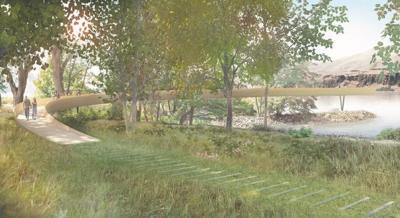
The Confluence Project—spanning 438 miles and over 12 years of work to be the largest public art project in the nation—is now making headway on their sixth and final project site, Celilo Park.
Confluence Project executive director Colin Fogarty asked the Wasco County Commission for a second letter of support at its March 21 meeting.
The county submitted an initial letter of support for the purposed work in Celilo Park in 2011 and agreed to submit a second letter for a Federal Lands Access Program (FLAP) grant application.
Though the grant is still in draft and has not been finalized, Fogarty anticipates receiving approximately $3.5 million to fund facilities, a renovated parking lot and widening the entrance at Celilo Park.
The park’s artwork will be privately funded and installed after the hardscaping is complete.
Confluence is a 501 (C) (3) nonprofit based in Vancouver, Wash., that is dedicated to connecting people to the Columbia River Gorge’s history through art and education.
The three elements to the Celilo Park Confluence artwork are: An interpretive pavilion with information about Celilo Falls and its history; a sculpture of the Columbia River; and the “Celilo Arc,” a 500-foot elevated walkway inspired by the indigenous fishing platforms that once crowned Celilo Falls.
The artwork was designed by artist and architect Maya Lin, who is most known for designing the Vietnam Veteran’s Memorial in Washington, D.C., the Women’s Table at Yale University and the Civil Rights Memorial in Montgomery, Ala.
She has been deeply involved with the project since its beginning and has designed elements for all six Confluence sites.
The artwork is intended to honor the history of Celilo Falls, which was silenced when The Dalles Dam submerged the site in 1957.
The falls were a critical resource and honored cultural site for the Columbia River Treaty Tribes and its flooding is viewed as a historic tragedy.
The four Columbia River Treaty Tribes: Confederated Tribes and Bands of the Yakama Nation, Nez Perce Tribe of Idaho, Confederated Tribes of Umatilla and Confederated Tribes of Warm Springs, have all been involved in discussions about the artwork for over 10 years, Fogarty said.
Umatilla, Nez Perce and Warm Springs all strongly support the project, he said.
"The wounds have to see the light of day and people have to learn and understand that history. It's more than symbolic —it's the beginning of a conversation or dialogue that this country has yet to have,” said Umatilla tribal member Bobbie Conner in a written statement.
Karen Whitford, an elder in Celilo Village, has also publicly supported the Celilo Park project.
“On behalf of Celilo Village and the Columbia River Indians, this project is important in remembrance that the Falls is sleeping and that walkway is like an honor to me, to honor the elders and the people of the river,” she said in a written statement.
“Knowing that the other tribal opinions are important but this is important to the people here, right now.
“So much has happened to the people of W’yam, historically. This would be the highest honor to the Falls and to the elders and to the river. The W’yam Indians always say that the Falls is sleeping but the roar of the Falls echoes in our hearts.
“And to me that walkway would give me the greatest feelings to walk to see where the Falls is sleeping because the Falls still echoes in our heart and our people. And I feel Celilo Falls should be honored in this manner with the Confluence Project.”
The Yakama Nation, however, has expressed concerns that the artwork is memorializing their culture and people, Fogarty said.
“We’ve tried to stress very clearly that it’s not a memorial,” Fogarty said, explaining that the project’s purpose is to educate, honor and strengthen tribal presence in the area.
“In our mindsets, that’s the opposite of a memorial…the point is that the native people of the Columbia River are still there.”
Confluence’s stated goal is to share stories of the Gorge’s history and “create reflective moments that can shape the future of the Columbia River system.
“These sites are ‘teachable places," transformed and reimagined to explore the confluence of history, culture and ecology in our region.
“Each work references a passage from the Lewis and Clark journals as a snapshot in time, while comparing it with the deeper story.”
Confluence was incorporated in 2002 and has completed five of the six planned project sites: Cape Disappointment State Park, dedicated 2006; Fort Vancouver Land Bridge, dedicated 2008; the Sandy River Delta, dedicated 2008; the Sacajawea State Park “story circles,” dedicated 2010; and the Chief Timothy Park “listening circle,” dedicated 2015.
Fogarty hopes it will be finished in 2019, but that timeline could change as a significant amount of permitting still needs to be done.
Fogarty hopes the massive project will be a “destination along the Columbia River” and bring jobs and tourists to the Gorge, he said at the March 21 meeting.
“We have been very humbled and honored by the support we’ve had,” he said. More information about Celilo Falls and the Confluence Project is available online at confluenceproject.org.


Commented
Sorry, there are no recent results for popular commented articles.