
The key message to the fire crews was this: When it hits 1,000 degrees in there, it’s time to get out.
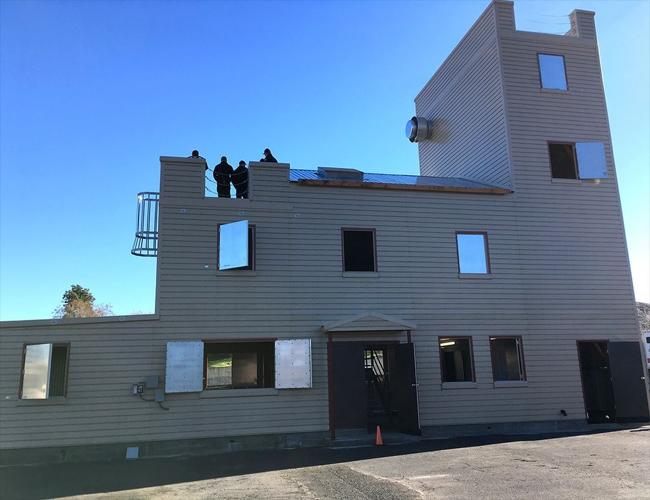
“There” was the new four-story fire training tower at Mid-Columbia Fire & Rescue’s main station at Eighth and Webber.
More specifically, it was the first-floor burn room, a bare space with several doors and “windows” — steel pieces on hinges — and generous holes on the bottoms of the sides for water to drain off the concrete floor.
Black rivulets of water ran down the exterior of the $80,000 tower as multiple fire crews took turns tamping down the fire. The walls are built to move, to withstand unbelievable heat, and to leak. But the rivulets have to be washed away before they dry, an official said, otherwise they’ll never come off.
In the burn room, the fire source is a small stack of untreated wood pallets, topped with a few flakes of alfalfa – the greener the better — for maximal smoke. After a few squirts of propane and a match, there’s soon a roaring fire. The pallets sit on a low metal tray six inches off the ground.
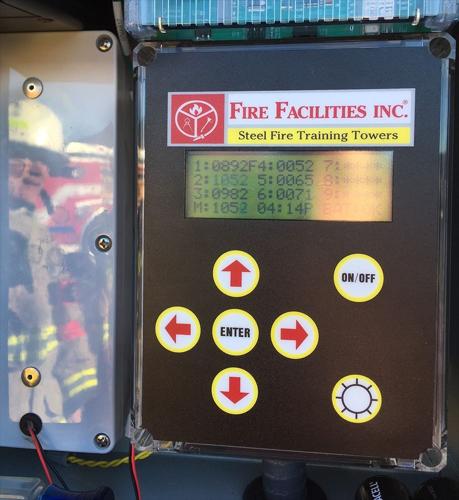
Firefighters entered the room in threes, with backups just outside. They tamped the fire down — but not out — and then got out. The next group started as soon as the temperature inside climbed back up to the appropriate temperature, according to a thermostat on the outside of the building that records the room’s ceiling and shoulder-height temperatures.
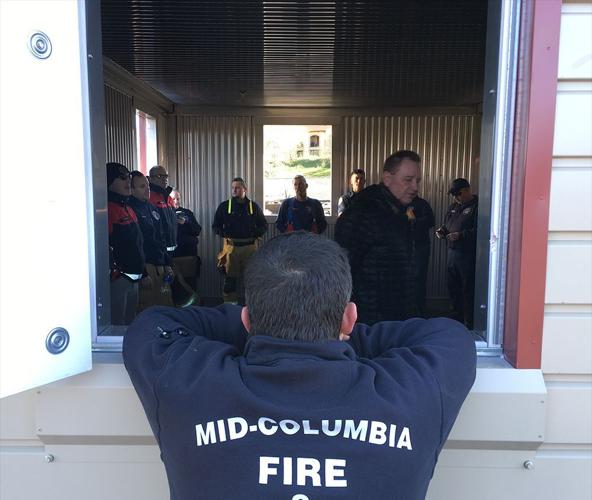
Crews first entered the room at 500 degrees, then 850, and then 1,000. For a quick breakdown of those temperatures, it was described as 500 degrees being no big deal, at 800 degrees its possible to do search and rescue missions, but at 1,000 degrees, it’s time to get out, explained Steven Harms, western regional manager with Fire Facilities, the manufacturer of the training tower, during a talk before the hands-on portion of the Feb. 13 training began.
Fire safety gear is rated to withstand 1,200 degrees, he said, but once it gets over 1,000 degrees, the antenna will melt on radios. “And you’ll melt too, quickly.”
Fire personnel from various agencies in the region participated, which Harms said would help them work together better on an actual fire.
Capt. Manuel Irusta, with the Hood River Fire Department, said his agency plans to use the tower for quarterly training. “Our first session is next week, actually.”
They will be using it mostly for non-fire related trainings, such as ladder use, forcible entry, getting people through windows, advancing lines up stairways, and search and rescue through windows via ladders.
The tower is equipped with a smoke machine -- in a typical fire, “You can’t see 12 inches in front of your face,” Harms said -- and also allows for training with ladder trucks, rappelling down walls, and ascending and descending for a rescue.
Mid-Columbia Fire & Rescue Chief Bob Palmer said, “The whole idea of this tower is to simulate the activities of what you would do on a fire ground.”
Harms advised crews who entered the 1,000-degree room, “Don’t panic, get everybody out of there.”
A normal house fire burns at 2,000 degrees, Harms said.
But, he said, “There’s no reason to be in there over 1,000 degrees.” It’s a heat that will “send you right to the floor,” he said. The training experience is designed to teach firefighters when it’s too hot to be safe while fighting in a fire.
Harms told a reporter the training tower “makes not only the firefighters safe because they train a lot more often under real fire conditions, but the public is safer too” because of that training they receive.
Crews took a tour of the tower before their burn room training. It has a four-story stairwell for training on stretching hose up floors of a building, and moveable “walls” to simulate finding your way in smoke-filled rooms.
While the burn room training might have seemed daunting to an onlooker, Mid-Columbia Fire & Rescue Firefighter Pete Thalhofer said, “This is a blast!”
Someone outside the burn room was monitoring the thermostat as it recorded the climbing temperature within. But firefighters kept opening the door to take a peek. He chastised them, “It’s going down, everybody’s looking. You can’t do this, guys!”
Harms told an entry team as it stood ready to go into the room, “Don’t put any water on it. I want you to feel that heat.”
As MCFR firefight Rick Harrington emerged from the burn room, he offered, in understatement, “It was warm. You can feel it in your ears.” He added, “I’ve been in real fires that are hotter, definitely.”
After Palmer took a turn, he said, “It’s hot in there. It’s like an oven.”
The 1,000-degree level is a stunning number to civilian ears. But it’s just a starter for the tower’s heat tolerances. Harms said material in the tower is rated to withstand 3,000 degrees, but once it gets over 1,850 degrees, molecular changes occur, halting the flexibility of a three-inch thick material in the walls, meaning it won’t return to its original shape.
The material is designed to bend, “to get away from the heat,” then pop back into place when cooled, he said.
The room cools down within five minutes, allowing repeated evolutions of training, he said. “No reason not to burn and burn and burn.”
An alarm sounds outside when the temperature hits 1,000 degrees, but fire officials quickly learned the alarm was surprisingly quiet.
Add-ons were available to make it louder, Harms said.
The tower was paid for largely with money from Google projects. In lieu of taxes, Goggle has made payments to The Dalles city and Wasco County, which have been passed along to other taxing districts.
The tower is being paid for via a 15-year loan.
Mid-Columbia Fire & Rescue firefighter Ben Sletmoe said, “1,000 degrees is pretty hot,” but added, “it’s difficult to replicate a real structure fire.”
For one, the burn room uses only untreated wood to burn, so it doesn’t release toxins. “That way we don’t get cancer from training,” he said. A real home has many materials made with plastics, from furniture to floor covers and contents.
Though it was a bit shy of realistic, Sletmoe said, “It’s fun to go in and fight fire. That’s what I like to do.”


Commented
Sorry, there are no recent results for popular commented articles.