

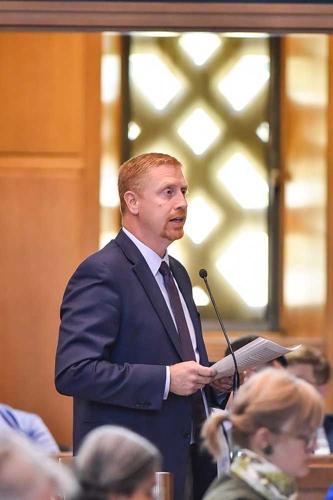
“The key is to surround yourself with good people and have a very loving and understanding family.” Rep. Daniel Bonham (R-The Dalles)
The Oregon Legislature swung back into action in February. With Democrats holding the majority of the House of Representatives with 38 members, Daniel Bonham, Republican house caucus deputy leader and 59th district representative, is part of the minority with 22 members.
Bonham was appointed as the 59th district representative in November 2017 and finished former Rep. John Huffman’s term. Bonham won re-election in 2018 and plans on running again this year. Last September, he was appointed as deputy leader of the Oregon House Republican caucus. Bonham said he was told he had until December to figure out what his job as deputy director consisted of and January to acquaint himself with it.
“Most of my focus as the deputy leader is, I’m recruiting and fundraising,” Bonham said. “My primary job is to grow that group, take us from 22 to say 25, hopefully more than 30 someday, to where we actually get to control a little more of the policy process in the building.”
With his most recent responsibility and as owner of Maupin’s Stoves and Spas in The Dalles, Bonham said he does feel overwhelmed at times but knows how to overcome that feeling.
“It’s a lot of work but it’s fun,” Bonham said. “I didn’t realize how much work it would be taking on a role with the campaign arm on top of the policy work that I do. I’m still very active in doing constituent work and trying to engage in policy discussions. Being a state representative and owning a business is a lot of work to begin with, and this other layer can be overwhelming at times. But the key is to surround yourself with good people and have a very loving and understanding family.”
Two policy initiatives that Bonham is focusing on are House Bill 4122, commonly known as “Ezra’s Law,” and House Bill 1530, also known as the carbon cap-and-trade bill.
House Bill 4122 proposes a mandatory 25-year sentence for abusers who intentionally cause permanent physical and/or cognitive injury to their victim (Related story page A3.)
Such injuries were inflicted on a four-year-old Madras child in November 2017. Josue Mendoza, then boyfriend of Ezra Thomas’ mother, was watching him while she was at work when Mendoza severely beat the child. The injuries Thomas sustained now have him in a wheelchair, with a tracheal tube and limited mobility.
“I think, even though he survived and thus it is not murder, you can make an argument that his life has been destroyed,” Bonham said. “Where’s the consideration in that. You can have attempted murder where the person ultimately had minor wounds, healed very quickly and returned to their life. That victim is treated the same as this victim, who has lost all potential quality of life. The bill ultimately specifies what that is. Quality of life is loss of significant cognitive function, permanent loss of hearing or vision or loss of limb or mobility. If it fits that criteria it must be a willful intent. It can’t be an accident.”
House Bill 1530, as explained by the 59th district representative, is a tax policy “disguised as environmental policy.” It’s a mechanism for the government to cap carbon emissions, charge for those emissions, and then take that money and do other things with it, Bonham said.
Bonham predicts if the bill is passed, companies and industries that can’t afford the tax will move out of the state and leave an unfulfilled demand for products and services.
“The manufacturing facility that’s producing concrete is going to shut down in Oregon, but the demand for concrete didn’t go away, so somebody else is going to make concrete,” Bonham said. “They’re going to make it in Texas or they’re going to make it in China. You now have areas where they manufacture the same product without the regulatory environment that we’ll have, but now you have to ship it here. So, in the manufacturing process, it’s creating more greenhouse gas, and the shipping process adds to that. So, what we’re doing here in Oregon is creating something that makes us feel good even though the global impact is actually a net negative, which is hard because there’s so many people that are passionate about this and I think most Oregonians want to do something positive with respect to environment and climate.”
Although Bonham is not supportive of the bill, he said that doesn’t mean he’s against improving the environment. He’d rather find a better solution where industries and companies stay in Oregon, he said.


Commented
Sorry, there are no recent results for popular commented articles.