
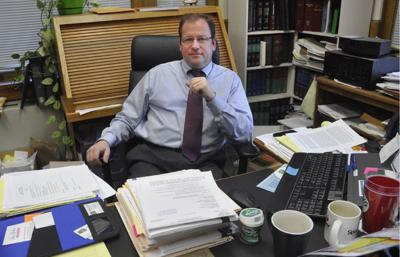
The Oregon State Bar has directed that a formal disciplinary proceeding be instituted against Wasco County District Attorney Eric Nisley, a “rare” step to take against an elected prosecutor, a spokeswoman said.
Kateri Walsh, spokesperson for the bar’s State Professional Responsibility Board, which acts in the role of a grand jury, alleged on Dec. 3 that Nisley violated a rule of conduct that states “a lawyer shall not knowingly make a false statement of material fact in a disciplinary matter.”
It centers on an investigation Nisley began in November 2014 against a former county employee regarding small cash loans she authorized to an intern.
The bar said Nisley’s responses to the bar about the actual target of that investigation “appeared inconsistent with his own prior statements.”
He is accused of falsely telling the bar that the investigation was not directed at the county employee.
The disciplinary proceeding itself, which is like a trial, Walsh said, would likely not take place until mid-2017.
Outcomes of trial panels can range from a finding of no wrongdoing to a public reprimand, a suspension or disbarment, Walsh said. Nisley also has the option of entering settlement negotiations with the bar.
Nisley said, “This is just another step in the process.” He was elected to a fifth term as district attorney in May.
A bar complaint was filed against Nisley in May 2015 by Wasco County’s attorney, Brad Timmons. It alleged that Nisley started an investigation against Monica Morris, then the county’s finance director, in retaliation for her rejecting a sexual advance he made against her in 2011. He later apologized for the advance.
Timmons alleged eight violations against Nisley, but none of those original allegations were pursued by the bar. Rather, the bar’s disciplinary counsel focused on Nisley’s response to the bar about who was the target of the investigation.
The investigation involved two small loans out of petty cash totaling $360 that Morris made to an intern in 2014. Nisley asked the Oregon Department of Justice to investigate. It closed its investigation without filing charges.
In emails with DOJ investigators, Nisley alleged it was “an illegal loan of taxpayer’s funds” and stated he considered it a “grave misuse” of public funds.
In another email to the DOJ, Nisley wrote, “As an elected official in Wasco County, I am very concerned about the conduct of our finance manager in her handling county tax funds. In my experience, people who engage in misconduct in one area often engage in misconduct in other areas. Right now there is very limited oversight of Ms. Morris.”
In another email, he wrote, “I would like to know the status of Ms. Morris’ case. She is in charge of all the county’s finances and appears to have committed a crime. Can you let me know what is going on?”
Robert Cully, a special agent for DOJ who participated in the investigation, emailed the bar in July 2016. He wrote, “I am hopeful that you have received all of the emails from Nisley sent to my office during the course of this investigation. Those communications offer a different perspective than the recent correspondence he has prepared for your office.”
In Nisley’s responses to the bar, he wrote, “I did not target Ms. Morris in the investigation. I asked other agencies to look into the propriety and possible unlawful loan of public funds. At the time I requested an investigation, I did not believe that Ms. Morris would make a loan without authorization from her supervisor.”
Nisley also told the bar that his emails to the DOJ just reflected “verbiage.” He said, “Ms. Morris was in the stream of an investigation, and was not the target.”
He wrote to the bar, “I wondered that if this kind of behavior was being tolerated, what else might be happening. This does not equate to me thinking Ms. Morris was the ‘target’ of the investigation – I did not have enough information to form an opinion as to who might be a ‘target.’”
He said, “In hindsight, I can understand how someone would infer that I saw her as a suspect, but I know what was in my mind at that time and it was concern about completing this investigation and determining who was responsible for authorizing the improper loans.”
In November 2014, Nisley issued a secret subpoena to get all emails between Morris, the intern who got the loans, Morris’s supervisor, County Administrator Tyler Stone, and the three county commissioners.
When told the emails sought were voluminous, he restricted it to just those between Morris, the intern and Stone.
According to the bar’s summary of the case, the DOJ did not learn of the subpoena until more than six weeks after it began its investigation, when Nisley offered to send two email message strings he believed were relevant to the case.
The bar summary noted that a DOJ investigator “expressed surprise that Nisley had issued the subpoena and had collected materials that were not fully shared with DOJ.”
The investigator “opined that the two email messages that Nisley sent did not appear to have evidentiary value and he suggested that Nisley provide the rest.
In response, Nisley stated that he did not want to mail the thumb drive [containing the rest of the emails]. DOJ never obtained the remaining email messages from Nisley.”
After DOJ declined to file charges, Nisley continued the investigation on his own, including interviewing the intern and researching her employment status. He determined she was not in a union and not entitled to draws on her wages. Nisley also noted it would not be considered a draw since draws are not paid back, as the $360 in loans were.
Nisley turned the investigation over to an outside prosecutor for a final decision. That prosecutor, Steven Leriche from Jefferson County, concluded that the evidence raised questions about the propriety of what occurred, but he determined further prosecution was not a useful use of resources. He suggested it be treated as a personnel matter.
Last year, according to Walsh, the bar’s state professional responsibility board authorized formal charges against 83 attorneys. It authorized admonitions, or warnings, in 39 cases. It dismissed complaints against 34 attorneys.
The bar’s office of disciplinary counsel opened 302 cases in 2015. Cases are primarily referred to it from the client assistance office, which screens all inquiries or complaints.
In 2015, the client assistance office had nearly 2,000 inquiries, requests or complaints. Of those, nearly 200 were referred for disciplinary investigation.
Timmons said of the bar’s decision to pursue charges, “This is in the hands of the state Professional Responsibility Board and it’s now going to be tried by disciplinary counsel and there’s nothing more for the county to do at this time.”


Commented
Sorry, there are no recent results for popular commented articles.