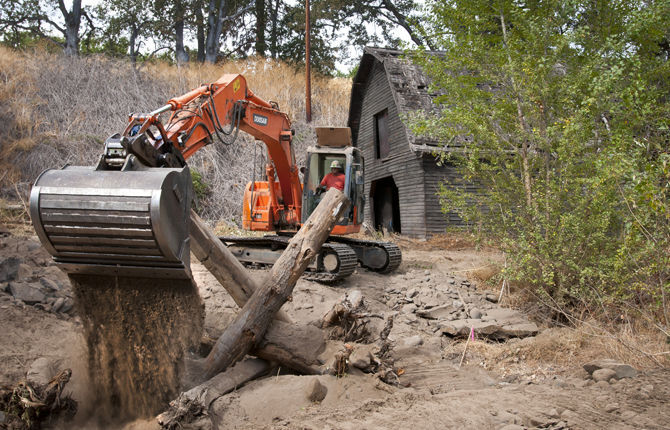
KURT OLSEN of Crestline Construction in The Dalles, dumps soil and rocks on the base of log structure that will provide fish habitat in a 500 foot section of a historical side channel of Mill Creek that is being restored for flood control and fish habitat. Project foreman is Tim Brown. Mark B. Gibson photo
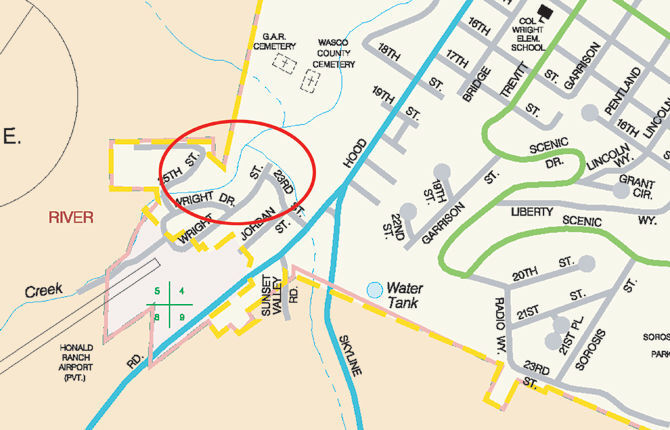
THE SIDE channel project area, circled in red above, is located at the southwest edge of The Dalles city limits. The project, designed for flood control and fish habitat improvement, is scheduled for completion near the end of October.
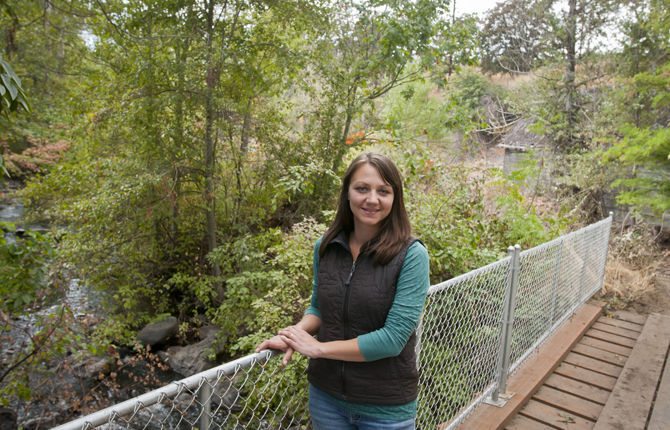
Shilah Olson, above, stands on a private farm bridge over Mill Creek located near the northern end of the side channel restoration project. Mill Creek is seen to the left, the channel is beyond the trees and brush behind her.
KURT OLSEN of Crestline Construction in The Dalles, dumps soil and rocks on the base of log structure that will provide fish habitat in a 500 foot section of a historical side channel of Mill Creek that is being restored for flood control and fish habitat. Project foreman is Tim Brown. Mark B. Gibson photo
Mark Gibson
THE SIDE channel project area, circled in red above, is located at the southwest edge of The Dalles city limits. The project, designed for flood control and fish habitat improvement, is scheduled for completion near the end of October.
Shilah Olson, above, stands on a private farm bridge over Mill Creek located near the northern end of the side channel restoration project. Mill Creek is seen to the left, the channel is beyond the trees and brush behind her.
After over a decade of planning — the first project easement was awarded in 2004 — work is now underway on a project that will restore a side channel of Mill Creek where it enters The Dalles city limits.
“It’s a historic side channel that was blocked off to create a place for migrant housing years ago,” explained Shilah Olson of the Wasco County Soil and Water Conservation District. Flow into the channel, located on the west side of the creek, was blocked top and bottom with levies. Without the channel, however, flood waters were inadvertently shifted toward homes on the opposite side of the creek, Olson said.
“Our first interest in this project was flood control,” she explained. Homes on the east side of the creek near 21st Street were impacted by the change in the creek, becoming more prone to flooding and flood damage.
As the conservation district began to design a fix for the flood issue, those working on the project realized the project of re-opening the channel was also an opportunity to provide improved fish habitat in Mill Creek.
Both flood control and fish are very much a part of the district’s mission, Olsen said.
Mill Creek is home to Mid-Columbia steelhead, coho salmon, Chinook salmon and cutthroat trout, according to a 2007 study written by the conservation district for the Oregon Watershed Board.
Fishery managers identified the steelhead runs in Mill and Fifteenmile creeks as a single population, and together they represent the easternmost population of wild winter steelhead in the Columbia Basin.
“They represent the edge of the range for the winter-run life history, and their genetic material is therefore valuable for the long-term survival of the species,” the study reported. “Considering the extremely depressed levels of the Fifeteenmile steelhead population (under 130 returns in the 1990s), the Mill Creek component of this run may be very important to the genetic integrity of the overall population.”
Olson noted that the side channel project offers a unique opportunity to improve fish habitat on the creek, given the urbanization of downstream areas.
The project involves breaching the levies at either end of the now dry channel.
The upstream end of the project is located at a bridge on W. 25th Street, built to provide access to the Evergreen Care Center, and terminates about 500 feet downstream near a private bridge used to access private orchards west of the creek.
Fish habitat will be enhanced the length of the project with a series of log structures. “These structures create calm water and hiding places for fish,” Olsen explained. The structures will be created without cable or rebar, as was done in the past, but by interlocking logs and rocks in the bed of the channel.
A culvert structure will be placed over the restored channel at the downstream end where the farm access road currently crosses it.
Local Oregon Department of Fish and Wildlife biologists have been monitoring fish populations near the project area, and will continue to monitor them for several years to evaluate project effectiveness.
Crestline Construction, based in the Port of The Dalles, has already begun work on the project. Completion is expected in late October or early November.
The Dalles Watershed Council has played a big role in getting this project underway, she said. The council is dedicated to “fostering stewardship of Threemile Creek, Mill Creek and Chenowith Creek watersheds,” according to their website, and has worked closely with the conservation district throughout the many years it took to get the project underway, Olson said.
The project cost, estimated at about $134,000, was funded in part by grants from the Oregon Department of Environmental Quality and the Oregon Watershed Enhancement Board.
Plans to include a backwater area to the southeast of the channel were dropped when a small portion of that property was discovered to be within the National Scenic Area.
“We had already worked through the permit and notification process with the Corp of Engineers, the tribes and the city,” Olson explained. “We would have had to go through an additional layer of permitting and notification.”
Instead, the district chose to stick to their timetable and drop out the backwater area.
“It reduced the cost as well,” she added.
The new channel will not only redirect flood water away from nearby homes, but will reduce flood impacts downstream as well, Olson noted.
Water entering the channel will be slowed and more of it will be drawn down into the ground, reducing downstream impact.
“Everyone downstream should see a benefit as well,” she said.
The Dalles Watershed Council will be walking through the project on Thursday, Oct. 1.
Anyone interested in learning more is encouraged to call Shilah Olson, at 541-296-6178 ext. 105.
When the project is complete in late October or early November, the district will be seeking volunteers to help plant grass, shrubs and trees along the restored channel.
Olson looks forward to showing off the final results of so many years of planning and work on the project, which she inherited 10 years ago when she started with the district.
“It’s pretty exciting to be implementing this project,” she said.



Commented
Sorry, there are no recent results for popular commented articles.