In September we’ll see the return of Saturn to the evening sky, the harvest full Moon, some nice passes of the International Space Station, and the opposition of the planet Neptune.
Welcome to the first full month of summer, and the start of the second half of 2026. Warm summer nights make for excellent stargazing. Venus will again be the one bright planet that is easy to see in July.
Our third month of the year brings us a total Lunar Eclipse, the vernal equinox, and a nice pairing of the Moon and Jupiter. Hopefully the clouds will part at the right time for viewing some of these events.
Jupiter continues to shine bright in February’s evening skies, and the winter constellations Orion and Taurus are bright on clear nights. But let’s focus on something else this winter month, called circumpolar constellations.
Happy New Year! Welcome to January. Our first month features Jupiter’s closest approach for the year, and plenty of bright stars to view. Nights will be cold and mostly cloudy, but step outside when skies clear for a stunning view, even if it is a short one!
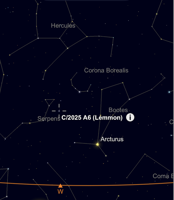
FREE NEWS: Comet Lemmon visits us about once a millennium, dropping in from far beyond the orbit of Pluto. It hasn’t changed much since it was formed 4.5 billion years ago, so getting a chance to see it is an experience that connects us to the very beginnings of our solar system.