
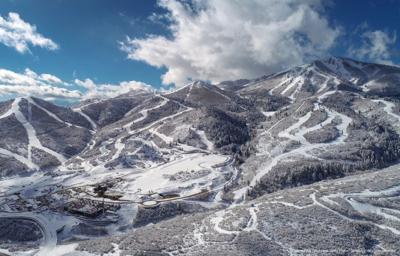
The Olympic Winter Games come to Salt Lake City in 2034. But when the Olympic torch returns to Utah, it won’t light a blank slate. It will reignite a region that never let the flame die out.
From the Utah Olympic Oval’s “fastest ice on earth” to the ski jumps and sliding tracks, the facilities that once welcomed the world are still humming. They’ve trained generations of athletes since their global spotlight in 2002. And if you ask three-time Olympian Fuzz Feddersen, that continuity, not nostalgia, is what makes Salt Lake City’s encore so compelling.
“I think it’s super cool,” Feddersen shares about the Olympic Winter Games returning to Utah. “They could pull the Olympics off this winter if they had to. You just can’t say that about most host cities.”
A Rare Do-Over Done Right
Utah’s Olympic infrastructure remains in daily use. The ski jumps at Utah Olympic Park still send aerialists skyward. The Oval continues to produce elite speed skaters. Unlike host cities where venues have fallen into disrepair, youth programs, national teams and recreational athletes share the same facilities that once crowned world champions.
Feddersen, who competed in freestyle aerials and now performs, coaches, and mentors athletes in nearby Park City, sees the difference firsthand.
“Salt Lake is kind of the mecca for winter athletes to go train,” he said. “By the time we get to ’34, we’re going to have a kick-ass team because we have these facilities that kids are learning on.”
The International Olympic Committee awarded Salt Lake City hosting privileges in 2024, after the city pledged a privately funded, sustainable and compact games model that utilized existing venues from 2002. It’s one of the few times a host city has been tapped again, largely because it maintained its legacy instead of abandoning it.
Building a Pipeline to the Podium
Feddersen watched the most recent Olympic Winter Games with particular attention to aerials, his discipline. He called the women’s competition “one of the best I’ve ever seen” and praised the U.S. team’s gold medal performance in the team aerials event.
But beyond medals, he sees a deeper shift in the sport.
“When we were competing, we were kind of experimenting,” he admits. “Now they know the fundamentals from the beginning. The techniques are so much better.”
That evolution, he says, is fueled by access. Young athletes in Utah grow up training on world-class facilities, coached by former Olympians like himself who have transitioned into new roles.
“There’s so much you can do after you retire from competition,” Feddersen adds. “Coaching, judging, instilling the right values in kids. That’s important.”
With federal, state and private funding expected to flow in ahead of the games to upgrade facilities, he anticipates a stronger grassroots pipeline, one that could push the United States closer to perennial medal leader Norway.
“Maybe by the time we get to ’34, we could take that medal count and be on top,” he says.
A Community That Knows How to Host
The 2002 Olympic Winter Games were a defining moment, staged just months after the September 11 attacks. Volunteers, many of whom still ski in their color-coded Olympic jackets, helped deliver an event widely praised for its organization and spirit.
“I still see people in those jackets,” Feddersen shares. “They’re hoping they get another one in ’34.”
That civic pride now intersects with rapid growth across the Wasatch Front. Resorts, including Deer Valley Resort, have expanded terrain and infrastructure in recent years, unveiling new lifts, additional acreage and the East Village base area to accommodate increasing visitation.
Through its Expanded Excellence initiative, Deer Valley has doubled its skiable terrain. The ambitious transformation proves a scale of investment and momentum building ahead of the upcoming games. The growth is both logistical and symbolic.
By the time the event arrives, that expanded terrain and modernized base infrastructure could play a critical role in dispersing visitors and showcasing Utah’s ability to balance elite competition with world-class recreation.
More Than Medals
Utah’s appeal extends beyond podium finishes. Feddersen believes the world will see a state that is more diverse, dynamic and outdoors-driven than stereotypes suggest.
“There are beautiful mountains, incredible winter and summer sports and great people,” he says.
Feddersen participates in Deer Valley’s “Ski With a Champion” program. On a half-day tour, he guides guests through hidden glades and wind-protected runs, sharing stories from his time competing while he helps them navigate terrain they might never find alone. “They don’t have to think about crowds or the best lift. They just follow me.”
He expects the next games to leave their own imprint, not only in upgraded facilities and tourism revenue, but in a generation of athletes who grew up under the shadow of ski jumps and speed-skating ovals.
“There are families moving here just so their kids have access to these facilities,” he points out. “That’s going to be the story.”
The Flame Never Went Out
As global attention builds toward the return of the games, Utah’s legacy feels less like a comeback and more like a torch that was never extinguished. The lifts never stopped spinning. The ice never melted. The jumps never went quiet.
When the world arrives, athletes and spectators will see a place three decades in the making. Not for two weeks of spectacle, but for a culture of winter sport that hasn’t, and won’t, disappear.
If Feddersen is right, the lasting image of ’34 won’t be empty stadiums or faded banners. It will be kids who learned to fly on Utah’s ski hills, who got to chase medals on home snow. The Utah community once again proving that here, the Olympic flame is less an event than a way of life.


Commented
Sorry, there are no recent results for popular commented articles.