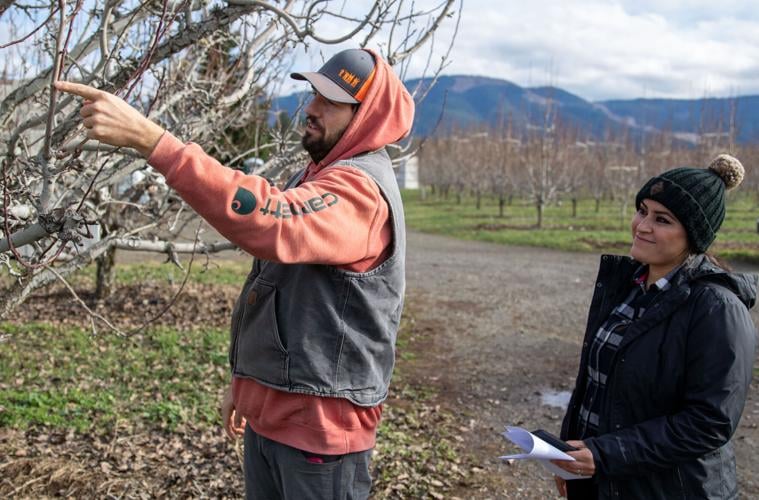
George Oates and Yesenia Sanchez-Oates explain the process behind keeping trees healthy in the off-season and ready for next years growth. Throughout the valley every tree is manually pruned.
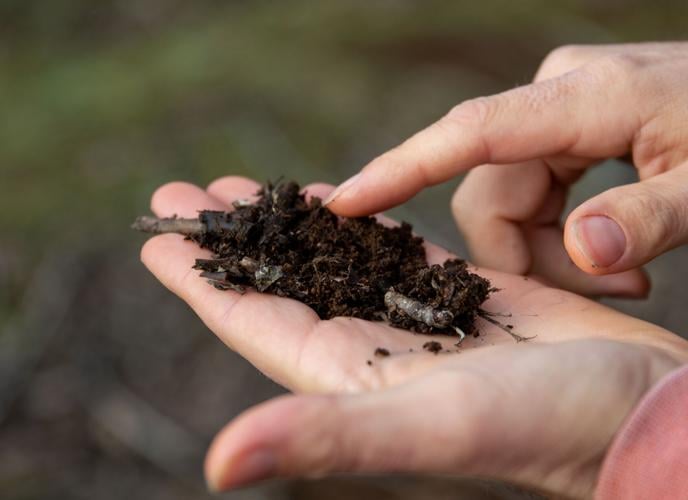
Instead of spraying the pears trees with pesticide, Old Parkdale Farms and owners Yesenia Sanchez-Oates and her husband, George, let the soil do the work. Fallen leaves, branches, and other minerals serve as fertilizer for their all-natural growing process.
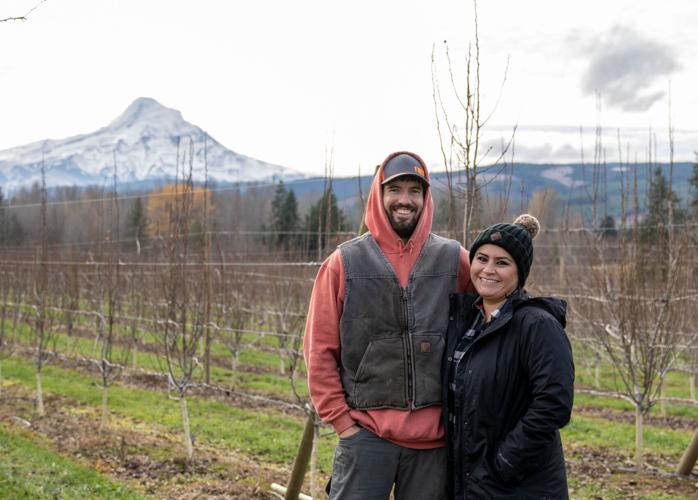
George Oates and Yesenia Sanchez-Oates stand in front of their youngest trees that are part of a newly introduced trellis system. The tree is groomed to grow a certain way which makes harvest and preparation much easier and less time consuming.
George Oates and Yesenia Sanchez-Oates stand in front of their youngest trees that are part of a newly introduced trellis system. The tree is groomed to grow a certain way which makes harvest and preparation much easier and less time consuming.
Noah Noteboom photo
HOOD RIVER — Sustainability is at the forefront of every farmer’s mind in the Columbia River Gorge. A new Gorge-based Agricultural-Technology Education Alliance (ATEA) is being organized engage the next generation of farmers using new technologies in the agricultural field. The project’s aim is to create a curriculum that incorporates future technologies into current farming practices while also engaging students.
The idea of an Ag-Tech alliance in the Mid-Columbia has been discussed for years, but momentum only began to pick up last October when a group of local farmers, education administrators and the Oregon State University Extension Office started to meet monthly and identify the needs and wants of future farmers. What started out as a dozen members has blossomed into a team of nearly 70 collaborators that represent the ATEA throughout the Gorge. The Mid-Columbia Economic Development District has teamed with the Gorge Tech Alliance, the Wy’east Resource Center, Columbia Gorge Community College, the OSU Extension Service, political representatives and about a dozen growers in the area.
Dan Spatz, director, Special Projects and Community Relations at Columbia Gorge Community College, says Hood River — an agricultural hub in the northwest — has, ironically, been missing an agricultural curriculum. Students are using phones, laptops, tablets in their everyday lives and CGCC wants the bridge the gap between farming and technology by applying their interests that to farming.
“We see kids using their cellphones all the time, intrigued by robotics and inventing things,” said Spatz. “Let’s use that as a way of engaging them.”
Former Major League Baseball coach and current fruit grower in Hood River, Don Wakamatsu, calls it “gamifying” the business of farming. Trying to engage students with the promise that technology will be involved. The program will also keep students close to home. Before, if a student is interested in this field of study, they usually end up transferring to colleges away from the Gorge, much to the dissatisfaction of school districts in Hood River, The Dalles and CGCC.
“We have some long-standing projects and some that we’ve just started this fall in The Dalles,” said Spatz. “But the need for a core program in Hood River has long been apparent.”
Hood River County School District Superintendent Rich Polkinghorn has been involved with the ongoing conversations to bring a project of this magnitude to the Gorge. The ATEA will expand the capabilities of the current agriculture program at the Hood River Valley High School. Students would receive dual credits that could easily transfer to CGCC and lessen the amount of work and time dedicated towards a bachelors or graduate degree.
“It is really looking to develop a dual credit high school program that leads to a degree or certificate at the community college, with the ability to potentially transfer to a four-year institution,” said Polkinghorn.
He added that courses would eventually be available for current farmers to hone their skills and grow their knowledge. The group is keeping a close eye out on potential property that could house a testing site for new technologies and practices.
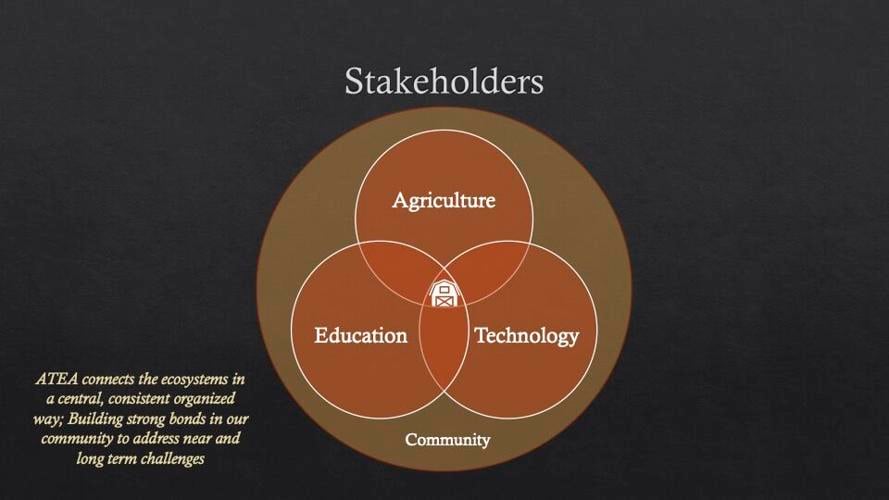
A slide from an ATEA presentation, which illustrates how the three industries will collaborate to help current and future farmers.
Contributed photo
The OSU Extension Office has played a crucial role in getting this idea up and running. Ann Harris, the Open Campus Coordinator for Hood River and Wasco counties, has plenty of experience with programs like the ATEA. She previously worked on coordinating the online Elementary Education Certification program at CGCC, where students can remotely earn certification to teach elementary school children.
“I see the ATEA as an avenue for students to finish college and pursue a career in the agriculture field,” said Harris.
The OSU Extension Office located in Hood River already has an “experimental station property” where OSU College of Agriculture faculty and students are already doing hands-on work. The OSU extension in Hood River has been in operations for 50 years and is currently working with orchardists and farmers integrate advanced technology.
Innovation Farm
CGCC President Dr. Marta Yera Cronin said much of the work has been trying to secure the CGCC Indian Creek Campus in Hood River a physical location for the “innovation farm.” A long and extensive search led them to a 31-acre plot of land on Barrett Drive in Hood River that could serve as home base for the ATEA. The property is currently owned by the Hood River Parks and Recreation District. The Barrett property is zoned as Exclusive Farm Use (EFU). Since Parks and Rec purchased the acreage, the Indian Creek Trail has been built around the perimeter and they have installed a geotextile runway pad for RC planes or drones. Parks and Rec Director, Mark Hickok, said this is a prime opportunity to keep the land in public ownership.
Instead of spraying the pears trees with pesticide, Old Parkdale Farms and owners Yesenia Sanchez-Oates and her husband, George, let the soil do the work. Fallen leaves, branches, and other minerals serve as fertilizer for their all-natural growing process.
Noah Noteboom photo
“We haven’t been able to develop the park to its full potential,” said Hickok. “The college is looking at purchasing it from us, and we are happy to talk with them about that.”
Should the college acquire the property, Spatz emphasized the primary goal would be to return Barrett to agricultural production; students would then be able to learn the business of farming in a real-world setting, where operations must turn a net profit — one of the greatest challenges faced by any farmer. Spatz added that college acquisition isn’t the only option for Barrett; for instance, a farmers’ cooperative might also be established for this purpose, with ATEA one of the members.
A Health Impact Statement (HIA) done by the Hood River County Health Department in June 2011 stated that the land was previously used as orchards for growing apples and pears.
CGCC has submitted a $60,000 feasibility study with the State of Oregon that will help identify financial assistance needed for operational, labor, equipment, and land use costs to start up the project, State Representative Anna Williams and Senator Chuck Thomsen have shown their support for the project. A final decision from the state is expected in late-January or early-February.
In another attempt to secure funding, MCEDD submitted a joint proposal with the Columbia Basin and Blue Mountain community colleges to the U.S. Economic Development Administration’s Phase 1 of the “Build Back Better Challenge,” which could give up to $500,000 for technical funding to develop and support projects in a regional growth cluster. The national competition will select 50-60 regional coalitions that will be awarded the funds. If selected for as a finalist the ATEA can submit another application for Phase 2, that awards anywhere from $25 to $75 million for the interrelated projects.
“The college has developed other programs of this scale, and we have a history of developing other career tech programs,” said Spatz.
Glimpse into creativity
Yesenia Sánchez-Oates, a pear orchardist who owns Old Parkdale Farms, with her husband George Oates, also a stakeholder for the agricultural side of the Ag-Tech. At many farms in the valley, fruit is hand-picked, and every single tree must manually pruned. Sorting the harvest presents another challenge, but the job isn’t finished when the fruit is sold.
George Oates and Yesenia Sanchez-Oates explain the process behind keeping trees healthy in the off-season and ready for next years growth. Throughout the valley every tree is manually pruned.
Noah Noteboom photo
Before working full-time at the farm, she worked as a business developer for Insitu for six years. She recognized a lack of efficiency in the fields and brought her expertise in the technology sector to the orchards. One of the first changes she made was making it easier for pickers to keep track of how much they harvest with a simple QR code scanner, which she purchased from Amazon. Each worker can now document their progress from their phones. This is one way her orchard is incorporating newer technology, while doing their best to remain cost efficient.
“We are bringing together agriculture, technology, and education for a more sustainable future for the next generation in the Columbia River Gorge and beyond,” said Sánchez-Oates.
She added that when the interest group finally got together the initial step was to identify the most pressing challenges for farmers. Climate change and rising labor costs were considered the foremost problems. Hood River and the Gorge has experienced heat waves that reach 115 degrees, cold spells which threaten crops, and a shortage and price increase for resources due to COVID-19 complications. Training workers is becoming redundant and time consuming. As the harvest season nears the end, work preparing for the following year has already begun.
Autumn arrives and the trees must be pruned and trimmed back in a very precise manner to accommodate next year’s growth. It takes a special skill set to understand where and how to cut the branches, so they don’t become overweight cause the tree to lose a limb. Workers must do this for every tree in each orchard. With orchards littering nearly every hillside, you can imagine this process takes a very long time.
To reduce time spent pruning trees, Sánchez-Oates’ farm in Odell has adopted a new technique to grow trees. Instead of your traditional free roaming branches, Old Parkdale Farms has constructed a wire trellis system that serves as a guide for the tree’s branches. Very similar to the way wine grapes are grown, Sanchez is incorporating this new way of growth to save time, energy and money while making it easier to also protect her crops. Rather than using ladders to trim every branch workers can simply walk along a single row and quickly trim and monitor the growth. Instead of totally replacing manual labor, they are making it less physically demanding for the pickers.
The trellis system provides one opportunity for new technologies, such as targeted spraying, to reduce labor and material costs while increasing efficiencies — technologies which would be integrated into ATEA’s curriculum.
Everyday Sánchez-Oates is scanning the internet for new farming techniques that she can integrate into her business. As a pear farmer, she and George are met with problems that apple or other fruit farmers don’t experience.
“Apples have become huge conglomerates, there are not a lot of family farmers,” said Sánchez-Oates. “It has become very vertically integrated.”
Next Steps
As the ATEA awaits word on their feasibility study and the funding proposals they will continue to meet and work closely with school districts and landowners. Participants, growers, and other organizations continue to pledge support.
Columbia Gorge News will continue to monitor progress from the ATEA and inform readers when information becomes available.