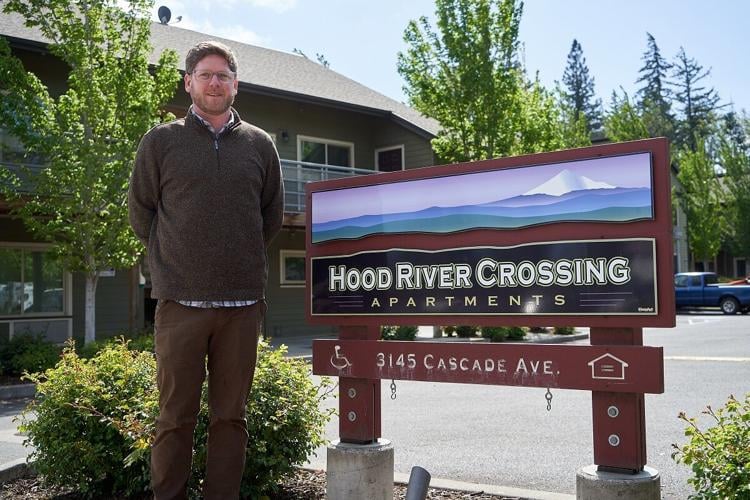
Mid-Columbia Housing Authority Director Joel Madsen.
Walker Sacon photo
Joel Madsen directs both Mid-Columbia Housing Authority and Columbia Cascade Housing Corporation. The two organizations have separate but related roles working towards a single goal: promoting and administering affordable housing in the Gorge.
Affordable housing is defined by the U.S. Department of Housing and Urban Development (HUD) as housing costing no-more-than 30 percent of an occupant’s gross income. For local groups like Madsen’s, Washington Gorge Action Programs (WAGAP) and Mid-Columbia Community Action Council, an affordable unit doesn’t “rent-burden” a person or family making a “low income,” defined by HUD as those at-or-below 80 percent of the area’s median income.
WAGAP director Leslie Naramore makes a distinction between “affordable housing” and “workforce housing,” though the two are not mutually exclusive and both are lacking in the region.
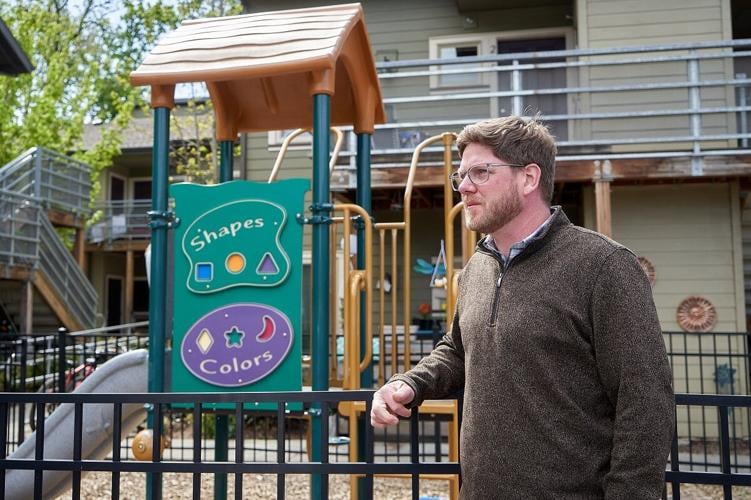
Mid-Columbia Housing Authority director Joel Madsen stands outside Hood River Crossing's playground on April 22.
Walker Sacon photo
“I think the way it gets muddled is … for example, right now in Hood River they’re talking about the middle housing and a lot of people are referring to that as affordable housing and it’s affordable housing for that income bracket but it’s not technically ‘affordable housing,’” Naramore said.
Madsen oversees 389 units of housing spread between 23 properties from Cascade Locks, Ore. to Roosevelt, Wash. and administers rent assistance through state programs and the federal Housing Choice Voucher Program, commonly known as “Section 8.”
The rent assistance program makes up the difference between what someone can afford before being burdened and the cost of their housing, Madsen said.
A shortage of inventory at all levels of the region’s market makes finding a rental to assist with difficult, even when funding is secured, Madsen said.
“We still need to have a healthy housing market where there are units available to rent in order to have that public private partnership,” Madsen said. “We need landlords who will engage with us, and we need the housing stock to be existing where we can use that rent assistance to support lower-income households.
“Our whole region is underproducing in the global housing stock, and that impacts us across the whole socio-economic strata,” Madsen said.
Mid-Columbia Community Action Council, the non-profit community action agency for Hood River, Wasco and Sherman counties, is directed by Kenny LaPoint. LaPoint’s previous job was with Oregon’s Housing and Community Services Department, before that he was the housing and resident services director for Central Oregon Regional Housing Authority from 2009-2014.
LaPoint said increasing inventory is a direct route to decreasing costs of housing. He said rising housing costs and lacking inventory are a problem across the state of Oregon.
“I think people try and get over-analytical about it or try to make some political statement out of it, or they try to say that if we build more or we add more services that results in more people coming here because we have access to things and I think that is not true,” LaPoint said.
In 2011, when LaPoint worked in Bend, Ore., around 15 percent of housing units were vacant and he had trouble filling affordable housing developments.
“Housing owners who were renting places had to reduce their rents to get people to move in, but it’s the opposite of what we’re seeing right now,” LaPoint said.
However, LaPoint said it’s more complicated than just supply and demand. It’s one thing to say “add more housing, but there is some more complex things to overcome in order to get to that point where you have enough development,” he said.
He said the cost and availability of land and a lack of market competition among contractors also drive up the cost of developing which drives up the cost of buying or renting.
Madsen said land-use and cost in the region is constrained by regulation, topography and infrastructure. He said the regulatory constraints of the National Scenic Area play a role in limiting the amount of land available for development, but dramatic, difficult-to-build-on terrain and existing infrastructure are also factors.
“You may find a chunk of land, but does it have sewer? Does it have a road to it? Does it have the critical adequate water services?” Madsen said. “If not the cost of land, it may also be the cost of infrastructure and improvements in order to make that land able to be utilized for production of affordable housing.”
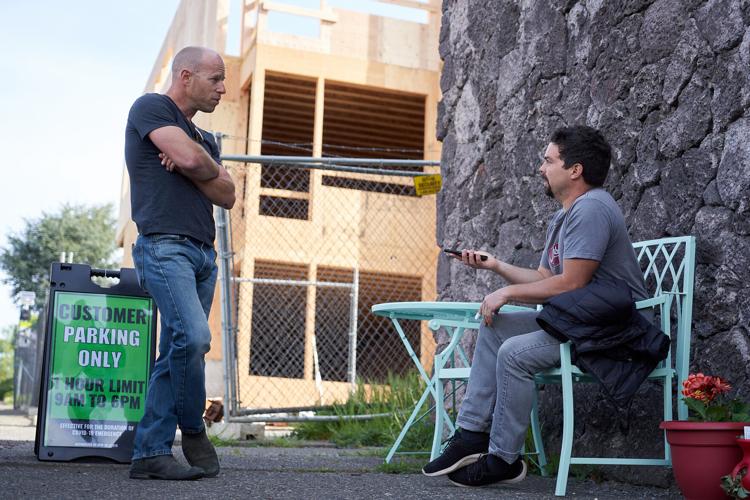
Tao Berman and Rafa Ortiz talk outside.
Walker Sacon photo
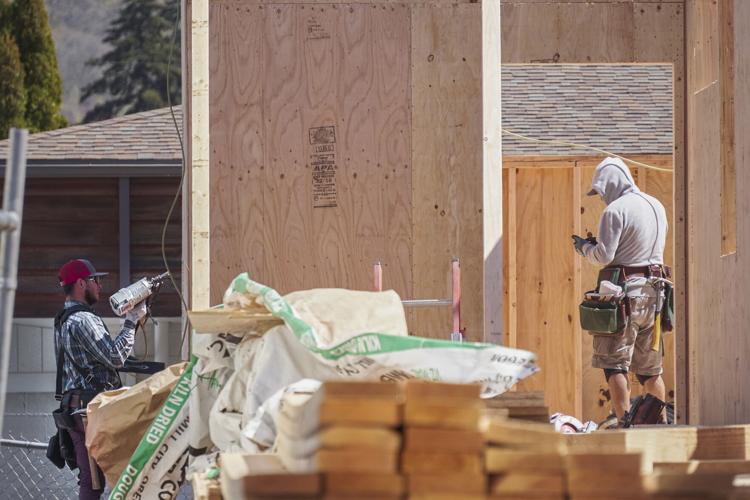
Retired pro-athlete and “reluctant developer” Tao Berman owns around 100 rental units in the Gorge and is building a 19-unit complex on Main Street in White Salmon.
Berman said rents “aren’t that high” relative to the cost of building in the area. The new building in White Salmon is his first new development as he said he couldn’t “make the math work” in the past, regarding the investment potential of new construction.
“It’s still not a slam dunk,” Berman said, but he said he would prefer to move his money out of stock markets into his community. He said “yield investors” in the area have been having the same conversation since he moved here in 2004.
Madsen, Berman and LaPoint all said increasing density allows developers to get a return on investment into more expensive land, whether the return is for business reasons like in Berman’s case or to make meeting subsidy standards sustainable for Madsen.
More dense developments also allow cities within the National Scenic Area to expand within their urban growth boundaries and avoid sprawling across the Gorge, Madsen said.
Framers work on Tao Berman's new building in White Salmon.
Walker Sacon photo
“Because of this beautiful place we live in, we have these urban centers that need to look and act much more urban than what they’ve historically been,” Madsen said. “The narrative around urbanization in this rural community is one that’s been challenging and will continue to be challenging into the future.”
Hood River Mayor Kate McBride said she has been hearing from constituents about housing as an issue since she was first appointed to city council in 2012.
She said the city’s efforts to encourage denser development — through the “missing middle” zoning changes making room for smaller lots and homes and the affordable housing development planned for the city’s property on Rand Road — are part of a “compromising game” as it balances affordability, natural areas and resources, diversity and sprawl.
“We all have to work together to make a community that works and functions and that is healthy, within the demand to live here,” McBride said.
Madsen said governmental action like the 1 percent excise tax on new construction in Hood River which goes towards incentivizing affordable housing developments is a step in the right direction, but he would like to see more action from local, state and federal government bodies.
Naramore said legislation is needed to encourage affordable developments “because, if left to their own devices, people are always going to want to maximize their profits.”
White Salmon Mayor Marla Keethler said housing action will be a focus of her city’s council when they finish revising their comprehensive plan next month. She said the city is “actively” recruiting a full-time land-use planner and will try to implement changes to their plan quickly after finding things in the plan’s 2012 revision that still hadn’t seen movement.
“A plan is nothing if it goes into a drawer and you don’t see true changes,” Keethler said.
This article will be continued in the May 12 edition of Columbia Gorge News.



Commented
Sorry, there are no recent results for popular commented articles.