
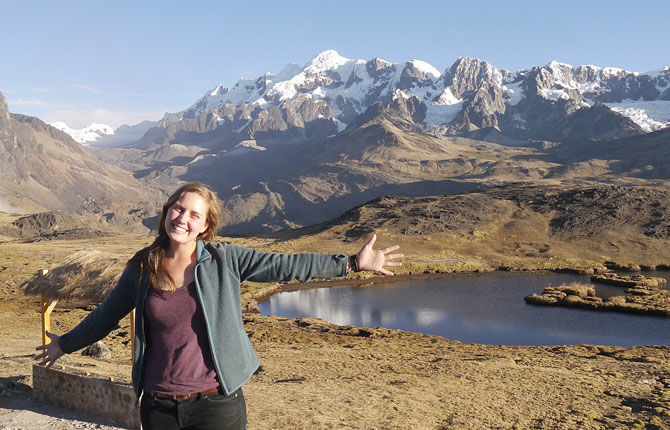
On a frigid 24-hour endurance hike across a glacial ridge of the Andes Mountains, an annual religious ritual, Sarah Brady learned a critical aspect of the Andean culture.
The 2008 graduate of The Dalles Wahtonka High School is nearing the end of a two-year Jesuit mission in Andahuaylillas, Peru. Since arriving in December 2012, she’s had many memorable experiences, from winning a chicken in a horse race to participating in colorful festivals that blend prayers to local deities with the Catholic faith.
But the “24 hour hike” really drove home for her how critical community is to the Andean way of life.
“Community is not just a nice concept, it’s a necessity for survival,” she wrote in an email to the Chronicle. “Walking through the night, sharing food, no one can be left behind or have their needs ignored. This is not just because the group makes an effort to be inclusive, but because if the group is not united, it will not survive the icy night.”
The hike is the culmination of the pilgrimage to el Señor de Qoyllurit’o (Lord of the Glistening Snow), where thousands of celebrants troop into a glacial basin to pay respects to el Señor, an image — celebrated as an apu, or deity — found on a beautiful rock.
For four days, the pilgrims “dance day and night,” Brady wrote. They are seeking blessings for their families, their health, and perhaps most important, their harvest.
“It is complete chaos on every sensory level,” she said of the noisy, colorful celebration. On the penultimate day, “everyone is playing and dancing and marching at the same time… A hundred different rhythms in clashing madness give the impression that in the midst of this enormous communal expression is a deeply personal offering from each dancer, musician, pilgrim. Not a parade, not a performance, but an offering.”
Unbelievably, it is at the end of this arduous celebration that the 24-hour hike begins. A much smaller gathering troops throughout the night – their bobbing flashlights serving as a “parallel galaxy” to the Milky Way above – to deliver an important crucifix to its chapel.
The crucifix is delivered under the gaze of another important mountain deity. “The climax of it all is the greeting of the sun, where the dancers put on their nicest garments and prance down the hill to their waiting family members,” she said.
Brady grew up in Venezuela, the child of missionary parents Phil Brady and Mary Jo Commerford. She came here at 13, and after getting her degree from Seattle University in international relations, found herself drawn to the same life.
She said a “dark stigma” comes with the label “missionary” throughout the world.
“The horrors suffered by the Peruvian people at the hands of those who have called themselves missionaries are still very alive,” she said.
They range from the “violence and destruction visited on Incan and pre-Incan cultures by Spanish colonizers, waving the flag of the Catholic Church” to the “patronizing attitudes” of some charities that creates a “white savior” dynamic that paints locals as unable to help themselves, she said.
Even so, she still sees herself as a missionary, rather than a volunteer, even though she’s there as a part of the Jesuit Volunteer Corps.
“To be a missionary means to seek to build the Kingdom of God. And this to me means to seek a world of justice, dignity, solidarity, a beloved community.”
The Jesuit model is one of “accompaniment,” she said. It’s not coming in to make a huge difference, but to be a part of people’s lives and support those working to create a better future.
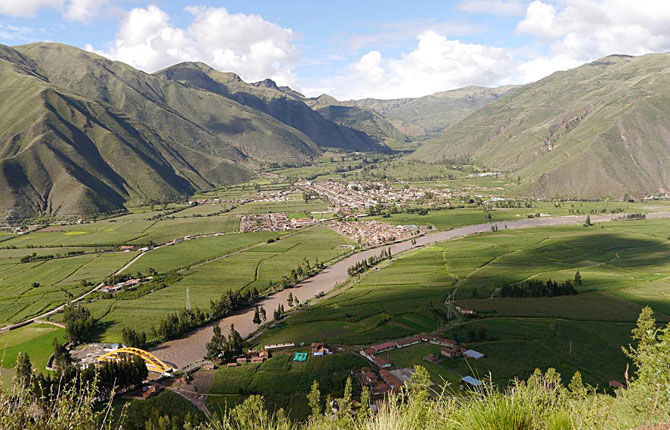
Her work Monday through Friday is running a hot lunch program for 300 kids – some of whom walk one to two hours a day to get to the town, nestled in a mountain valley, in the shadow of the Andes.
“I feel invested not just in the success of my workspace, but in the life and spirit of the community,” she said.
She also takes time to just hang out, such as going hiking with kids at 4 a.m. to pick flowers for their Holy Week flower rugs, or playing soccer in a threshed wheat field while dodging cows and sheep, and “getting schooled” by kids who are carrying younger siblings on their backs as they play.
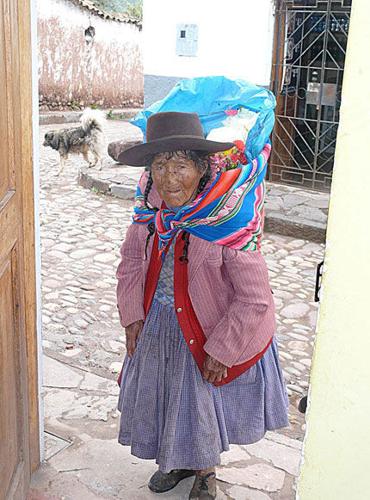
Harvest and faith are both critical to life in the Andes, and her agriculture-based town of 5,000 blends religious celebration with important dates in the growing season. For example, carnival marks the beginning of harvest, and holy week the end of it.
The Internet only came to her mountain town three years ago, and she’s had a front-row seat to watch the generation gap played out “so drastically” as Andean families face the “monumental challenge of assimilating their indigenous roots with the rapidly modernizing culture of the youth.”
Brady’s father, Phil facilitated the email interview with his daughter, and explained that it might take time to communicate that way, because Internet access was spotty at best.
“Before getting work done,” he said, “just living in the Third World is a full-time occupation. Every meal is prepared from scratch, everything we do by mail or online has to be done in person and usually includes a wait in line. When one says the pace of life is slower in the Third World, it means that there are lots of hassles that slow a person down.”
In this slowed down world, she has learned some things about herself, including that she loves working with kids.
She also sees parallels between her Peruvian village and The Dalles, where she worked cherry harvest, like her dad and granddad did before her.
“There’s something unique to a harvest town like Andahuaylillas or The Dalles where life is necessarily lived by the seasons.” That is particularly marked in Andahuaylillas,” she said, where every holiday matches up with some aspect of harvest.
She once helped a friend’s family in a ceremony where a local deity is asked to bless the family cornfields and provide a good harvest. “We decorated the fields with streamers and dyed flour,” she said. They threw fermented corn beer and wine from each cardinal point. This day takes place on Ash Wednesday, an interesting unfolding of tradition, she noted.
“Life is hard but the earth is generous, and you can’t get more spiritual than that,” she said.


Commented
Sorry, there are no recent results for popular commented articles.