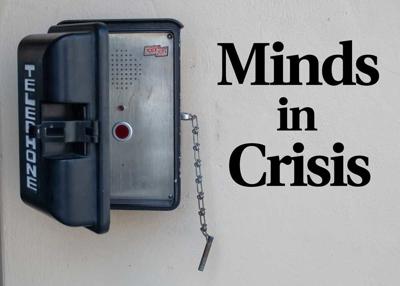
A pad phone at the entrance of The Dalles City Police station on Third Street provides 24-hour emergency contact with 911 dispatch for those without access to a phone.
A pad phone at the entrance of The Dalles City Police station on Third Street provides 24-hour emergency contact with 911 dispatch for those without access to a phone.
Mark B. Gibson photo
Part three of a four-part series looking at the impact of calls from the mentally ill on public safety resources.
As the mental health counselor at the regional jail, Steve Bradley used to hear inmates complain that they were arrested by police for “no reason.”
It piqued his curiosity enough that he wanted to get the police view, so he reached out to do some ride-alongs. His first ride was 10 years ago, but he began stepping up the frequency about three years ago.
Bradley, who works for Mid-Columbia Center for Living (MCFL), a regional mental health agency, noticed officers were asking a lot of questions about mental illness and how they could better help people who were mentally ill, help get them connected to services, and have better prevention strategies.
Bradley had attended a 40-hour crisis intervention training on de-escalating crisis situations and wanted to provide the training locally, but local police agencies had cost concerns.
Then a deputy with the Wasco County Sheriff’s Office, Chris McNeel, asked about it, and the first local training was held in early 2017. They have now done four in Wasco and Hood River counties.
The training also helps improve communication between police and mental health providers, Bradley said.
Where there might have been “finger pointing in the past,” said Al Barton, interim director of CFL, now its more of a “shoulder to shoulder view.” These days, instead of agencies seeing a challenge as belonging to someone else, it is “our” challenge, Bradley said.
Bradley has noticed that police and mental health counselors are “effectively different microcultures that have a different perspective on the world and how they deal with the world.”
Mental health is more process-driven, he said, and police are “very task-driven, call-driven. You can’t be on a call too long because you never know when you’ll get a call that’s a crisis that needs law enforcement.”
He said, “There’s definitely law enforcement that would never make good therapists and there’s definitely therapists that wouldn’t make good cops.”
But now, “we’re getting a better idea of how each other works, so we’re trying to bridge that cultural gap.”
In 2014, CFL got a grant and became an early adopter in Oregon of mobile crisis intervention, where counselors respond anywhere in the community to a mental health crisis, 24-7, wherever law enforcement wanted them. Mobile response is now a statewide mandate.
Previously, counselors would typically respond only to the hospital or the jail. Now, about 20-25 percent of all crisis calls are responded to out in the community, said Barton.
The grant helped boost staff from two crisis workers—one each in Wasco and Hood River counties—who worked until 5 p.m. (with after-hours calls divided among staff) to four crisis workers and a supervisor, Barton said.
Perhaps surprisingly, much of the work is not face-to-face crisis response, but arranging services for the person afterwards, he said.
Mobile response has had a clear and invaluable benefit, Barton said, resulting in a more rapid and collaborative response with law enforcement.
Barton has seen a noticeable improvement in CFL’s relationship with local police agencies.
He said sheriffs and police chief, “feel the collaboration or relationship has notably improved. That doesn’t mean there’s not challenges or strains.”
Also, for the last 18 months or so, law enforcement, CFL, Mid-Columbia Medical Center and the juvenile department meet monthly to discuss cases.
“These meetings have sometimes been intense because we have difficult people who are consuming time and resources,” Barton said. “It’s an avenue where we’re able to, quite frankly, fight and bicker about things as we work on problems.”
That helps them come up with some creative solutions where multiple entities can participate and help each other out, he said.
Those meetings have been the key to improved relationships, he said.
One curiosity is that while the police say calls related to the mentally ill have gone up significantly, Barton said CFL has not seen a dramatic increase in crisis responses. “How many times do we dispatch a crisis worker? Those levels have remained relatively flat,” Barton said. It has averaged around 90-100 calls per quarter since 2014. Annualized, crisis call-outs ranged from 362 in 2016 to 419 in 2015.
But he said the police can get called multiple times on a person before CFL is involved.
One thing that has dramatically decreased since the state made an investment in crisis response is the number of civil commitments of the mentally ill. “It used to be 15-20 hearings a year. Now if we get 2-4 that’s a lot,” Barton said.
As to what has caused the spike in mental health calls for police, Bradley said, “that’s a huge academic question.” It has many factors, including substance abuse, housing costs, the economy, and even social media.
He said the vast majority of crisis calls, about 85 percent, don’t need a hospital or acute psychiatric care. They can work with their family to create a safety plan. That can include removing weapons or medication, deciding how to respond to triggers, and involving loved ones to help monitor the person. Counselors then check in with the person a day later, a week later and a month later.
Part of the safety plan, Bradley said, might just be eating, if the person hasn’t eaten all day, or sleeping if they’re exhausted. It can also be taking time off social media if that’s what stresses them out.
Bradley likes to do ride-alongs with officers once they’ve had the crisis training to see if they have any further questions. On one such ride-along, they went to a call of a person in crisis. At first, Bradley spoke to the person in crisis, while the officer spoke to the spouse. Neither seemed to be getting anywhere, so they switched, and each achieved better rapport and were able to make progress.
“The officer said if he’d been by himself it would’ve taken an hour and a half, or he’d have called another officer,” Bradley said. But the two of them were able to resolve it in less time, and the person in crisis was safe.
Another officer used his new crisis intervention skills and “was able to deescalate the situation and he got a compliment from the civilian family,” Bradley said. “And nobody got arrested and nobody got hurt.
“We’re fortunate to have some pretty compassionate officers and deputies out there,” Bradley said.
He said, “officers are finding a little more job satisfaction because they’re leaving these calls less frustrated because of the some of the skills that they’re using, or because CFL is responding much more quickly.”
Barton said that early on they realized it took a bit of work to contact a crisis counselor. He credited Wasco County Sheriff Lane Magill with taking the steps needed to make that process easier. Now officers can access a pager and use a system called Everbridge that is “like a blast text message” to multiple people to get a response.



Commented
Sorry, there are no recent results for popular commented articles.