


Amidst hate, Maria sings, ‘I have a love and that’s all I have’
“West Side Story” is like a time capsule never closed or buried.
Its lyrics and rhythms move and entertain just as they did when it debuted more than 60 years ago, and its contents also disturb.
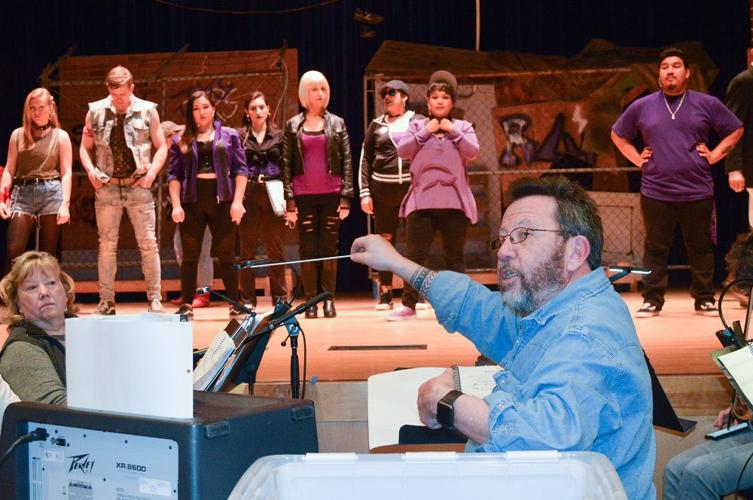
“It is fundamentally troubling that some of the more explicit themes, dialogue and language of the script sound as relevant now as they did in 1957,” Director Mark Steighner said.
Racial and class disparity and gender identity are timeless concerns that are dealt with outright or hover just below the surface.
“West Side Story” appeared on Broadway in 1957, the product of a creative team that included such luminaries as Leonard Bernstein, Jerome Robbins and the newly arrived Stephen Sondheim.
The Columbia Gorge Orchestra Association version of the tale debuted March 6 at Wy’east Performing Arts Center, and continues the next two weekends. (See Tickets and Times, at left, for details.)
“The show was innovative, challenging, shocking and not a big success,” Steighner said.
“It wasn’t until the film version arrived in 1961 that ‘West Side Story’ became a staple of American culture.
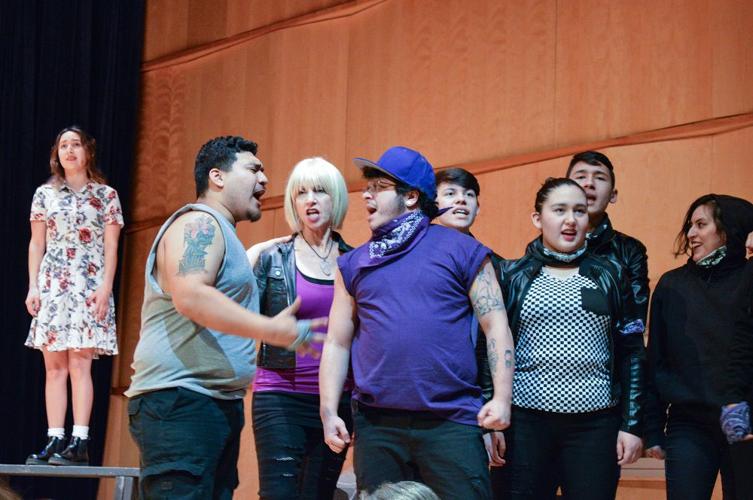
“It’s about people co-existing in the world and trying to live in the same space, which is a theme now,” said Gorge theater veteran William Thayer-Daugherty, who plays the central role of Riff, leader of the Caucasian street gang, the Jets.
Thayer was in the 2016 local production of “Romeo and Juliet,” the Shakespeare play “West Side Story” is based on, in the parallel role of Benvolio.
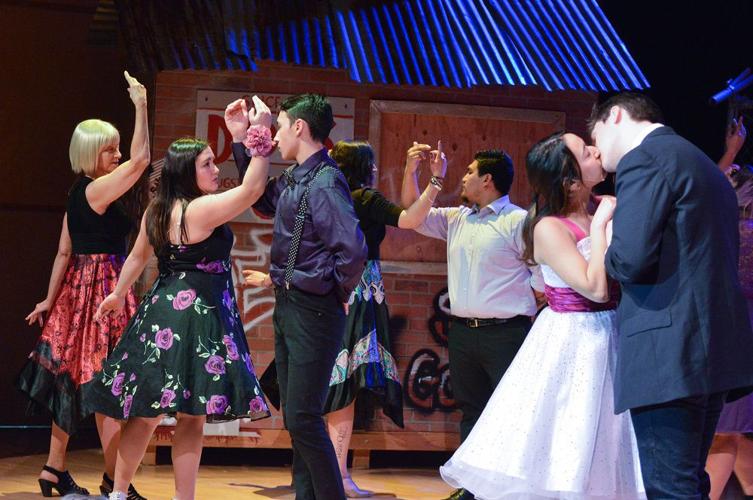
As the Jets and rival Latino gang Sharks, led by Bernardo (Nik Portela) vie for inner city turf, a secret love develops between Tony (Orville Grout) and Maria (Lily Galvez). The racial divide is what fuels the hatred that makes the love ill-fated — “star-crossed” as Shakespeare put it.
“Stick to your own kind,” her friend Anita (Amalia Vasquez) tells her in a key scene.
But love, tragically, prevails.
“This is something we’re dealing with still today,” Petrela said. “These kinds of issues, and it’s going to be interesting to see what the community has to say about us like embodying these stereotypes and is it harmful we’re doing something like this or does it shed light on the reality of where we’re living right now? It’s a really intense play for something so campy.”
Steighner said, “Over 60 years later, West Side Story still retains its capacity to challenge audiences to think about American attitudes around race, culture and our treatment of immigrants — in short, and sadly — issues that are still headline news and the topics of political rallies.”
“‘West Side Story’ is, like the Shakespeare play from which it draws inspiration, a love story first, but its context is an America that continues to struggle when asked to accept and embrace immigrants or those that are ‘different,’” Steighner said.
“Of course, at its fundamental level, ‘West Side Story’ is simply about conflict and misunderstanding, suspicion and tribalism and innocent lovers out of step or uncaring about the violence around them (as it was in Shakespeare’s original play, ‘Romeo and Juliet’).”
In his playbill notes, Steighner wrote, “As lyricist and composer Stephen Sondheim recently remarked, theater is an art form in which there is constant re-invention.”
Susan Sorensen based her choreography on Robbins’ original, but modified it for a less experienced cast; and dance captains Claire Rawson and Maza Brady (who are Jets members on stage) have helped to shape some of the dances and fight scenes.
Steighner said the musical “will always have a fundamental dissonance between the violence of the characters and story and the fact that they are — unrealistically — expressing their rage through stylized dance. It is simultaneously one of the most brilliant and least convincing aspects of the show.
“Our production of ‘West Side Story’ follows both the leads of the 2009 Broadway revival and the current Broadway production in setting the story not in the 1950s but in something like present day, with gangs that are a mixture of genders and speech that reflects several languages. We hope that we have found a respectful middle ground between tradition and making ‘West Side Story’ speak to, and reflect, our present moment.
“One important difference is that now, we probably don’t see the white Jets as the ‘good guys’ and the Sharks as the enemies. If we do the musical correctly, everyone should be equally responsible for the violence.”
The musical cast of more than 40 people large and, by necessity, diverse. It contains a large number of Hispanic members.
Portions of the dialog are done solely in Spanish, as well as the classic song “I Feel Pretty/Mi Siento Hermosa.”
“First, and most obviously, appropriate casting of the gangs in ‘West Side Story’ requires that the Sharks be predominantly — if not entirely — Hispanic. We are happily no longer satisfied using Caucasian actors in dark makeup (as the film did), and locally, our ability to stage the show depended on casting members of our Latino community,” Steighner said.
“Equally important, I — and CGOA — wanted to stage WSS as a sign of recognition and a calling card to our Latino population that maybe isn’t aware of CGOA or attend performances. CGOA wants to be an organization that embraces a diverse audience, whether we do this through programming, ticket incentives, marketing or on-stage participation.”


Commented