
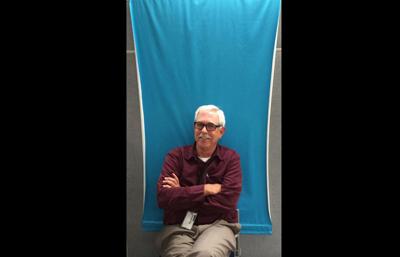
Think your job is tough? Try administering driving tests to newly minted 16-year-olds for a living.
“I’ve been involved in five accidents in driving tests,” said Randy Palmer, who has worked at the Oregon Department of Motor Vehicles for 25 years now and oversees 13 field offices in eastern Oregon. “All of my examiners have been in accidents.”
Actually, he noted, two of them haven’t, but they’re newer employees. The implication being: give it time.
He can go on.
“Sheared off a fire hydrant with a semi,” he recounted of one commercial driving exam.
He’s seen a row of mailboxes go flying.
“I’ve walked back before,” he said. “Had them pull over to the curb, got out and said, ‘That’s it, we’re done. We’re walking back.’”
And this: “I grabbed the steering wheel one time. We’re trained not to do that but reflex and self-preservation took over.”
But, to provide perspective, he also noted that he’s administered 10,000 driving tests, so a handful of accidents — all of which he walked away from — is really nothing in the scheme of things.
“The close calls are worse than the accidents. Many, many, many of those,” he said.
Palmer is a customer service manager who is based out of The Dalles and Hood River. For all the paperwork the job entails, the sometimes grumpy customers and the reams of regulations they have to know — and scary driving episodes — the best part of the job is still the people, he said.
When it really gets rolling and busy, “You can really have some fun.”
All walks of life come through the door, because everybody will need something from the DMV at some point: A driver’s license, an ID card, registration tabs for their vehicle.
He tells his employees, “We are the face of state government. We are the ones they see.”
He’s impressed others with his ability to read people, but he attributes it to his years on the job.
He can tell from looking at a person as they’re sitting in the waiting area whether he can be jocular with them or should just stick to business.
On a driving test, he can tell within one mile whether it’s going to be a bumpy ride.
Once the state started requiring permit holders to log 100 hours of driving before taking an exam, examiners saw an “almost immediate improvement” in the driving skills of test takers, he said.
Even so, about 25 percent of drivers still flunk. It’s just that the drivers who pass are even better drivers now, he said.
He’s had people swear to him that they’ve logged the required hours — which are on the honor system and are attested to by the youth’s parent or guardian — and it’s quickly obvious that they’ve done nothing of the sort.
There are two driving test routes — and both are secret. The test takes about 30 minutes. They won’t administer tests on icy days, although some people still try to be tested on those days.
He’s looking for observational skills. “Can you avoid getting hit by that car coming off that side street?”
They don’t test parallel parking skills. “That went by the wayside 30 years ago. It became an unnecessary skill” because of the widespread switch to angled parking, for example.
In a testament to the busy-ness and potential wait time at the DMV, the waiting area is ringed with chairs.
On a recent afternoon, it wasn’t quite half full. A baby was squalling and a toddler was marching around entertaining others. A man began to play peek-a-boo with her, and she squealed with delight.
Earlier, a reporter entered and walked up to the counter. Before she could speak, an employee said, “You need to take a number, ma’am. Other people are in line in front of you.”
Palmer said that line is delivered daily by DMV staff. “The problem child more than those folks is the one who has a quick question between customers. There is no such question,” he joked.
Flared tempers are rare, he said, and, perhaps surprisingly, those most likely to raise a fuss are older folks. Their ire arises when they learn about the system the state switched to in 2008, which requires they provide proof of legal residence in the United States.
For most people, that will be a birth certificate or passport, Palmer said. “People think it’s going to be way, way more difficult than it is.”
Sometimes, folks tell him they’ve served in the military, and that should darn well be proof enough. “I have to remind them there’s no requirement to be a U.S. citizen to serve in the military.”
The upside is, once a person’s legal status is confirmed, in almost all cases they will never have to provide that proof again.
That’s because the driver’s license photo literally becomes the proof of who they are, courtesy of facial recognition technology.
That famously bad driver’s license photo we all love to hate actually contains over 20 identifying measures — like the distance between your eyes, for example — that are used to uniquely identify each person.
The facial recognition technology also means people have to take their glasses off for the photo, which is also unpopular.
Palmer acknowledges “we will never be known for our photos.” But, in his defense, he said, “We tell you when we’re about to take the picture. We want you to smile. We want you to present your best face.”
He will especially razz the teens, sometimes telling them, “’Are you going to give me the criminal look or a decent one?’”
The state has 10 million photos in its database, and each new photo is compared with the rest of the database to ensure there isn’t already another name attached to that face.
“That’s why you don’t get your driver’s license right away anymore,” he said.
As for the potentially touchy issue of declaring your weight, the DMV lets it slide if you fudge a bit. But “If we are talking an enormous amount of weight we might ask if there are any changes in weight that we may have missed,” Palmer said.
Ouch.
Ironically, for all the fun Palmer has in his work, state rules to prevent corruption or collusion means he can’t come in as a customer for a transaction at a DMV office.
“I do all mine online because I can’t do it in any of my offices.”


Commented
Sorry, there are no recent results for popular commented articles.