
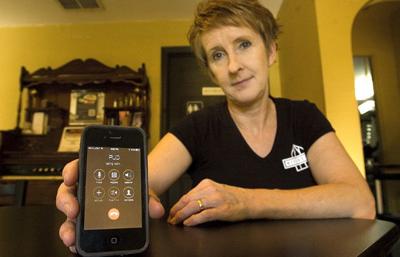
The PUD has been telling its customers that one way to ensure they’re not being scammed when someone calls seeking money is that legitimate PUD personnel will show up as the PUD on their phone’s caller ID.
But last Friday, local business owner Molly Ott faced a sophisticated, persistent scam artist seeking nearly $1,000 and initially believed him because the number that came up on her phone when he called showed it as the local PUD.
Kathy McBride, executive assistant/media manager for the Northern Wasco PUD, said, “we’re quite alarmed” by the sophistication of the scam. In a press release, the PUD said, “Today’s technology makes it possible for scammers to use a fake number on the caller ID — in this case they used the PUD’s telephone number.”
If the PUD calls a customer, they will know their name, account number and account balance. They will never demand payment only by cash, credit card or prepaid card, or demand that the caller go to another location, such as a local store, to make payment.
Ott’s employee at her business, the Riverenza, answered the call Friday at 3:15 p.m., and was told the local PUD was calling to tell them their account was delinquent and they needed to go use the Western Union location at Rite Aid to pay $998.31 within 15 minutes or their power would be shut off.
The employee handed the phone to Ott’s husband, Greg, who heard the same spiel. Greg handed it to Molly, who heard the spiel all over again. “And I said, ‘How am I going to make an instant payment in 15 minutes?’ And I said, ‘I’m pretty sure I paid my bill, you must have the wrong address.’ And he said, ‘No ma’am, it’s your address, and if you don’t pay, your power will be shut off in 15 minutes.’”
Because the number came up as the PUD, she took it seriously, and went to get her bank records. She found proof that she’d paid, and told the caller. But the man, who had an Indian accent, was insistent, and Ott started to get suspicious.
Finally, she offered to drive to the PUD to show her bank statements. The man told her there wasn’t enough time, because it was Friday afternoon. When the man told her to go to Rite Aid and use Western Union to send the money, “that’s when I knew it was a scam.
“I said, ‘that’s crazy, I am not driving over to Rite Aid and putting $1,000 into a machine,’” she recounted.
At one point, she asked the man, who gave his name as Terry Howard, to talk to his supervisor. A male voice came on the line, again with an Indian accent, and said his name was Joe Wagner.
She believed it was the same man, since they sounded exactly alike.
In all, the man called Ott three times. “He kept calling us back. I finally kept him on the phone and [decided] I’m going to drive him over to the PUD right now.”
She told the man to call back on her personal cell, and kept him on the line while she drove.
She asked, “’Will I be able to meet you?’ He said, ‘Yes ma’am.’ And I said, ‘Ok, what office are you in?’ He said, ‘I’m on the fifth floor.’ And I said, ‘Oh, that’s interesting, our PUD is only one level.’ And he said, ‘No ma’am, you’re mistaken,’ and I said, ‘I’m pretty sure you’re trying to scam me.’”
At the PUD she got the office manager on the line with him. The man seemed to think it was still Ott, and again gave the woman his spiel, not realizing he was talking to a PUD official.
The manager, while pretending to be Ott, said she had to check with her husband first before making the payment. He spent some time on the phone with her, and she eventually hung up after calling him a liar.
So the man again called Ott’s husband and gave the spiel all over again.
After leaving the PUD, Ott drove to Rite Aid, where a manager told her that another woman came in that day to put money on a pre-paid card, because she’d been told if she put $200 on, she’d automatically get $2,000 back. An employee convinced the woman not to make the transaction.
“He said he would tell all his employees to be on alert if anybody came in to get money on Western Union,” she said.
Ott has heard of two other people locally who also were told they’d have something shut off if they didn’t make an instant payment. One was told their Internet would be shut off.
Ott was also given an 800-number to call during the scam. When she called it, it was a sophisticated sounding automated system with an American female voice.
The extension number given took people to the utility disconnect department.
The Chronicle called the number Tuesday but it was not in service.
“I probably should’ve hung up on him, but he was so persistent. He just didn’t ever waver, that was the weird thing. He just stayed so consistent,” Ott said.
“I had just reconciled my checkbook that morning and otherwise I would’ve thought, ‘Oh, maybe I did miss a payment.’ But $998, that’d have to be at least two months.”
“If I had been somebody who didn’t take care of his bookkeeping and I was really sloppy about it and the guy didn’t have an eastern Indian accent, it might’ve been tempting,” she said.
The PUD asked that anyone who receives a suspicious call write down the individual’s name, the phone number from your caller ID and the number you are asked to call with your payment.
Then call local police at 541-296-2613 and the PUD at 541-296-2226 to report the incident.


Commented
Sorry, there are no recent results for popular commented articles.