
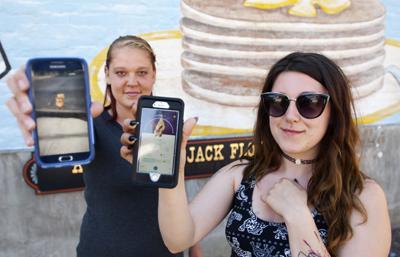
Anyone over a certain – rather youngish ─ age is probably baffled with the sudden international phenomenon that is the virtual reality game “Pokémon GO.”
But not CheyAnne Lynn. A lifelong Pokémon fan, the 21-year-old The Dalles resident said, “I got it literally three minutes after it launched in the United States. That’s how long it took it to download.”
That was clear back on July 6. In the mere week since, as Pokémon has taken over the airwaves and social media feeds, she’s been playing the game practically every waking minute.
“I just got a Pokémon while walking in here,” she told a reporter as she came for an interview at the Chronicle.
For the uninitiated, she likened the game to geocaching, the activity where people use GPS devices that provide map coordinates in order to pinpoint the location of physical items that have been stashed someplace by others.
With Pokémon GO, the GPS Google Maps feature of a user’s phone is utilized to find virtual Pokémon, the fantastical creatures that populate the Pokémon universe.
The creatures are scattered all over, indoors and out, and the best way to find them is by walking.
“You can’t play it sitting on your butt,” Lynn said. “Since the game came out I’ve done probably over 30 miles.”
She said, “What I like is you don’t have to buy anything, you can earn everything, and you literally have to walk around.”
While some have criticized the game as being anti-social, that couldn’t be further from the truth, she said. “You have to be social to play it.”
She’s added 100 Facebook friends in just the last few days. “I’ve always considered myself a social person, but this is just amazing.”
A user’s phone vibrates or dings when they get near a Pokémon. At a certain point, as you get nearer the creature, the game asks if you want to switch on your camera for a real-time view. That’s when the game gets weird, and a mundane real-life image, say of a countertop in a break room, suddenly has a virtual creature overlaid on it.
As Lynn spoke to a reporter, she found a Pokémon “sitting” on the reporter’s leg. “It’s right there!” she said excitedly.
The objective is to capture Pokémon – there are 152 in this game – then grow their strength, or combat power, by finding more of the same type of creature, or finding more powerful creatures, and then do “battles” at “gyms.” There are three teams, red, blue and yellow, and each vies for the right to own a gym. Gym ownership can and does change hands.
To capture a Pokémon, you have to throw a “pokéball” at it, and the game gives first-time users a few pokéballs to start out with.
The “toss” of the pokéball is done by a swipe of the finger, and it’s easier said than done.
Ashley Almas, 24, is also a fan of the game, but newer to it than Lynn. She had to throw 27 pokéballs to capture just one creature, a Meowth.
As a reporter was interviewing Almas, she ignored a question, so the reporter asked, “Are you playing Pokémon right now?”
“Yes,” came her sheepish reply.
Once captured in a pokéball, the creature fits in your pocket – Pokémon is a shorthand for “pocket monster” – and then you can pull them out and release them to attack other people’s Pokémon, Almas said.
While the Pokémon GO game is free – it topped 15 million downloads Wednesday in the United States – users can buy items that make their Pokémon more powerful.
But Lynn sniffs at such things. “I refuse to spend money on it. I’m good. I’m good at it.”
Players can be found around town gathered at gyms or “poké-stop” locations.
A poké-stop is a place to gain pokéballs and other useful things, and is usually a well-known public location, such as a city hall, library or park. Poké-stops are updated daily, Lynn said.
One person back east said she lives above a poké-stop and has watched people repeatedly crash into a lamppost as they stare intently at their phone.
Lynn has run into things playing the game, and almost ran into the door of the Chronicle as she came for an interview, so absorbed was she in capturing a Rhyhorn.
As Lynn stood across the street from the Chronicle talking to a reporter, a group of teens walked by on the opposite sidewalk, with the giveaway stance of walking while holding their phones in front of them.
Lynn yelled across the street, “Hey, are you guys playing Pokémon?”
“Obvee!” came the hip response.
She learned they were on the same team and she gave a whoop.
The game gobbles up data and power on phones. Lynn has used six gigabytes of data in the last week, and that’s her monthly allotment. “The only thing I like about playing here vs. Hood River is The Dalles has wi-fi.”
For power, she invested in two portable chargers specifically to play Pokémon GO. “I keep them in my bag at all times.”
Lynn was born in 1994, the year Pokémon was introduced. She got her first Pokémon plushie as an infant, and has been obsessed ever since. She said it served as her safety blanket throughout childhood as she endured a toxic home life.
Wandering around town – or in an office setting -- if two people happen upon the same Pokémon, they have to fight to get it, Almas said.
Another aspect of the game are “eggs,” found at poke-spots, in which a creature can incubate to become more powerful. The incubation period requires a certain amount of walking. Almas has to walk five kilometers – 3.1 miles – to release the egg she has. Lynn has an egg that requires walking 10 kilometers to release.
And that’s another thing: Americans are having to familiarize themselves with the metric system to play the game.
Stories already abound about the real-life instances that have occurred from people playing Pokémon GO. Lynn heard about a girl back east who found a dead body while looking for Pokémon in a wooded area.
Another story was about a father and son who were pulled over by police because a girl was afraid they were stalking her by constantly driving by her home. The dad explained to police he was circling the block to look for Pokémon.
A player in Forest Grove was stabbed while playing, but ignored the wound to keep Poke-hunting.
In a more sinister bent, players can add “lures” to certain areas to draw other players. Some players did that, in a remote location, and robbed 12 other players who showed up to their lure spot.
The players are even cropping up in The Dalles police report, with one officer noting the other day that a group of people he spotted wandering around town at 3 a.m. were playing the game.
The game is so popular that it constantly crashes.
At one point, as Lynn intently stared at her phone, she blurted out an excited, “Ohhh yesss!” A reporter asked if she caught something, and Almas replied, “No, my server came back up.”


Commented
Sorry, there are no recent results for popular commented articles.