The fire district recently bought the first two of its seven fire apparatus that voters approved in a 2016 bond. It also recently acquired a foam trailer should another incident like the oil train fire in Mosier arise.
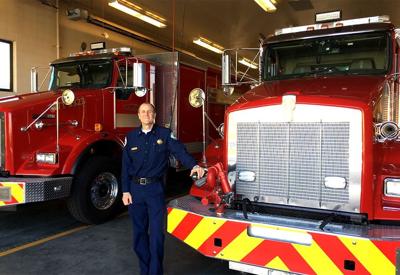
Purchased in August for about $375,000 each were two 3,000-gallon water tenders, said Bob Palmer, chief of Mid-Columbia Fire & Rescue. They replace a 1991 Kenworth and a 1993 Kenworth.
The district also got a $297,273 grant to offset the cost of one of the tenders, he said.
MCF&R donated one of its old tenders to the Dallesport Volunteer Fire Department and is auctioning off the other one.
Voters approved a $3.85 million bond to buy seven new fire apparatus and two ambulances, and also do some maintenance to the fire station and grounds.
Water tenders supply fire apparatus in rural settings, and essentially takes the place of a fire hydrant. It is known as a mobile water supply, Palmer said.
Tenders can carry as little as 1,500 gallons and as much as 5,000 gallons. The district went with something in the middle of the pack. “You need something you can still get around in and still have an ample water supply,” Palmer said.
Still to be purchased are two structural engines to fight structure fires, one ladder truck, two wildland engines, and also two ambulances. All have been ordered and will be delivered in the next three to nine months.
Already completed are maintenance jobs, including repainting the main fire station on Webber Street, pavement sealing and striping the west parking lot, adding a new layer of asphalt to the south parking lot and training area, and installing an oil/water separator at Station 2, located in Columbia View Heights.
In the event of an oil leak from a vehicle, separators allow water to wash away the oil down a drain, but the separator captures the oil so it doesn’t go into the wastewater system.
Still to be completed is buying new mesh metal lockers for turnout gear, to replace old wooden lockers that are in disrepair and could pose mold problems. “We want well-ventilated lockers that don’t draw mold and mildew,” he said. He’s not sure if there is a mold problem with the lockers, but said, “We haven’t torn them out to see.”
About 40-45 lockers are needed.
The fire district had to wait almost a year for the old bond that paid for building the fire station to be retired before it could issue the new bonds and begin purchasing equipment.
The new bond has a 16-year term and was estimated to come in at 21 cents per $1,000 of assessed property value, but ended up costing just 17 cents per $1,000, a nearly 20 percent lower rate.
The $90,000 foam trailer, on permanent loan to the fire district, has a 270-gallon supply of foam which is used to blanket oil to extinguish an oil fire or keep one from starting, Palmer said. Union Pacific maintains the trailer,
It has fixed and mobile nozzles, lines of hose, and two portable tanks that each hold 3,000 gallons of water. It also has a pump and a generator to run it.
The trailer was provided to the fire district through a partnership between the fire district, UP and the Oregon State Fire Marshal’s office, Palmer said.
The fire district also got a $128,000 grant, which required just a $6,400 match, to install apparatus exhaust removal systems for all 17 pieces of apparatus at Station 1 and three at Station 2.
A hose runs from each exhaust pipe to the ceiling. The exhaust removal mechanism automatically kicks on when the engine starts, and the nozzle connecting the hose to the exhaust pipe automatically disengages when the vehicle leaves the fire bay.
Palmer said, “When the guys start the rigs out there, you can smell it,” even in the offices next to the fire bays. Nobody has complained, he said, but “It’s not healthy.”
The fire district previously had a filter system attached to exhausts, but they didn’t remove all the particles.



Commented
Sorry, there are no recent results for popular commented articles.