
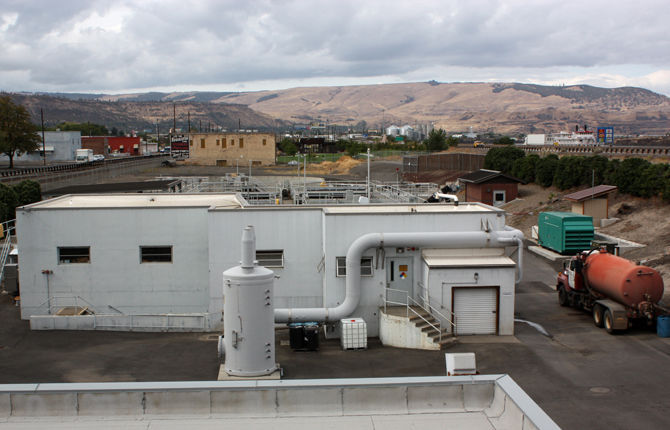
The price tag for substantial improvements to the city of The Dalles’ wastewater treatment plant may be getting smaller.
In 2013, a series of expensive plant upgrades were identified in the city’s Wastewater Facilities Master Plan. The plan evaluated capacity, impacts of regulatory issues, and the community’s projected residential, commercial and industrial growth needs for the next 20 years.
Upgrading the nuts and bolts of the wastewater treatment infrastructure came with an initial price tag of roughly $13.1 million.
According to Dave Anderson, director of the city’s public works department, a three-phase capital improvement plan was proposed for the facility over the next 10 years. The first part of the project – which has an initial overall price tag of roughly $8.7 million – is geared to increase the capacities of the plant’s pumping and screening systems and build backup systems for critical plant operations. A co-generation plant will also be built.
“Different portions of the plant have been built at different times over the decades,” said Anderson. “The oldest part, which includes the pump station that is part of this project, was built in about 1937. The 2013 master plan recommended building an all new pump station, but one of the ways we’re trying to save money is to refit the existing building with larger pumps rather than build new.”
Although inflation and other fiscal changes could alter the numbers, a second round of upgrades was initially pegged to cost around $4 million. Phase two called for a second clarifier — a settling tank for removal of solids — sludge thickening systems and a sludge storage tank.
However, Anderson said phase one improvements will blend in some of the enhancements and eliminate the need for other improvements that had been scheduled for the second and third phases. As a result, Anderson projected the cost of phase two — the design portion of which is expected to get started in about two years — is more likely to be approximately $2.5 million.
A third phase of the 10-year capital improvement project would entail building a new administration building for the wastewater plant, as well as new lab facilities and additional aeration basins. But Anderson pointed out that the Dalles City Council wants to revisit phase three, and it’s possible phase three will be deferred as a way to cut costs.
“The council wants to have more discussion on that part of it (phase three) before we actually build it,” Anderson said.
When first envisioned, the upgrades were expected to be paid for by issuing bonds — and a corresponding series of rate increases were scheduled to pay them off. Customers of the city’s wastewater utility were originally going to see annual 3.4 percent rate increases, from 2013 through 2022, to pay for the infrastructure renovations.
The city anticipated issuing three bonds over a 10-year period to pay the costs because it provided the lowest rate impact to the city’s customers. But Anderson pointed out that since then, annual inflation rates have been less than anticipated, while wastewater flows have increased more than projected.
The combination of the beneficial rates and increased revenues allowed the city to cancel planned rate increases that would have taken effect in 2015 and 2016.
“All the rate increases were based on paying off bonds,” said Mayor Steve Lawrence. “Now we don’t have to do bonds. There will be much less impact on ratepayers, if any.”
Another major alteration in the scope of the project came about when a pilot program determined earlier this year that co-generation of electrical power from methane gas production at the site was feasible. The cost to add the co-gen capabilities to the project was estimated to be about $2.2 million, but the city may be able to recover those costs.
“We are pursuing outside funding from the Oregon Department of Energy and possibly the Oregon Department of Environmental Quality to help pay for the co-gen plant as developing a renewable source of energy,” Anderson said.
Councilor Tim McGlothlin said revenue from the co-generation could possibly cover the cost of the project.
“Reclaiming lost methane gas to produce electricity will save approximately $350,000 per year,” he explained. “This electricity is used to power high energy ultraviolet lamps that kill bacteria before re-entering the ecosystem. We hope to generate enough electricity for it to pay for itself. How cool is this?”
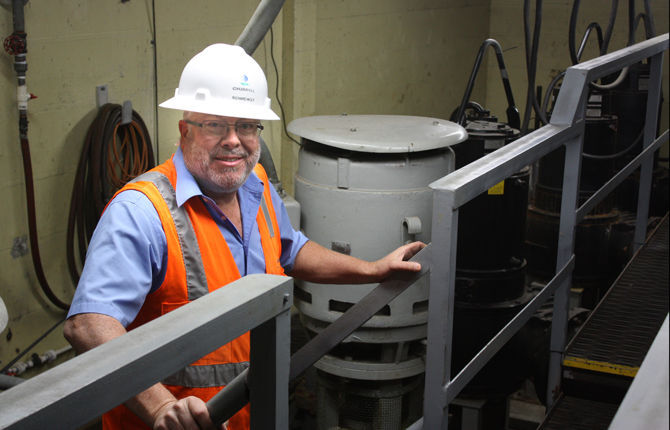
According to Richard Wolf, project manager for CH2M Hill — the company contracted by the city of The Dalles to operate the wastewater plant — improvements to the plant are needed to bring it up to health, safety and environmental objectives required by the federal government.
“Much of the project is regulatory-driven,” said Wolf. “We’re upgrading to meet redundancy requirements. Right now, we can meet peak flow demand, but we need all the pumps to do so. So if something goes wrong, we have potential for a violation.”
He explained that if a pump or two were to fail at the wrong time, sewage could go into the Columbia River.
McGlothlin added that in 2015, a “design-build” contract was awarded to the team of Mortenson Construction/Kennedy Jenks Consultants for the wastewater system upgrading project. Design-build is where both the design and construction services are contracted by a single entity, another significant factor in cutting costs.
In another development related to the wastewater project, The Dalles City Council voted 4-0 on Sept. 12 to add $327,503 to the overall project costs to pay for a stretch of new pipeline that was recently identified as inadequate for the anticipated volumes the plant is expected to handle.
“A portion of the existing pipeline from the effluent pump station to the plant headworks is too small to handle the flows that will result from the new pumps,” explained Anderson.
Some of the existing pipe is 18-inches in diameter, and to boost capacity, about 200 feet of the old pipeline will be replaced with pipe that is 24 inches in diameter.
According to Anderson, the funds approved by the city council on Sept. 12 will pay for the engineering services to design the new pipeline as well as the co-gen systems.
Construction is expected to begin next spring. Once it starts, completion of the upgrades is expected to take about 10 months.
When finished, Wolf said the upgrades will make a big difference.
“The systems will be better, more efficient, and require less maintenance,” he said.


Commented
Sorry, there are no recent results for popular commented articles.