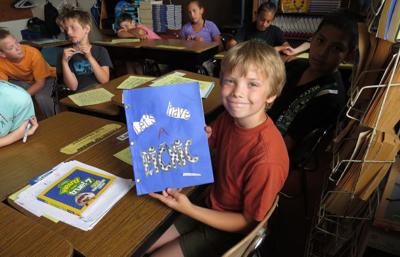
Layne Ellison planned a Memorial Day picnic for 14 people of varied ages that included catering so the family would not have to work too hard and rented tables to make service easier, for a total cost of $305. His was not the highest bill in the real-world math lesson given by teacher Steve Chance that included multiplication and fractions to figure out the number of servings.
Layne Ellison planned a Memorial Day picnic for 14 people of varied ages that included catering so the family would not have to work too hard and rented tables to make service easier, for a total cost of $305. His was not the highest bill in the real-world math lesson given by teacher Steve Chance that included multiplication and fractions to figure out the number of servings.
Fifth-grader Lindy Taylor decided to add two pools to her shopping list for a Memorial Day picnic, bringing the cost to feed and entertain 14 people to $405.
“I was planning for a warm day,” she said about the math lesson given to her Colonel Wright Elementary class by teacher Steve Chance. “I was really nervous about it because I thought I was going to mess up on the math, but once I got going, it was a lot easier than I thought it would be.”
Layne Ellison decided it would be too much work to get ready for a large gathering of mixed ages, so he hired caterers, and also rented tables, bringing his bill to $305.
“I hired someone to do all that stuff because we’re too lazy,” he said. “I tried to be really creative with this.”
The challenge Chance gave students was to look at grocery ads for Memorial Day —everything purchased had to be advertised — and put together a party for friends and family.
“They had no particular budget, but they had to track all expenditures,” he said.
Students were required to include barbecue ribs and corn in the menu because these are traditional favorites, and some type of soda for a beverage.
Jasmin Elias was much more frugal on her planning efforts than Taylor and Ellison.
The bill for her party — itemized in a well-organized spreadsheet — came to about $155.
“I liked it a lot, it was fun,” she said of putting together the shopping list and preparing a report that included a custom-designed cover.
Some of the students added dog food to the list in order to accommodate furry guests.
Others, like Naomi Heredia, focused on the extras, like watermelon and a veggie tray.
Taj Kjenslee added not only the standard bags of chips and potato salad, but Goldfish crackers and A1 Sauce to please even finicky palates.
Students agreed that real-world math was much more interesting than just studying a textbook.
And that was exactly the point, said Chance.
“I’d rather show kids how they can use math,” he said. For example, he said students deciding to add ice cream, or another food item that would be shared by the group, had to figure out servings, which required them to use multiplication and fractions.
They also had to prepare for people who might want a second helping.
Hot dogs turned out to be a puzzle, since there are eight buns in a package but the wieners often come in a 10-pack.
Chance has lessons in other areas of education that are equally appealing to students.
As an example, they are given the geometry challenge of redesigning his backyard using a grid of circles and rectangles, this time with a spending limit of $1,000.
Finding ways to incorporate lessons into living, he said, is good for students and fun for him as an educator, because of the excitement these projects generate.
“One of the nice things about these types of projects is that kids at any level can be successful,” Chance said.



Commented
Sorry, there are no recent results for popular commented articles.