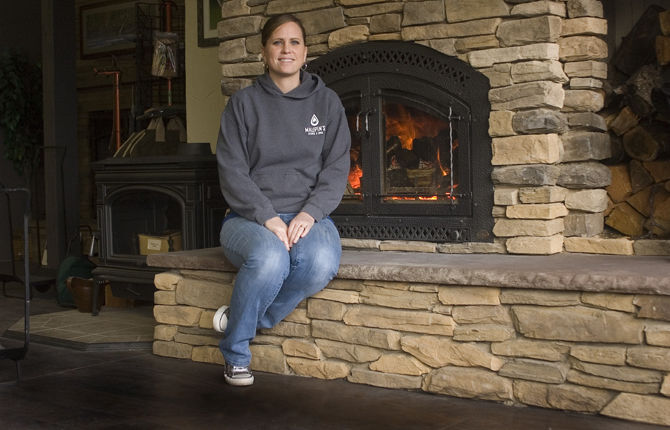
Lori Bonham, co-owner of Maupin Stoves and Spas, sits on the hearth of a 0-clearance fireplace at the store. The fireplace is designed for modern homes without a masonry chimney, and is made with two-by-four construction and a chimney pipe.
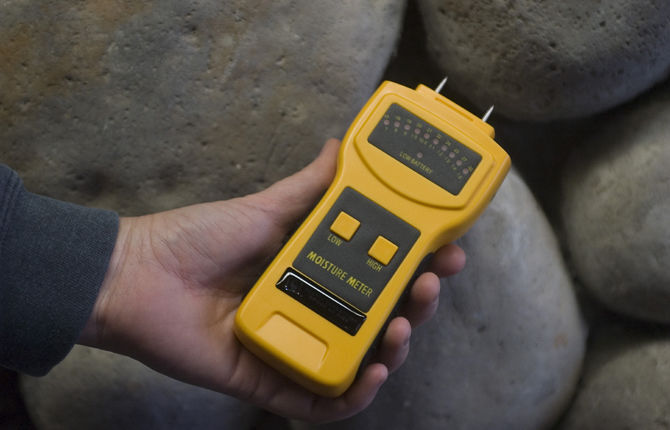
Lori Bonham, co-owner of Maupin Stoves and Spas, displays a moisture meter, designed to assure homeowners that the wood they are burning is truly dry, which helps reduce soot buildup.
Lori Bonham, co-owner of Maupin Stoves and Spas, sits on the hearth of a 0-clearance fireplace at the store. The fireplace is designed for modern homes without a masonry chimney, and is made with two-by-four construction and a chimney pipe.
Mark Gibson
Lori Bonham, co-owner of Maupin Stoves and Spas, displays a moisture meter, designed to assure homeowners that the wood they are burning is truly dry, which helps reduce soot buildup.
Wood burning stoves have long been admired for the quality of their heat and the atmosphere they create as they radiate a comforting circle of warmth within the home on a cold winter day. But like virtually any home heating option, wood stoves are not without their hazards, as a chimney fire can quickly destroy or damage a home.
It's a disaster that doesn't need to happen, said Lori Bonham, co-owner with Daniel Bonham of Maupin Stoves and Spas.
The first step to burning wood safely is an annual chimney cleaning. “With any wood-burning appliance, it’s recommended to have the chimney swept annually because of the particulate matter, or creosote, that's produced,” said Lori Bonham. “Once you have an accumulation of creosote, it can catch fire,” she added.
Proper operation is also important, to reduce the amount of creosote that builds up in the first place. “The biggest thing we see is incorrect venting and improper clearance,” she explained. If you are installing the stove yourself, you need to follow the correct procedures and have the stove inspected, she explained.
In Wasco County, inspections are done by the Mid-Columbia Council of Governments, which will make sure the installation meets building codes as part of a mechanical project permit.
A mechanical project consists of work on heating, cooling and ventilation systems, including bath vents and wood stoves. It also includes installation, alteration or repair of gas piping between the meter or liquid petroleum gas (LPG) tank and equipment. The State Fire Marshal's licensing law requires anyone, including homeowners, who install, extend, alter or repair any LP gas appliance or piping, vent or flue connection to be licensed through them.
Incorrect venting is a matter of usage. “If you continually dampen the stove down (reducing the amount of air to the fire), more creosote will accumulate,” Bonham said. It's important to burn the stove “wide-open,” with a full measure of air reaching the fire, every week if the stove is in daily use. “It will preemptively burn out the accumulated creosote,” she explained.
Catalytic stoves, which pass gasses through a secondary converter that looks something like honeycomb, accumulate creosote more quickly than other stove types, she added. “They are designed to burn at lower temperatures,” she said. With regular cleaning, a catalytic style stove is a good idea, she noted. They are extremely efficient, using less wood -- as much as two thirds less in a season -- to put out the same amount of heat.
The catalytic stoves can still be burned hot each week to burn out accumulated creosote, she noted, pointing out how the stoves are designed with a lever that bypasses the converter and lets the stove burn wide open.
Another common source of excessive creosote buildup, with its risk of chimney fire, is burning wet or unseasoned wood. “Burning seasoned wood will decrease creosote buildup,” she said. Often, when a customer feels their new stove isn't heating the home well enough, green or wet wood is the culprit.
“We can measure the moisture of the wood,” Bonham said. “People think their wood is dry, but it isn't.”
The Bonhams sell a moisture meter – it has two sharp probes that can be inserted into a piece of firewood to measure the internal moisture – for those who want to check how dry their own wood really is.
In addition to having the stove cleaned annually, burning “wide open” once a week and using dry wood, other products are available to help clear out creosote. They can't be used with a catalytic converter stove, but “creosote sticks” will help remove built up creosote.
With proper care, a chimney fire need never happen, Bonham said, but if the stove or stovepipe is red hot, it's important to shut off air to the fire, leave the house and call 911 from outside the home.
But it needn't happen, she added. “The real key is an annual cleaning by a licensed chimney sweep. That's the real key.”



Commented
Sorry, there are no recent results for popular commented articles.