

Transients in The Dalles are becoming more numerous and more visible, police officers say.
Longtime officers with 20-plus years on the force say the problem is much more notable than earlier in their careers.
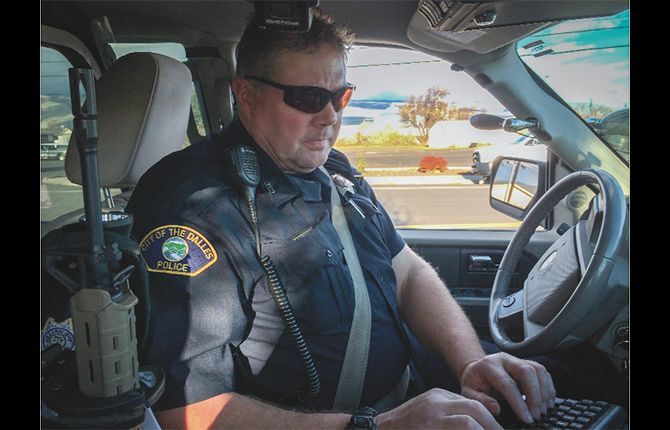
Officer Brent Larson, who joined the department in 1995, said he’s seen an uptick even in the last five or six months.
Larson estimated there are a handful more transients than half a year ago. “Let’s just say that you have five more people in your community that have mental health issues or a history of mental health issues. That can really amp up the call load,” he said.
Transients who fall in the category of having mental health issues “talk to themselves and cause problems and they have an arrest record that’s lengthy and they become problems,” Larson said.
One possibility for the increase in local transients may be found when talking with Officer Chris Simonds. He said he’s asked four transients in the last two months how they got to The Dalles and all of them told him “a bus ride from Portland.”
Portland’s “Homeward Bound” program, begun last May to address the homeless problem by offering them rides out of town, has been controversial. Portland officials have said the program only provides transportation when they verify the transient has family or friends in the destination town who are ready to meet the transient and help them get on their feet.
Simonds thinks social media has played a role in getting the word out for transients to come to certain locations.
Another officer, Josh Jones, talked to a woman who told him she went to Hood River, and within an hour, was given taxi money from city employees to come to The Dalles.
The woman has had numerous police contacts, including arrests, since arriving in The Dalles, including getting rousted from sleeping in the Commodore and, most recently, the post office.
Officer Jeff Kienlen has had homeless people tell him other police agencies have dropped them off in The Dalles because it had a warming shelter.
Other times, it can be an unexpected drop-off in town. Larson said one recent homeless resident got kicked off the Greyhound bus here and ended up staying.
Over the years, Kienlen has asked people how they became homeless. None listed a lost job, or corporate downsizing, he said.
Rather, he said, the invariable story is that, through their own poor life choices, they burned all their bridges and eventually had nobody to stay with, so they ended up homeless.
Jones said the poor life choices often include drug use at an early age, not finishing high school, then ending up with numerous arrests and finally homelessness.
With mentally ill people, though, it is hard to get the story of how they became homeless, Kienlen said.
Drug and alcohol use and mental illness are the main factors, but there are also instances of just bad luck.
Larson recently had to roust a man and his two teenage sons from a spot by the public pool. They had been heading home to Florida when their car broke down. They can’t afford to repair it.
Larson saw they were unprepared for the weather, so he went to Salvation Army and asked if they could help. They gave him coats, sleeping bags and pads for the stranded trio. He gave them the supplies and took them to another location, where they remain.
The 16-year-old son, Dylan Bozeman, said his family has never been homeless before.
Larson said officers are expected to treat transients with dignity and respect. “I frankly oftentimes think – what if that was me?”
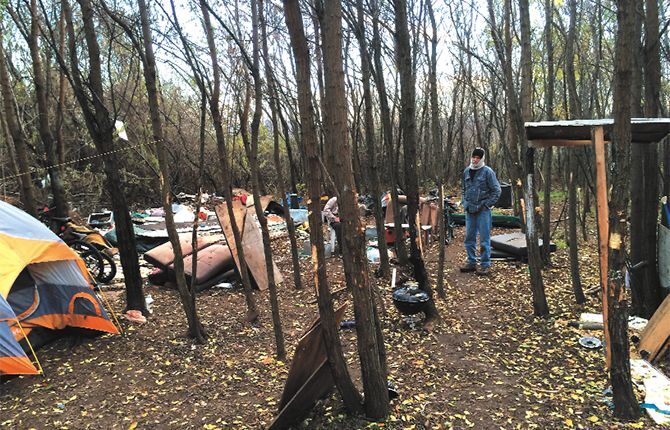
While the presence of transients is becoming more visible, by and large, their living arrangements are, by design, hidden from public view, Larson told a reporter on a recent ridealong.
He and other officers estimated there are maybe 30 to 40 transients in town, and maybe 20 long-term, established camps. Both numbers are in constant flux.
Larson and other officers make a point that many transients, who are mostly men, live quiet lives and are no trouble to police.
One transient, who goes by the name “Jesus,” (pronounced the Spanish way) actually provides a public service, Larson said. He hauls around a barrel on a trailer and picks up trash. He stays relatively hidden on property where he has a garden with several crops. His camp is well kept and clean.
That is in marked contrast to other camps. It is the trash and the wind that are the culprits behind much of the problems with other camps, Larson said.
“There’s filth beyond measure,” said Sgt. Dan Nelson.
Hattenhauer Distributing Co. on First Street has developed such a problem that the owner, Alex Hattenhauer, raised the issue to city council last February, saying his property had become “a prime homeless transient camp” in the last few years.
Four major garbage-strewn camps are on the property right now. (Two of the four campers are sex offenders, one officer noted.) While there are concentrated places of trash, wind has also blown garbage everywhere.
The cruise ships coming to town have registered complaints with the city when garbage-strewn camps were visible from the docks. This past summer, Kienlen said police were called because tourists were afraid to get off the bus when it stopped near The Dalles Area Chamber of Commerce, because there was a long line of transients standing by a white picket fence.
They were waiting for free meals at the St. Vincent de Paul office, which houses two meal programs – Bread and blessings and Community Meal – and also has showers. On extremely cold nights, it opens its doors as a warming shelter.
The St. Vincent office has become the epicenter of the homeless problem, its officials have acknowledged. A city committee is studying how to help the homeless.
Kienlen said more and more people are panhandling on busy street corners in town also. Some have become aggressive.
Years ago, the city had a rule on the books against transient camping, and officers would almost nightly force people to move on from camps, said Kienlen, who joined the department in 1995.
That prevented camps from becoming well established. But a similar law in Portland was found unconstitutional, so The Dalles also dropped its rule.
Now, breaking up camps on publicly owned property is more time-intensive, with requirements that officers post notices before taking action. No such rules exist for camps on private property.
Officer Amanda Rosier has taken an interest in the topic and has begun focusing on it.
“It’s a very complex issue with a lot of things going on with it, and issues at all levels,” she said.
Some simple changes have been made. Things like cutting down trees to expose hidden areas, or putting in boulders in areas to discourage camping, are measures that have worked here, she said.
One campsite she’d been monitoring was beneath the Ninth Street bridge over Mill Creek. One day earlier in the fall, she checked on it while a reporter was along for a ride. “It looks like they’re getting out of this one. I’m sure I’ll find the next place they’re going to.”
“A lot of times they just pick up what they care about and leave the rest,” she said of abandoned camps.
Rosier discussed the restrictions that have been placed on removing camps. “A lot of the camping has been designated as protected under the housing act,” she said.
So, a collection of tarps and tents is “almost considered housing,” she said. A 24-hour notice must be posted before action is taken. Then, the site can be cleaned up. Anything of value is held for 30 days in case someone wants to claim it.
“It’s one of those things where we can’t just go there and say, ‘You have to leave.’”
On private property, however, they can kick them out immediately.
The hard part, she said, “Is you go to the camp and nobody’s there.” That’s the case most of the time. And when she does find someone, “a lot of times they’ll ask me, ‘Well, where can I go?’ and I tell them, ‘I don’t have a good answer. You can’t camp on private property without permission and you can’t camp on public property.’’’
She knows they’ve been told the same thing before. “They know the drill, basically.”
Every underpass in town has housed the homeless, and major camps exist in brushy areas on the east and west ends of town, right along the railroad tracks. Some of the sites seem uninhabitable, perched on steep areas closely hemmed by roads and railroad tracks. Every so often, the state comes through and cleans out the camps, spending thousands of dollars doing it, Jones said.
Major, years-long encampments, with multiple RVs and trailers, have been cleared from railroad property in recent months. The other day, a few tents were pitched just a few feet away from facilities belonging to AmeriTies.
Close to downtown, a camp is behind the rock wall on the opposite side of the street from the pool. Camps are also scattered in the brush along Mill Creek, especially in summer, Larson said. There are camps in the brush between Fred Meyer and Motel Six. Larson said there was what he described as a “Vietnam bunker” behind another building.
Businesses have reported people camping under their loading docks.
An outdoorsman, Larson admires the ingenuity that some campers have shown.
One camp was so stout it had walls and a padlocked door. Sometimes, campers even “sell” their campsites to other transients. A transient told him he’d sold another man his site “I believe it was for 20 bucks.”


Commented
Sorry, there are no recent results for popular commented articles.