

On Aug. 14, The Dalles resident Yvonne Pepin-Wakefield, a local artist, drove to her rural cabin outside John Day only to find herself amid the Canyon Creek Complex fire. After four days of being evacuated from the log cabin she built at age 18, she returned home to The Dalles.But she couldn’t stop thinking about John Day.
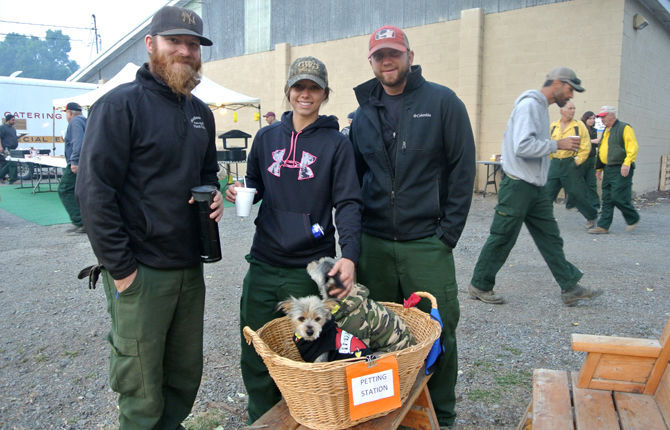
On Aug. 25 she returned to help with the fire the only way she could: With her two registered therapy dogs Henry and Zachary she set up a post at the John Day fire camp, offering petting therapy every morning and evening for five days.
Following is the story in her own words about the effects on a community endangered by a lightning caused fire that grew from 150 acres to over 110,000 acres in three weeks:
FIRE CAMP
The first evening at fire camp, Henry and Zachary sit in a basket with signs “Petting Station” posted on the sides to advertise their business: Customers come in steady streams, firefighters and support personal stopping to pet and hold “The Boys.”
For the next five nights I sleep in the back of my Dodge truck, beside a field of pup tents in the fire camp at the fairgrounds along with other evacuees, couples and families who have lost everything.
“We didn’t have time to take anything,” sighed one man. Earlier that week he had been allowed to return to his home up Canyon Creek and found a 10-cord pile of fire wood, a freezer full of meat and his house all reduced to ash.
In the morning I drive up Canyon Creek for a firsthand look, a new definition of devastation written on both sides of Highway 395. For miles along this once forested draw only chimneys are left standing at home sites reduced to charcoal.
On Wednesday afternoon, I sit along with fire crews watching the fire blow up again in the Strawberry Mountain Wilderness. I sketch a convection fueled mushroom cloud, a monolith of doom as if I’m obsessed trying to make sense of some abnormality, like in a scene from Close Encounters of the Third Kind.
“My place is up there,’ I say, not knowing then a friend’s real estate and equipment were at that moment burning up. My eyes tearing from more than smoke.
Molten nightmare
After our evening petting station shift I drive to Pine Creek road and stand with law enforcement at the road block, watching a molten nightmare torching landscape I’ve painted on canvas for years. That night I hardly sleep and it’s not because of a leaky air mattress and the steely truck bed, but because like so many others around me I fear waking up to learn I’ve lost my dwelling.
In the morning a woman who caters meals for the fire crews brought two doggie sweat shirts for The Boys to wear. A firefighter bent down to help me dress them. “I put hoses on your cabin at midnight,” he said. It was just 6:30 a.m., and he was heading back to work.
After Thursday’s morning shift I am allowed through the blockade even though it’s still a level three evacuation. Fires are burning along hillsides all the way down to a metal gate I’ve opened and closed on a road I’ve traveled for years. I am turned back by fire crews in advance of retardant dumps, helicopters trailing water buckets overhead, tankers hosing hillsides, yellow shirted crews trying to get a handle on this Hieronymus Bosh scene of Hell.
Throughout the next three days firefighters come to pet The Boys and to tell me they have been cutting line and keeping a pump going to spray water from the creek onto the cabin. That’s the only way I know it’s still standing.
One firefighter showed me a picture on her phone of a hand-painted sign in red, “Thank You Fire Crew!”
“Is this your place?” she asked.
Yes. I painted the sign and nailed it up when I first had to evacuate two weeks before.
“We love to see these signs,” she said.
One of those days
At the 6 a.m. firefighters briefing on Saturday, Aug. 29, Steven Beverlin, Malheur National Forest supervisor said, “There are days on a fire. And there are days on a fire. This is one of those days.”
The fire expanded to nearly 100,000 acres and threatened Prairie City, where some areas were evacuated.
Even Zachary senses the tension in the air as crews set out to battle fire that will flare in predicted 50 mph winds. When people bend to pet him, he slips out of the basket to the ground and leans consolingly between their legs.
The swirling smoke is so dense I can’t even see if there’s any wilderness left to burn. I’ve driven up Pine Creek road to check the fate of the cabin. Security won’t let me through. The winds are so strong they buckle my listless gait as I walk up and down the deserted road, not wanting to leave or to believe that like three houses earlier that morning, my cabin is now toast.
At the relief center I return the sleeping bag and a pair of shoes given to me earlier. I talk with a couple who were evacuated from Prairie City that morning and another woman whose Canyon Creek house had burned down less than two weeks ago. “You just take it day by day,” she said.
On the drive back home to The Dalles, I stop at the Red Cross shelter in Mt. Vernon.
It wasn’t even noon and already 15 persons had registered as new evacuees; at least two of them lived on Pine Creek.
All along the 200-mile trip, I check my phone for the message I don't want to get.
Just past Wasco, my cell rings, and I hesitate to pull over before answering what I’m sure is bad news. It wasn’t.
On Sunday afternoon the cabin is still standing strong, as is my hope and praise for the people of Grant County.
To say it’s been an emotional roller coaster is an understatement. But I’m not alone on this ride with a fire that’s claimed over 40 homes and 50 outbuildings and been declared a national disaster by FEMA. I’m lucky though. Whatever the outcome I have a home in The Dalles to return to.
Still standing
On Sept. 9 I was allowed up to the cabin. It was still standing, unlike the nearby forest, although it was not safe to stay there as the National Guard and firefighters continue to work still blazing portions of the 110,000 acre fire.
I spent two more nights at the fire camp with The Boys. Fire personnel and evacuees I first met three weeks ago were still there.
On Sept. 11 the relief center at the fairgrounds closed. Advocates have been assigned to those who lost homes and property, who will have access to supplies.
Hay and firewood are especially needed. Hay donations can be arranged by contacting Jim Hamsher at 541-620-2861 and firewood by contacting Mary Weaver at 541-575-1900.


Commented
Sorry, there are no recent results for popular commented articles.