
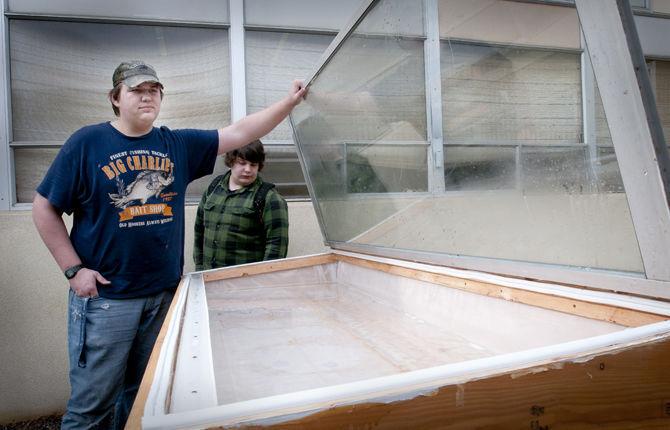
Some 30 minutes earlier, Anthony Weyerman, a 17-year-old junior at Wahtonka Community School, had filled his hand-made solar water purifier with a few gallons of water from a hose.
Already, as he explained his project to a reporter, it was functioning as intended: The sun’s heat was evaporating the water, where it rose up in a mist and formed fat beads of water on the glass lid.
Once heavy enough, those drops rolled down the slanted glass and fell into a channel, itself angled so that the re-formed water — cleansed of impurities — dripped into a five-gallon jug.
The impurities — soil, metals, e.coli, — are too heavy to evaporate and remain behind in the basin, Weyerman explained.
“You can literally put raw sewage in it and it will purify it and you can drink the water,” he said.
He even threw a few handfuls of dirt into the water to prove the system.
Weyerman’s project is just one of many at any given time at the community school, a new project-based program that lets students learn required academic subjects by following their own interests in a hands-on way.
The year-round community school started last July. It has just 55 slots, and all are filled, with another 38 students on the waiting list, said Principal Brian Goodwin.
All the students now enrolled at the community school had dropped out of high school. This method of learning better suits their style.
Sophomore Quinn Gavette, 16, purposely dropped out in order to get into the program. For him, the regular classroom is “like prison.”
At the community school, students work at their own pace. Instead of shifting from one classroom to another in 45-minute chunks, “The whole school is our classroom,” Gavette said.
He and others are working on a composting project with students at nearby Chenowith Elementary.
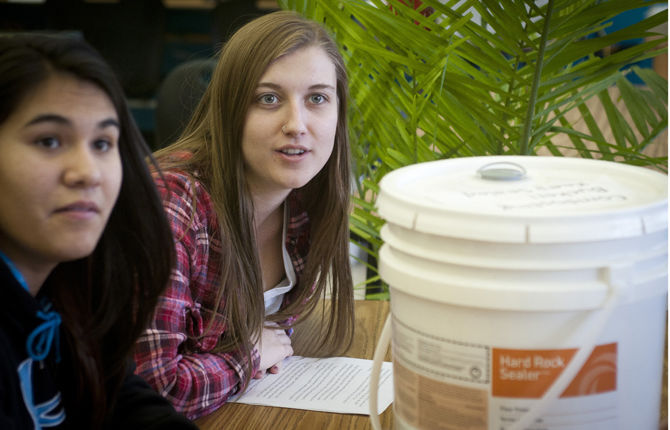
A group of teenagers go every day to Chenowith and help students sort food waste into five-gallon buckets: fruit, veggies and bread in one, milk in another. “We taught them what they can and can’t compost,” Gavette said.
Meat and dairy are not allowed, since “they’ll mold and make all your other stuff gross,” he said.
The compost is used to amend soil, and “It’s also used to keep your greenhouse warm because it produces heat,” Gavette said.
Compost is decomposed material, Gavette said. Once it decomposes enough, “we’ll start integrating soil with it so we can grow plants,” he said.
Students are calculating how much heat will be given off by the compost when it is mixed in with wood chips.
They collect two buckets a day, and so far, they’ve collected 30 buckets, which will be stored in a greenhouse belonging to school board member Dean McAllister.
From there, the compost will be taken to a garden being created behind the nearby former Westgate Market, which is being converted to a transportation center.
Their daily trips to Chenowith Elementary are a highlight for the teens. Tiffany Lindsey, 18, a senior, loves interacting with the kids. “They are so cute and fun to play with.” She comforted one girl who fell and cried, and offered to sit with another whose friends weren’t sitting with her. The girl tearfully accepted.
Each project the students undertake has to explore at least three areas of academics, such as math, science or writing.
Each academic area studied is called a quest. If students do four quests a month, as is expected, that is slightly more than a typical academic schedule at the high school, Gavette said.
A quest starts with posing questions, then moves on to doing research, conduct public service connected to each quest, giving a presentation about the results and then writing an essay on the whole experience.
Arieanna Argueta, 17, a senior, helped create a Mexican dish for 40 people, and it was so popular she and her project partner, Tua Faamausili, 17, a junior, were convinced to make the dish for 80 National Guard soldiers returning from training. They also made them homemade waffles for breakfast.
“It turned from a one-day project into more of a two- or three-day thing,” Argueta said.
Argueta wanted her ceviche — a Mexican dish with crab, shrimp, avocado and lime juice with tacotillo sauce or ketchup, served on a tostada shell -- to be just right. So she called her grandmother in Mexico for expert advice.
She learned that a key was marinating the seafood in the lime juice for an hour to soak in the flavor.
The soldiers “were really super nice and really grateful,” Argueta said. “They actually thought we were professional people.” She also saw the soldiers in formation, and “That was super cool, I’ve never seen that before.”
She was able to talk to the soldiers about what it was like to be in the service and to “see the people they are, underneath the uniform.”
Argueta’s first round of ceviche was for the school board and students. She had to make a speech and was very nervous, but was grateful to school board member Carol Roderick for giving her helpful advice.
Argueta reluctantly had to take three days away from school to do the large meal. “I didn’t want to be out of school,” but it was worth it, she said.
Faamausili wanted to do a favorite Samoan dish — a sushi-like dish called musubi — for their cultural foods project, but somebody else had already taken it.
Faamausili likes the community school for the one-on-one help, the small class sizes, and the lack of bullying. “There’s a lot of help here,” she said. At the high school, when she asked for help, she didn’t “get any details,” and didn’t feel helped.
Goodwin said students are taught to “haggle” about the academic requirements of their projects. At any given time, students are working on 200 to 300 projects between them.
“We demand they manage their own time, set up their own projects,” he said. They’re effectively project managers who have to make phone calls and arrange transportation, for example. The school is “more like a think tank than a classroom,” he said.
Goodwin can’t wait to get to school every day to work with the kids, and from one student’s comment, it seems the experience is just as enjoyable for them.
Outside at the solar project, David Rogers, 18, a senior, was discussing with classmates when school started. Realizing it was seven months ago, he was surprised. “Geez, he said, “It doesn’t feel like it.”


Commented
Sorry, there are no recent results for popular commented articles.