
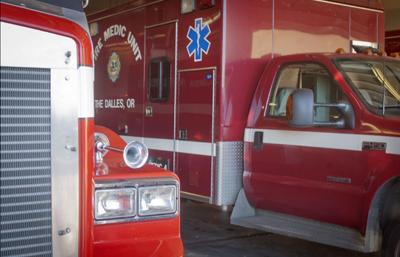
With a 20-year building bond retiring soon, Mid-Columbia Fire & Rescue is asking voters to approve a new $3.85 million bond to replace aging fire apparatus and ambulances and do property maintenance.
Property taxes would not increase if the Nov. 8 bond passes, said Fire Chief Bob Palmer.
The old $3.5 million bond, passed by voters in 1998 to build the main fire station, retires in December 2017.
The new 16-year bond would not kick in until that one retires.
The current bond has a taxation rate of 21 cents per $1,000 of property value, and the new bond would have the same rate, Palmer said. The cost of the bond for a $200,000 home would be $42 per year, he said.
“We did a lot of research and studying on this and the goal was to keep the cost of the bond at or near the same as the current bond so the taxpayers would see no increase in taxes,” he said.
“We’ve been trying to be frugal, but we’ve got to a point where all our equipment has aged to a point where we’ve got to replace it to have reliable equipment to protect the community,” Palmer said.
Ideally, he said, the district should be setting aside $424,000 a year into reserves in order to do timely replacement of its apparatus and ambulances. But, the district has never come close to meeting that level, and for the first time ever, this fiscal year it put no money at all in its reserves.
“Current taxes and ambulance revenues are not covering the costs that are needed to replace equipment and maintain our facility,” Palmer said. “We’ve been able to do the small things, but the big stuff, we’re just not able to swing.” Since 2006, the district has put an average of $127,000 in reserves, ranging from a high of $203,000 to a low of $25,000. But some of those years reflected equipment grants, so the money did not stay in savings, Palmer said.
Tax receipts go up with growth, and the city is working to enhance growth, Palmer said. The district is only reimbursed 36 cents for every dollar it bills for ambulance services.
Most of the bond, about $3.45 million, would buy new fire apparatus and ambulances.Another $275,000 would go toward painting the main fire station, putting an asphalt overlay in the parking lot and training area, and installing new lockers for turnout gear. It would also pay for a drain in the apparatus bay of Station 2 in Columbia View Heights.
The final $100,000 goes toward bond costs and fees.
The district has put chip seal and crack seal on its parking lot and training area, “but the asphalt is just starting to deteriorate. The cracks are getting larger, and it needs an overlay,” Palmer said.
The current lockers are wood and don’t allow air flow, trapping moisture and causing mold.
As for fire apparatus, national standards call for replacing it every 20 years. Nearly all of the current apparatus is at or well past that mark, Palmer said.
The single biggest ticket item would be a new ladder truck, at an estimated cost of about $1.1 million. The current ladder truck was new in 1999, but a focus group the fire district appointed earlier recommended that the district go ahead and seek funds to replace it now, rather than seeking another bond in a few years, Palmer said.
When the district looked into refurbishing it they were told it would cost just as much to refurbish it as to replace it because of the complexity of the apparatus, he said.
The bond would also pay for two fire engines, at a cost of about $575,000 each. They would replace engines that are 32 and 23 years old, respectively.
Also proposed is replacing two water tenders, the current ones are 25 and 23 years old, at about $300,000 each. One of the water tenders is a converted milk truck with a 1950s tank that is now leaking occasionally, he said.
It would also replace two booster trucks, or light brush engines, at an estimated cost of $140,000 each, that are 23 and 19 years old. They are used in wildland fires and take a lot of hard use on challenging terrain, he said.
“They carry a lot of weight too. Water is not light,” he said. The replacement trucks would be diesel instead of gasoline for improved safety, he added.
Also slated for replacement are two ambulances that were brought used four or five years ago. New
ambulances would cost about $160,000 each.
Because of their heavy use, ambulances are ideally to be retired after 12 years of use, he said.
The fire district has five ambulances, and because of maintenance issues, at times, up to three of them have been out of service.
“It puts the community in a bind and it puts our other customers, like the hospital, in a bind,” Palmer said.
Normally, all five ambulances are in service – though one right now is being repaired in Portland — but if they aren’t replaced, having multiple ambulances out of service at a time could happen more frequently, said Palmer.
The district bought itself some time by buying the used ambulances, he said, but about a year after they were purchased, one needed a new engine and the other needed a new transmission.
Continuing to buy used apparatus carries its own cost in maintenance, he said.
“We felt now it’s time that we need to replace and upgrade our fleet in order to get it up to date so we don’t have the maintenance issues we’ve been having,” he said.
The district did buy a used engine from San Diego two years ago, which depleted reserves.
The district has tried three times to get grants for fire apparatus, but the competition is stiff and they have not succeeded. They will keep trying though, Palmer said.
The equipment the district would replace is already in reserve, behind first-line equipment.
If the bond passed, the first-line equipment would become reserve, and the reserve equipment would be sold, and the proceeds put into savings for future equipment purchases, Palmer said.


Commented
Sorry, there are no recent results for popular commented articles.