Sydney J. Harris, a journalist and novelist who was born in London but lived the last 64 of his 69 years in Chicago, said, “An idealist believes the short run doesn’t count. A cynic believes the long run doesn’t matter. A realist believes that what is done or left undone in the short run determines the long run.”
For a bridge player, what happens in the short run can have a critical effect on the long run — the final result of the contract.
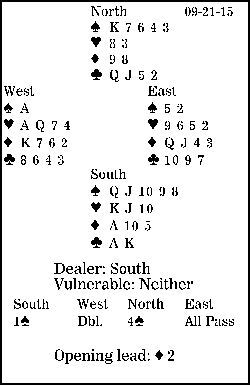
Today’s deal is the cousin of yesterday’s. How should the defenders play to defeat three no-trump after West leads his fourth-highest heart?
As I mentioned yesterday, I think North, with such a strong doubleton, should just raise one no-trump to three no-trump, not give the defenders free information about declarer’s hand.
West leads his heart five, and after dummy plays the six, East should cover with his eight, not because he is playing third hand high, but because he is playing high-low with a doubleton when his higher card is lower than the nine.
South will take three rounds of spades ending in the dummy (to find out how many tricks he is getting from that suit), then run the diamond 10.
Now West, who knows that South still has two hearts left in his hand, should win with his king and shift to the club nine (high to deny an honor), hoping that his partner can win a timely trick and return a heart through South’s king into the jaws of West’s ace-queen.
Declarer has no choice but to risk the club finesse, and here will go down three.



Commented
Sorry, there are no recent results for popular commented articles.