
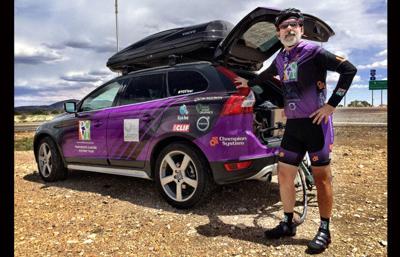
Eric McIntyre, a 58-year old grandfather living in New Orleans, arrived in The Dalles last week just in time for the heat wave.
While the weather, which he compared to the Mohave Desert, was far from pleasant, it wasn’t about to slow McIntyre down. He had already been through too much and traveled too far.
Nearly two years ago, McIntyre got a crazy idea.
Ten months earlier, his wife Liz had been diagnosed with pancreatic cancer.
“I thought about doing something big,” McIntyre said. “It struck me like a bolt of lightning to engage in the fight back against the disease, not just for Liz but for other people.”
The original idea was to ride his bike around the entire perimeter of the country but that was around 12,500 miles so instead McIntyre decided to settle for 7,200.
When he was 17 McIntyre rode his bike 90 miles roundtrip out to the Pacific Ocean from his home in Santa Rosa, Calif. Now more of a runner, he had completed two marathons but McIntyre didn’t consider himself an endurance athlete. McIntyre also had no idea how he would bike from his home in New Orleans across the country but the thought wouldn’t leave him alone.
In May of 2014, he began seriously training and by August knew he would do it.
But McIntyre was searching for the perfect organization to raise money for.
In November, he found Lazarex Cancer Foundation, a grassroots non-profit which has successfully supported 1,000 end-stage cancer patients by connecting them to 399 FDA-approved clinical trials for 88 cancers and covering the cost of travel for each patient and a companion.
“I was looking for a non-profit that matched people to clinical trials and made sure they could afford to attend them,” McIntyre said. “Turns out that Lazarex is the only one that does both. It was absolutely perfect and fortunately they thought I was perfect, if crazy.”
McIntyre founded the Pancreatic Cancer Victory Foundation, a 501(c)3 non-profit.
In 11 months of training, he biked over 5,000 miles.
Working at the same company, State Farm, for 36 years, he had more than enough vacation days.
But McIntyre only agreed to make the trip if Liz was feeling well.
“The deal I made with God was I’ll do it if she’s well enough for me to be away from her for three and half months and she’s been doing great,” he said. “That’s the mutually motivating thing. In my mind, I’m pedaling her cancer into the ground and she’s supporting me by everything she does and doing well. That keeps me going.”
McIntyre left for his 18-state Pancreatic Cancer Victory Tour on April 19. From New Orleans, he rode through Las Vegas and Los Angeles. On Thursday, June 25, McIntyre arrived in The Dalles, where he spent two nights before taking off for Yakima and then Spokane. From there, McIntyre plans to go to Minneapolis, Minnesota and Madison Wisconsin before heading down the Mississippi River Valley and back to New Orleans.
Although he’s more than halfway to the goal, McIntyre doesn’t expect to quite get to 7,200 miles by the time he returns home on August 8.
The first bike was destroyed on the fourth day of the trip. McIntyre replaced it in Houston but that still cost him a day of riding. He then had to get four new tires in Las Vegas, which also set him back a day.
McIntyre has fielded interview requests from television stations and newspapers all over the country, which has cost him time. But he doesn’t mind that.
“It’s more about the message than the miles,” McIntyre said.
McIntyre’s ultimate goal is to make people aware of how clinical trials work and raise as much money as he can for Lazarex.
“There are people who die because they can’t afford to go. People die because they don’t know clinical trials exist,” McIntyre said. “Not all oncologist believe in clinical trials or take the time to learn about them. Lazarex fills a really critical need.
“In the world of clinical trials, you would think that people would be standing in line hoping to get into one, like adopting a baby or an organ transplant, where there’s a long list and it may be two years before you get one kind of thing. It’s just the opposite with clinical trials. They can’t get enough people to attend a lot of them. It’s a really critical part of the mission not just to raise money but it’s to raise awareness about the whole clinical trial arena. Thats it’s out there, that is exists.”
In order to do that, McIntyre had to get out of his comfort zone of anonymity.
“I had no desire to get out at the head of the spear and lead this kind of an effort that would become really big,” he said. “I had to get used to the idea that if this was going to succeed, I was going to have to become known and visible and smile a lot and talk a lot and do a lot of interviews.”
Since McIntyre’s trip is self-funded, 100 percent of the money donated is going to matching people to clinical trials and travel costs for each patient and a companion.
So far, the PCVT has raised nearly $30,000 but McIntyre wants more.
“The only thing that hasn’t exploded or really met or exceeded my vision for this is the money,” he said.
But help could be on the way. McIntyre recently found out that State Farm is allowing his story to be on the company’s different social media platforms and out to its 27,000 agents and 80,000 total employees.
Anyone willing to donate can do so at https://www.crowdrise.com/pcvtour or follow McIntyre’s journey on the Pancreatic Cancer Victory Tour Facebook page.
Joining McIntyre on the journey is Tod Hillman, a video producer and photographer for Hollywood Media Services who previously worked with NBC Television shooting Last Call with Carson Daly and editing Access Hollywood. Hillman is driving McIntyre’s Volvo as well as shooting video and taking photographs each day. He’s posted 20-plus videos on the PCV Tour’s YouTube channel and would like to use his footage for a documentary.
McIntyre’s wife Liz has completed cycle one of a new vaccine trial with few side effects.
“She has no disease symptoms,” McIntyre said. “She still has tumors but they’re small. They’ve been stable for about a year, very little change and the doctors are excited about her continuing through the trial.”
If everything goes as planned, Liz will soon begin cycle two, which means another 12 days in the hospital. If she makes it all the way through, Liz will be the first pancreatic cancer patient to go through all three cycles of the vaccine. She’d be patient zero.
“As long as she’s doing well, I’ll be out here,” McIntyre said. “That hasn’t changed. It’s mutually motivating. She’s really proud of me and I’m really proud of her.”


Commented
Sorry, there are no recent results for popular commented articles.