
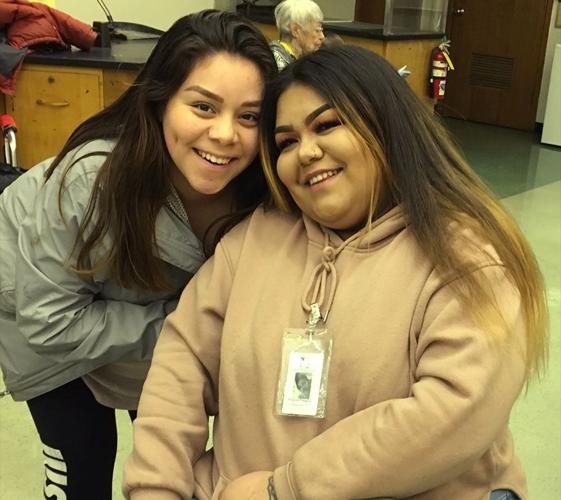
A new after-school program on Wednesdays — an early release day in the school district — at Wahtonka Community School is the brainchild of two sisters who are students there.
Sisters Anyssa and Nevaeh Campos spent five years in foster care, three of them apart, in homes all over the state and even in Colorado. Just one or two home situations were any good. They loved school because it was a break from home.
They don’t know if any of the kids in their program are also foster kids, but at any rate, they just wanted to create a place where kids could come and have some snacks, read some books and play some games.
The sisters thought of the idea last fall and have been working since then to get the pieces into place.
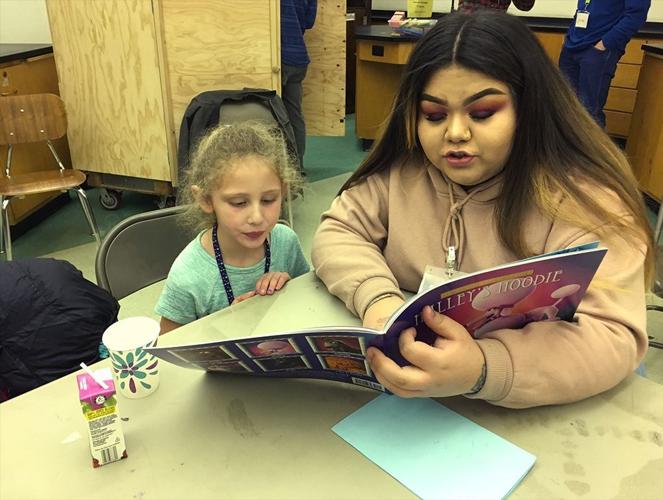
They started a few weeks ago, and one recent Wednesday afternoon found Anyssa reading a Disney princess book to kindergartener Addison Buckles, as other adults and students also paired up with youngsters for games or reading.
After one interesting passage, Buckles piped up, “My friend has a wiener dog.” Anyssa responded, “Really? I had a wiener dog too.”
At a nearby table, a boy played with a small plastic dinosaur.
Anyssa asked Buckles what she liked best so far about the program, which was then in its second week. Buckles said, “Everything.”
Later, another kid said, “We only have 20 minutes,” and Anyssa said, “that’s ok. We’ll be back next week, and the week after that.”
As they talk to a reporter, Anyssa, 17, a junior, and Nevaeh, 15, a sophomore, finish each other’s thoughts.
One goal of theirs is to provide consistency in the kids’ lives, since it’s something they lacked as they were bounced to some 20 foster homes between them.
Anyssa recounted pitching the idea of an after-school reading program to Brian Goodwin, the principal/teacher of the community school.
The community school, with a 55-student enrollment cap, teaches wtih a project-based model.
Goodwin suggested that the Campos sisters make such a program, “So we made one,” Anyssa said.
It was no small task. “We had to get students, volunteers, funds to get books,” Anyssa said.
“Taking care of the parents was, I felt, the most difficult,” Nevaeh said.
There was a communication mishap with Chenowith Elementary; parents were led to believe that any student who wanted could join the program, but the sisters had initially set a limit of five students.
“I had one parent yelling at me and saying, ‘Well, if this is how you run your program,’ and then hung up,” Anyssa recounted.
They settled on nine to accommodate the extra interest in their program.
Each Wednesday at 1:15 p.m., adults go over to adjacent Chenowith and escort the participating elementary students to the Wahtonka campus. There, five adult volunteers and four other students, in addition to the Camposes, are ready to hang out with them until about 3 p.m.
“It gives them a little break from school and gives the parents more time,” Anyssa said of having an after-school program slotted into the early release days on Wednesdays.
Nevaeh said it also develops social skills for the kids to interact with people as they play games or get read to.
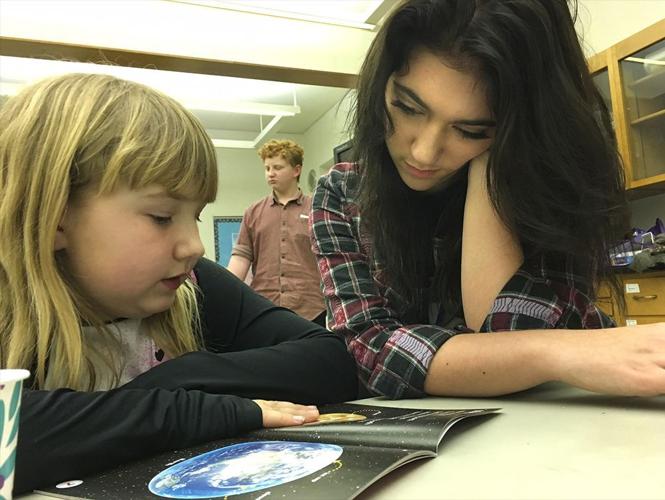
At a nearby table, Keira Bauc, a 17-year-old junior at Wahtonka, read to third grader Abby Moore, 9, who asked her, “Are you going to go to college next?”
“I’d like to,” Bauc answered.
She explained to Moore that in 12th grade, you’re a senior in high school. “Only in high school?” Moore wondered. “It’s high school and then it’s college? What do you want to do in college?”
Bauc told her she’s thinking of “art, theater or culinary arts, which is baking and cooking.”
Moore replied, “I’m a good cooker. I cook with my grandma. I know how to make scrambled eggs. I almost know how to make macaroni and cheese all by myself.”
The Camposes had a $600 budget, with donations coming from The Dalles Kiwanis Club and Wahtonka Community School. With the money, they buy games, snacks, prizes and books.
They want to grow the program, but need more volunteers. Those interested in volunteering can call Anyssa at 503-776-8253 or Wahtonka Community School at 541-506-3449 ext. 3211.
She said donations of games, books, toys and store-bought snacks are also appreciated.
Goodwin said of the program, “I’m thrilled with it. Our two young ladies have done a tremendous amount of work coming up with the idea for the actual program.
“They partnered with Kiwanis, have trained their peers, and helped get supplies. The two of them are so capable and competent.
“They’re giving back,” he said. “So for me, I love that its intergenerational. It’s adults with Kiwanis, with my teens, with little kids. So you have a double level of mentorship going on, which is so healthy.”
Asked why they wanted a reading program, Nevaeh said, “We obviously had to put educational purposes into it, but when this was just an idea and talked about, I thought it would be cool where kids felt they had a place.”
After Nevaeh explained that they were in around 20 foster homes altogether, Anyssa said, “It’s just hard.” They were young when they first got in the foster system, and they also saw even littler kids than them in foster care too.
With all the moving around, it has wreaked havoc on Nevaeh’s education. She’s a sophomore, but only has two high school credits so far. “I should have like 12 credits, at least.”
Anyssa said education in foster care, in her experience, was “self-directed almost. We thought that the reading was a good way to help: kids, especially if they happened to be in foster care.”
Nevaeh, who wants to be an attorney or an ultrasound tech, said she is entitled to free in-state college as a former foster child, “but how are we supposed to get through high school when you have two credits?”
Anyssa wants to get a business degree and then go to cosmetology school, so she can establish her own line of makeup.
“She’s been obsessed with it since she was little,” Nevaeh said.


Commented
Sorry, there are no recent results for popular commented articles.