
The Wasco County Commission spent April getting updated about the status of Immediate Opportunity projects that are paid with Google funds.
Last year, the county and city of The Dalles set aside almost $250,000 of the $1.45 million initial payment made by the internet search giant, through Design LLC, as part of its third Enterprise Zone property tax abatement deal.
As co-sponsors of the zone, the county and city equally split the remaining dollars. The government agencies set aside Immediate Opportunity funds to cover projects that could be undertaken and completed in a short period of time.
In early April, county officials were updated about efforts undertaken by the Wasco County Soil and Water Conservation District to fight the spread of skeleton weed in rural areas with $10,000 in Google money.
“We are finding canyons and draws full of weeds,” said Rod Asher, director of the district.
He said because weeds do not recognize property lines, multiple agencies were working collaboratively to control them.
Skeleton weed is very invasive, spreading by root and seed, said Asher.
He said the weed causes problems for wheat growers because it can bind up combines — and every piece of root can create a new plant, furthering the problem. Because the weed has wind-blown seed, he said it is difficult to contain.
The primary focus of the latest effort has been along both sides of the Deschutes River and in state parks.
Some of the work, said Asher, is being done from boat, which allows crews to gain access into areas that are not easily accessible by foot. He said the district has been connecting with landowners and mapping areas where the weed is plentiful so that eradication efforts can focus there.
He said the Google funding has been leveraged with other grant dollars to make it go further.
Shilah Olson, district manager, said the agency had also contributed $10,000 to the project this year.
She encouraged the county to continue providing support for the program.
Arthur Smith, public works director for the county, joined the conversation by saying his department was also working hard to control the weed wherever they found it.
The Wasco County 4-H and Extension District ran into problems while attempting to spend its $30,000 of Google money to purchase a van to transport children to and from after-school programs and activities, said Lynnette Black, county leader.
She said it had been determined following research that buying a van would not work out. She said the cost of liability, fuel and maintenance was too high, and it would be better to lease a van owned by Oregon State University instead.
“We have come to the conclusion that purchasing a van is not for us,” she said.
She asked if funds could be used for a five-year lease.
“I apologize for putting you in this predicament,” said Black.
Commissioner Scott Hege said the intent had been to have the money invested into long-term resources. He suggested that there might be something other than transportation to which the funds could be directed. He said the board would be open to considering an alternative project, but city officials also needed to be briefed, and would have a say in the matter.
“There might be something that would be so much more helpful for the 4-H program,” said Hege.
Kathy White, executive assistant, suggested that she work with Black and the city to move the request forward.
Next to give a report April 5 was Mindy McHale, chair of The Dalles Area Chamber of Commerce board.
She requested an extension to complete the designated project, which was replacement of the existing wooden stairs in front of the Second Street office with concrete stairs and an ADA ramp, as well as fascia improvements to the front of the building.
The chamber was given $15,000 for this work, but McHale said severe winter weather had caused construction delays. She said the outdoor work was expected to begin May 1 and be completed by August.
Hege noted that the chamber had leveraged the Google investment with other monies to undertake a bigger project. He recommended that, because of the scope of the work on the roughly $76,000 investment, the due date for completion be set back to the end of September and Commissioners Rod Runyon and Steve Kramer agreed.
“We give you our blessings,” said Hege.
Ann Ferguson, secretary/treasurer, of the Dufur Parks and Recreation District, had good news to report April 5.
She said construction of a new ADA restroom in city park, paid for with $25,000 in Google funds and $30,000 already banked, was nearly complete. She said, even though bad weather delayed installation of the building, which sat in the factory for two months, it was plumbed and ready to go after a ramp was built.
“It looks good, we went with an electronically operated door,” said Ferguson. “It’s going to be really nice; right in time for baseball.”
Donna Lawrence, president of the Wasco County/City of The Dalles Museum Commission, updated the commission on the progress of $35,000 being spent to preserve and repair aging wooden buildings.
She said the work, also delayed by weather, could possibly start in June. She said the paint to retain the historic colors, and be fire retardant, had to be specially mixed. There were some structural issues that also needed to be addressed, such as replacement of flooring in the Anderson House, she said.
It was going to take another year or so, she said, to complete the work with the Google money that was originally slated in an agreement to be done by mid-November.
“I’d like to push for November because the whole idea is ‘immediate opportunity,’” said Hege.
Lawrence said a retaining wall in front of the Anderson House also needed to be repaired and asked if the Google funds could be used on that as well.
Hege said the agreement was for structures but, if there was money left over from that work, the matter could be revisited.
On April 19, Ann Harris, from the Wasco County Extension Office, updated the commission on how the $3,700 for equipment to film a Juntos video helped with the project.
She said Juntos was the Latin word for “together” because the program was designed to bring school, family, and community organizations together to increase school success and to help students prepare for higher education.
“This will help families make a path to higher degrees,” she said.
She said the video and workshops showed some of the possibilities, including apprenticeships and career opportunities in the fields of math, science and engineering.
“We want to connect students with a wide range of interests,” said Harris.
According to information provided by the extension office, Latinos make up 33.5 percent of the student population in Wasco County and more than 66 percent are on the free and reduced lunch program for lower-income families. The graduation rate among this population is slightly over 28 percent, a dynamic the Juntos program, which was developed by an Interdisciplinary team at North Carolina State University in 2007, seeks to change.
There are 54 families participating in Juntos activities in The Dalles or Mosier, said Harris.
She said Sean O’Connor, a professional videographer, will be training about 10 students through 30 to 40 hours of intensive training in filming so they can teach others.
“At the end, we’ll have a documentary that I’ll come show you,” said Harris.
The videography project is intended to teach new skills, nurture creativity and increase confidence. Participants will tell stories that bridge gaps and increase a sense of belonging and engagement, said Harris.
Four of the “Immediate Opportunity” projects are already completed:
• Northern Wasco County Parks and Recreation District used $19,000 in Google funds to purchase equipment for the Movies in the Park program, which starts July 22 and extends weekly through Aug. 26. The movies will be shown Saturdays at dusk in Sorosis Park. Featured films, in order, are: Trolls, The Sandlot, the Secret Life of Pets, the Princess Bride, Guardians of the Galaxy and Sing.
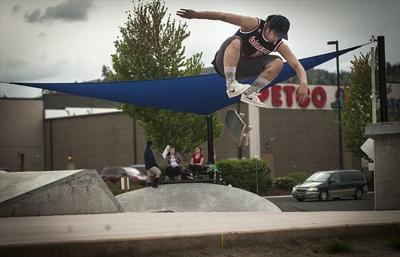
Another $40,000 was used by the parks district to install shade structures at Thompson Park near the splash poll, swimming area and skate park.
• The Mid-Columbia Senior Center folded $50,000 into its “Uplifting Elevator” fund and installation is currently underway. When the project is completed, clients will be able to get from the main floor to the basement without walking down an outside staircase.
• The Dalles Main Street used $5,000 to construct another parklet for public use in the downtown area.
The city of Mosier is using its grant match of $15,000 to grow a $150,000 fund that will be used to install a bike hub that requires a retaining wall and has an upper level deck and hardscaping.


Commented
Sorry, there are no recent results for popular commented articles.