
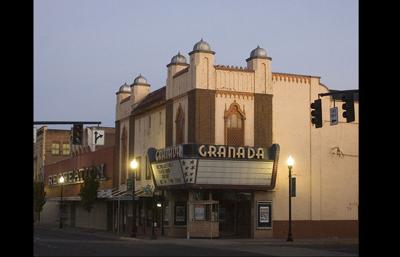
The Dalles City Council, in its role as the Columbia Gateway Urban Renewal Agency board, decided Monday to seek new proposals for redevelopment of the Granada block.
Michael Leash, principal for Rapoza Development, failed in his bid to get the elected body to continue working only with his team toward construction of a $24 million hotel/conference center.
Rapoza’s agreement for exclusive right to purchase three buildings in the downtown block expired Sept. 30. The development group wants to construct a 117-room Hilton Garden Inn with 6,000 square feet of dining space, as well as meeting rooms and retail outlets.
In a follow-up interview Tuesday, Rep. John Huffman said the council’s decision changed his plan to ask the Legislature for $1 million for the project during the 2016 session.
He said the money would likely have been available in 2017 and could have been used to repay urban renewal for buildings purchased to accommodate Rapoza’s project.
“I really don’t have anything now to go to the Legislature and ask for,” he said. “There has to be an agreement in place for me to be able to ask for the last dollar on a project. The way it was left last night there is no project so there can’t be an ask.”
After a lengthy executive session, the council voted unanimously, and without discussion, to open the door for other development plans.
No action was taken on Leash’s request that his development agreement be reinstated until March 2016, by which time the success of Huffman’s funding request would be known, as well as the fate of the Garden Inn application.
City attorney Gene Parker is preparing language in an advertisement that will go out about Nov. 10. Companies will be invited to submit plans for revitalization of the “blighted” area on Second Street until the end of February, 2016.
Leash said at the Oct. 12 meeting that he was unable to comply with some of the predetermined conditions of the development agreement because his franchise application with Hilton is still pending.
He turned in the application six months ago and said site plans and engineering work could not be finalized and turned over to city planners for review until his design was approved.
He said some of the delay in meeting benchmarks set by the city had been caused by the first Hilton administrator he dealt with going on maternity leave.
In addition, Leash said the building design had been challenging because it was an infill project instead of Hilton’s usual full build on about three and one-half acres.
On the financial side, he said Rapoza faced another challenge after state officials decided earlier this year not to extend tax credits that would have been part of his “capital stack.”
And there had been a shuffle of equity groups that each had timelines and requirements to meet, which did not always match with planning and design changes that needed to be made, he said.
After the Chronicle recently published an editorial that revealed Mayor Steve Lawrence’s written intent in December 2014 to “stop the Rapoza project as it currently exists,” Leash said investors became unsure about the level of city commitment to the project. And that was making it more difficult for him to move forward with financing, he said.
“Unfortunately, this has been a waterfall effect,” said Leash.
“The agreement expired but we’re there. We’ve got the ability to go forward and I’d like the chance.”
He said architectural plans were ready to be approved by Hilton and it was important to stay the course because the city stood to gain economically from the project. He anticipated the creation of more than 150 jobs and payment of about $153,000 per year in property taxes.
Although Rapoza has been working with the city for more than five years to get the project underway, Leash reminded councilors that there had been a couple of location and design changes, so the final draft of the development agreement had been signed only 29 months earlier.
Leash presented to city officials an Oct. 11 email from Denise Carpenter, Hilton’s vice-president and managing director of development for the Northwest region.
He said she needed to know the planning process was stable.
“We will need assurance that the site control document can be extended before finalizing the approval and sending a formal letter on the application.
“I am happy to discuss the process with your city manager or council if that is helpful. Hopefully we will have all replies from the (internal) committee within 10 days,” Carpenter wrote.
Leash was allowed by the council to invite comments from Huffman, Risa Wonsyld, who had been in the real estate business for 25 years, and Jeff Plew of Venture Hospitality, who established four Thirsty Lion Pub and Grill operations in four states.
“There’s nothing like it and it’s taking a long time but that’s what they (complicated projects) do,” said Wonsyld.
“When Michael came to me and said, ‘I have this great idea up in The Dalles,’ I and my partners drove up here and took a look at it. I thought it was awesome,” said Plew, who estimated the payroll for food and beverage services alone would be $750,000-$800,000 per year.
Leash also brought to the table Melissa Martin, who had 15 years in the hospitality industry and had been affiliated with Skamania Lodge and the Columbia Gorge Hotel.
“The Dalles is really a good regional destination for business,” she said. “This project will have meetings on the books before it opens.
“I hope I can provide some insight into bringing those businesses here.”
Audience members were not allowed to speak for or against the project.
Most of the crowd in the room, many business owners, had come to support Rapoza’s plans, according to Leash.
Lawrence did grant Robin Miles and her husband, Nick, an opportunity to address the council so she could get a question answered and he could present new information.
Robin Miles, who had been seated on the urban renewal advisory board for three years and owns a Farmers Insurance franchise as well as couple more commercial properties, asked what would happen with the Washington Street underpass and parking garage projects if Rapoza was out of the picture. Lawrence said he did not have an answer because the Oregon State Department of Transportation had offered grant funding for the underpass and would have to be consulted.
Robin then said the council needed to give consideration to Leash’s request because money had been spent on archeological work and other planning to accommodate a project that would be conducive to economic growth.
Councilor Russ Brown, told Miles the parking structure was to have been paid with urban renewal funds.
Lawrence added that the developer was also to have chipped in on the project, although the actual level of Rapoza’s contribution had not been determined.
Nick Miles told the board he creates metal art but had been forced to move his studio to Hood River because there was not enough foot traffic in downtown The Dalles to create a base of clientele.
“I think this project would benefit people like me,” he said.


Commented
Sorry, there are no recent results for popular commented articles.