
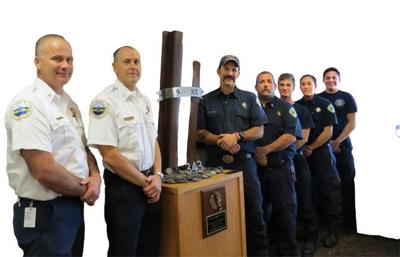
Bob Palmer recently watched a documentary about United Airlines Flight 93 and was struck by the bravery of passengers who stared death in the face as they made a desperate attempt to stop terrorists from killing more Americans on Sept. 11, 2001.
“They were the real heroes of the day,” said Palmer, chief of Mid-Columbia Fire & Rescue in The Dalles.
Flight 93 took off from Newark International Airport in New Jersey about 8:42 a.m. and had originally been headed for California.
About 46 minutes after takeoff, four terrorists breached the cockpit and overpowered the flight crew. Ziad Jarrah, a trained pilot, took the controls and was assisted in the hijacking by Ahmed al-Haznawi, Ahmen al-Nami and Saeed al-Ghamdi.
Jarrah turned the plane back toward the east coast and, although the specific target is not known, federal officials believe he intended to crash the aircraft into the White House or the Capitol Building.
Several passengers and flight attendants were able to make covert phone calls about the hijacking, so they learned that two other planes taken over by Islamic extremists had been flown into the World Trade Center in lower Manhattan. A third had crashed into the west wing of the Pentagon in Arlington County, Va.
Analysts believe that terrorists on Flight 93 decided to fly it into the ground near Shanksville, Penn., to prevent the passengers from regaining control. All 44 people aboard the plane were killed but no one on the ground was injured.
“I think about what those last moments were like for the passengers — it must have been horrific,” said Palmer.
He said the tragedy involving Flight 93 was, perhaps, overshadowed in the news on 9/11 by reports of catastrophic devastation at the World Trade Center, where both towers had collapsed and the death toll was quickly mounting, but would remain unknown for days.
The National Institute of Standards and Technology estimated that about 17,000 civilians were in the WTC complex at the time of the attacks, so the mortality rate was expected to be high.
The remains of only 1,640 of the 2,606 people who died in the towers would ever be positively identified.
The casualties included 56 passengers, nine crew members and five terrorists aboard United Airlines Flight 175, which had crashed between floors 77 and 85 of the south tower at an estimated 590 miles per hour.
American Airlines Flight 11 was the first to slam into its target, the north tower between floors 93 and 99, and carried five terrorists, 81 passengers and 11 crew members.
At least 100 people (some reports say 250) chose to jump to their deaths from the north tower after being trapped by smoke and fire.
Added to the horror of the day were 189 deaths at the Pentagon, including five terrorists and 54 passengers aboard American Airlines Flight 77.
More than 90 countries lost citizens in the 9/11 attacks.
Palmer, who was then assistant chief at MCF&R, was alerted by his mother-in-law and Dan Hammel, division chief at the agency, by his neighbor that a plane had flown into one of the twin towers. They thought for a few minutes that a calamitous accident had occurred.
“It was actually my day off and my wife and I were getting our four kids ready for school,” remembers Hammel, who was a senior firefighter in Klamath Falls.
“As events unfolded, it became evident that this was going to be a history-changing moment, not only for America but the rest of the world as well.”
What haunts him to this day is the question “Why?” that was posed by one of his elementary school-aged children, something he still cannot answer.
“It was overwhelming,” said Hammel.
What he, Palmer and Hal Woods, a Marine and now a firefighter at MCF&R, would soon learn was that 343 firefighters and 71 law enforcement officers had died while trying to help terrified
citizens escape the towers. Woods, who had been watching the news from the onset of the attacks, had been out of the Corps for eight years but immediately wanted to re-enlist.
In fact, the first question asked by his father, also a Marine veteran, was whether Hal, who had been part of Operation Desert Storm, was going back into combat.
“I was in complete disbelief that someone had the stones to take us on,” said Woods. “I knew something had to be done —there definitely needed to be retribution.”
“They woke the sleeping giant,” said Hammel.
He said American youth had been taught about the two world wars in the 20th century, as well as Korea and Vietnam. He knew that his grandchildren would one day study 9/11 as part of their education – something that he and millions of people around the globe were viewing in shocked disbelief.
“Our television was on 24 hours for days,” he recalls.
Command Losses
Because the incident command center to deal with the 9/11 emergency had been set up inside the north tower lobby, the post was wiped out.
Fire and police agencies had to immediately promote people into positions of authority.
“Those agencies took a humongous hit,” said Hammel. “My first thought (when the promotions took place) was there was not a single one of them who wanted the new rank because of how they got it — but they had to move on.”
The Fire Department of New York lost its department chief, first deputy commissioner, one of its marshals, one of its chaplains and other administrative personnel. There were 75 firehouses where at least one member was killed.
The two most senior officers at the Port Authority of New York and the New Jersey Police Department — Superintendent Ferdinand Morrone and Chief James Romito — were among the dead.
Four sergeants and two detectives were lost from the New York Police Department.
Eight paramedics and medical technicians from private companies also perished at the trade center while trying to help hundreds of injured people.
“It was a beautiful fall day and these emergency responders got up to go to work that day just like any other,” said Palmer. “While others were running away from the danger they ran toward it because that’s what people in these professions do — they gave their lives to save others.”
America’s New WAR
Like Woods and Hammel, Palmer knew that America would hunt down the mastermind behind the attacks, who was quickly identified as Osama bin Laden, a Saudi national.
It would take 10 years for U.S. intelligence experts to pinpoint bin Laden’s location and send a team of Navy SEALS into the Abbottabad, Pakistan, compound to execute him.
“Unfortunately, we’re still at war with terrorists,” said Palmer, in reference to the growing threat of attacks from Islamic State militants in the Middle East, Europe and the U.S.
“It’s discouraging that there is still so much hate and discontent in the world — I guess, in one sense, Osama was the spark to trigger all this.”
He said terrorism is fueled by religious extremism that encourages attacks on Americans, citizens of France and others by organized groups or “lone wolf” killers, such as the June 12 shooting at a nightclub in Orlando, Fla., that killed 49 and wounded 53 others.
“This is a different kind of war than the U.S. has ever been involved in and we all hope 9/11 doesn’t happen again, but I think most Americans realize that it could — and pray it doesn’t.”
Woods, who became a firefighter the year after 9/11, believes the way to prevent another major attack is to “quit playing politics and stop chaining the military down.”
“We need to let them fight, they know how to win this war,” he said.
DEVASTATION GOes ON
He, Palmer and Hammel have grieved the loss of emergency responders on 9/11 but said the deaths didn’t stop there. More than 71,000 first responders and survivors have required medical monitoring and/or treatment for injuries or health problems stemming from that day. And more than 3,700 have been diagnosed with cancer from exposure to carcinogens at ground zero.
“They are still taking away from our brotherhood and sisterhood,” said Woods.
There have been many changes in American culture since 9/11, some good and some less so, say the three firefighters.
Woods said airline travel has become much more burdensome and people tend to worry about the potential for further hijackings.
“Flying is a whole new world,” said Hammel.
On the ground, he said people are growing more concerned about the threat of mass shootings.
On the positive side, Woods said the wars in Iraq and Afghanistan have led to new discoveries in medical care that paramedics can use to save lives.
For example, there are now bandages that cauterize wounds and a tourniquet that reduces blood loss without damaging tissue below the injury, which can prevent an amputation.
During years of war, the military discovered that ketamine, a phencyclidine derivative initially used in veterinary medicine, is more effective than either morphine or fentanyl in providing rapid relief of severe pain, which has led to widespread use.
TRAINING EVOLUTION
Hammel, who joined MCF&R in 2008, said training for firefighters has also evolved in the last 15 years.
“When I entered the fire service, if somebody would have told me, ‘You are going to have to train in chemical and biological warfare,’ I would have said, ‘We’re a firefighting service, you’re nuts.”
But that is exactly what U.S. emergency responders now train to deal with.
Hammel has twice attended specialized classes in Anniston, Ala., to learn how to use chemical detectors and deal with “hot” scenarios.
He was in Alabama on the first anniversary of 9/11 with a lieutenant from a fire department in Washington, D.C., who had responded to the Pentagon attack.
“He said that when they opened the double doors to the west wing, it was like opening the gates of hell,” said Hammel of the fiery aftermath.
Palmer said firefighters began learning how to handle scenarios involving hazardous material spills prior to 9/11, but instruction in dealing with weapons of mass destruction and active-shooter drills have since become commonplace.
“Let’s hope we don’t have to train for anything else,” he said.
LOOKING AHEAD
Hammel said 9/11 illustrated the need for better communication between response agencies, and that has taken place at all levels of government.
Federal agencies are also doing a better job of sharing information, which has prevented other terrorist strikes.
He said incident command centers are now usually set up near an emergency scene but not in the midst of it to prevent another major loss of officers to an agency.
When the bombing of Pearl Harbor by the Japanese happened at the onset of America’s involvement in World War II, massive damage was done to the fleet because so many ships were grouped together, said Hammel.
He said the same problem occurred in the financial district around the World Trade Center on 9/11.
“Are we going to learn from our lessons and totally protect ourselves? Only time will tell, but history has a tendency to repeat itself,” said Hammel.


Commented
Sorry, there are no recent results for popular commented articles.