
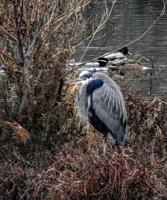
A great blue heron stands on a small island in a pond at the corner of River Road and Klindt Drive in The Dalles as a pair of mallard ducks swims by in the background.
A great blue heron stands on a small island in a pond at the corner of River Road and Klindt Drive in The Dalles as a pair of mallard ducks swims by in the background.
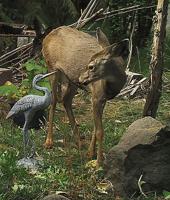
A deer comes nose-to-nose with a Great Blue Heron garden sculpture in this trail camera photograph contributed by Flora Gibson. Trail cameras are small cameras in waterproof housing triggered by motion. The Chronicle encourages readers to submit their local photographs for publication: Email TDCPhotos@thedalleschronicle.com, include the name of the photographer and a description of the subject.
Two lost wallets, one six year old girl, one Great Blue Heron and a random license plate may not seem to have anything in common, but this week they collectively have reminded me that life’s messages are everywhere.
Living with Beavers, Wed. May 21 ODFW and the North Clackamas Urban Watersheds Council will host a presentation about living with beavers, featuring ODFW biologists Susan Barnes and Dave Stewart. The presentation will take place from 7-8:30 p.m. at the Milwaukie Center, located at 5445 SE Kellogg Creek Dr., Milwaukie, Ore.

Great blue herons and great egrets Coastal estuaries are host to two impressive birds this time of year, great egrets and great blue herons. Both herons and egrets are wading birds that prowl the shallows looking for fish, crustaceans and amphibians.
NEWTS, a type of salamander common in the Pacific Northwest, may be observed in their migration from terrestrial environs such as rotten logs and moist soil to their breeding grounds in ponds, small lakes and the edges of streams. These small amphibians may be found if you are hiking in forests during or just after it rains.
Ruffed grouse courting Listen for a rhythmic drumming as you hike the forests this spring ― male ruffed grouse are out courting females and their rhythmic wing beating (drumming) is used to advertise their presence and draw females into their territories. Drumming starts with a slow but powerful wing beat every second, rapidly speeding up, and ending 8 to 11 seconds later. This acoustic “calling card” is repeated every 3 to 5 minutes in the early morning and late afternoon during the breeding season. Ruffed grouse are native to Oregon and can be easily identified by their relatively long, fan-shaped and distinctively banded tail in addition to their neck ruffs. Look and listen for these 16-19 inch long, brown or gray-brown, chicken sized birds in deciduous and mixed forest communities in western Oregon.
Springfield Area Fern Ridge Wildlife Area Fern Ridge Wildlife Area is open daily for public use providing great wildlife viewing opportunities. (One section of levee in the western portion of the Fisher Butte unit is posted closed to provide wildlife sanctuary during nesting season.)
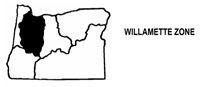
VALLEYWIDE The WESTERN MEADOWLARK was voted Oregon’s state bird by school children in 1927. Meadowlarks are found in grassland-type habitats where they sing from perches such as fence posts, shrubs, trees, or powerlines. Remnant grassland prairie habitats, pastures and even young Christmas tree plantations along the edge of the Willamette Valley are good places to find these birds. Listen for their liquid, melodious song. Western meadowlarks can be seen in fair numbers just north of the east end of Diamond Hill Rd. (Diamond hill road crosses I-5 at the Harrisburg exit). There are untilled pasture lands that still support the native Willamette Valley sunflower and our state bird that has such a beautiful and distinctive call. Although meadowlark populations are abundant in Eastern Oregon, they are declining in the valley because of loss of native prairie to farming and development. s their habitat shrinks nest predators like fox, skunk, raccoon and non-native opossum and house cats have an increasing impact on these grassland birds.
Saturday, May 25 – Animal Tracking Workshop, 10 a.m. – 1:30 p.m., Oxbow Regional Park. Learn how to identify beavers, otters, deer and other creatures at this workshop hosted by Metro. Registration and payment of $11 per adult required in advance. For more information, call 503-220-2781. Oxbow Regional Park is located at 3010 SE Oxbow Parkway, Gresham, OR 97080. Parking $5.


