
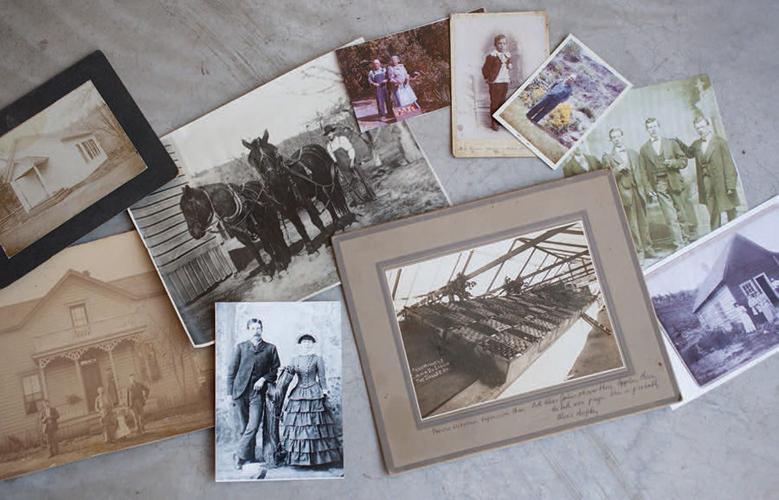
Mary Sandoz Leighton draws a rough, farm-worn finger down the ledger page. The customer bought cabbage, carrots and turnips, and hasn’t paid his bill. There’s not much luck of Mary collecting, however. The debt is 131 years old.
“They will forever owe 60 cents,” Mary says with a sigh.
That the debt seems close, almost touchable on the yellowed page, is a testament to how the Sandoz family has held tenaciously to the land through five generations. Just 30 miles west along the Columbia River at Riverside Farms, five generations of the Morton (now Struck and Gay families) are as bound to their farm land, even though much of the land itself disappeared under the Bonneville pool. Through it all, these family farms survived, and are inventing new ways to harvest a life for the next generation.
Three Sandoz brothers, Swiss immigrants, bought their farm, located five miles south of The Dalles in the Mill Creek Valley, in 1880. Now Mary and her brothers Ted and Chuck, and their cousin Dan Sandoz, manage most of the farm, with plenty of help from other relatives … sisters and brothers-in-law, nieces and nephews.
Don’t spend too much time sorting them out when you visit the farm stand. As any family that has been at something for so long, through so many generations, the family wheel is a kaleidoscope of marriages, divorces, births, deaths and untimely departures.
The Sandozes today have not traveled far, literally or figuratively, from those early farm roots. Founding farmer Alphonse Sandoz was one of 12 Sandoz siblings, and the only one sent to horticulture college in Europe before six brothers immigrated to the Western United States.
When Alphonse and two of his brothers took a ride up Mill Creek, the view of Mount Hood reminded them of the mountains in their Swiss homeland. It seemed like a good place to grow vegetables for the local market, and to plant apples, peaches, apricots and grapes.
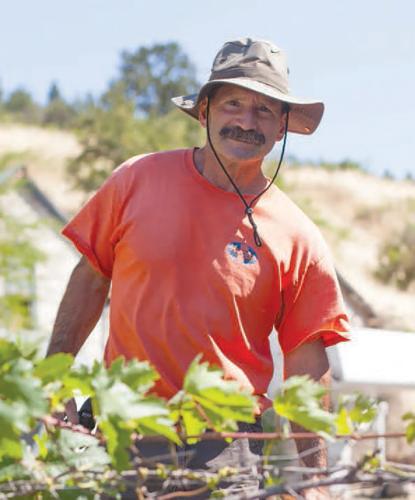
Ted, Mary and Dan stand under a shade tree on a hot July morning, and point out the wine grapes still growing on the hills above Dan’s house, which is one of the original Sandoz homes.
“They made a lot of wine,” chuckles Dan. “And they drank it all themselves,” adds Ted with a grin.
Next to Dan’s house is one of the original storage cellars, built into the hillside. The first Sandoz generation was selling root crops to local residents well into the winter months, according to that farm ledger, keeping vegetables and fruit safe with leaves and wood chips. When Highway 30 rolled by in the 1920s, it opened the Portland market for the first time. George Sandoz was often tasked with driving a loaded wagon in to the city to sell vegetables. A favorite family story involves a particularly foggy day. After delivering in the city and heading toward home, George drove the Ford Model T truck up through the roundabout at Vista House.
He became disoriented in the thick ground fog, and ended up circling and heading back to Portland.
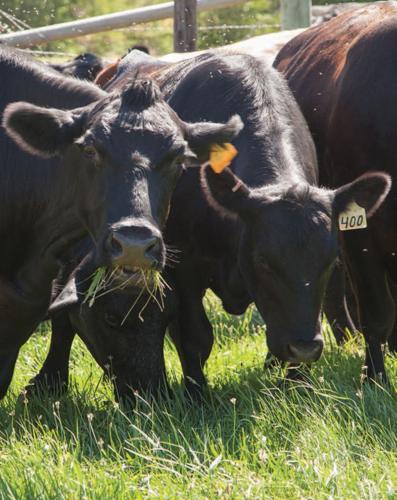
Today, farm management has settled into comfortable divisions. Dan manages about 100 acres of cherries. Mary tends to the cattle and gardens. Ted handles the haying. Chuck wrangles the chickens and eggs. Holly, Ted’s wife, raises the pigs and helps Mary run the farm stand and produce canned and pickled vegetables and cherry juice.
It’s possible to pick up everything you need for an excellent dinner at the farm stand. (Open Wednesday through Saturday from 11 a.m. to 6 p.m., and Sunday from 11 a.m. to 4 p.m., 5755 Mill Creek Road, The Dalles.)
A freezer holds wrapped beef and pork, an open cold case is full of fresh vegetables and eggs, and rows of picked carrots, kraut, relishes and jams line the shelves. The air-conditioned stand, with roll-up doors for more pleasant days, has a commercial kitchen in the back for canning and food prep.
At one point, Ted, Mary and Dan all left the farm and went off to college and jobs. But it was the lifestyle that called them back, says Ted. When asked to describe what that lifestyle is, Ted stares off at the distant cherry trees. Mary and Dan look at each other and smile. It’s just hard for them to put into words.
“To have the land, the ability to go out into the fields that belonged to our grandparents,” says Ted finally. “Keeping it up, taking care of it, and the scenery of the land.” Dan and Mary nod. It’s the beauty of it all.
Today, says Mary, even with the diversification they’ve achieved with the farm stand, cattle, pigs, eggs and cherries, “Somebody in the household has to work.” Mary worked for a vet clinic. Dan is a pipe fitter, Ted a farm equipment mechanic.
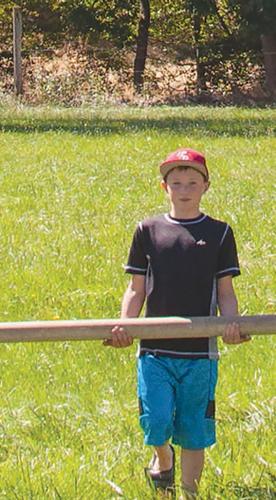
We walk down the road between fields and historic farm houses, and Mary points to three 11-year-old Sandoz boys, two cousins and an uncle (it’s that kaleidoscope of family relations again) moving irrigation equipment. The three boys laugh and josh with each other like boys on a summer morning do. But they are also working for $5 a day—$7 if they work extra hard, says Mary. “They are our future, but they’ll have to go to college, and they’ll have to work another job, just to keep the farm,” Mary says.
Besides that next generation, the farm’s best hope for future success is water. Their parents were wise enough to drill an artesian well in 1957, so deep and plentiful that pumps aren’t required. And then there’s Mill Creek itself: no surprise, the Sandozes have one of the earliest water rights on the stream. Their biggest challenge in the next generation is labor. Without pickers, it’s all at risk, says Dan.
Ted, on his lunch break, takes the golf cart down the road to show off one more treasure: the barn. Built in 1868 just before the Sandozes bought the farm, its walls and ceiling are braced with square, hand-hewn timbers and wood pegs. Ted stands in the dappled light in the middle of the barn and turns in a circle.
“We leave the door open just a crack, especially in the winter,” he says. That way, the owls and bats can come in out of the weather, roost, hang out, and rest for a while. It’s the kind of care you’d expect from a family, five generations into a love affair in the Mill Creek Valley.
IF WATER is Sandoz Farms’ greatest asset, it is conversely Riverside Farms’ greatest bane.
The knob of orchard land that juts out into the Columbia River just west of Hood River, held by the same family since the 1880s, is a mere shadow of its original splendor. The building of Bonneville Dam in 1938 condemned 220 acres of the farm to a watery grave.
“And we still pay taxes on that 220 acres!” says Sue Gay.
Gay recounts the farm’s story, beginning as the state’s first donation land claim in 1858, started by Amos Underwood, who also loaned his name to Underwood Mountain. Great-great-great-grandfather JW Morton bought the farm in 1886, and grew pears, apples, strawberries and asparagus.
We don’t know if the early Morton and Sandoz families knew each other, but it stands to reason they might have. Until Highway 30 came in, the only access to Riverside Farms was from the river. That same highway eventually brought George Sandoz and his vegetables within spitting distance of Riverside Farms. You can almost imagine him stopping in for a cold cider, and offering to bring along the Morton’s asparagus and berries to the Portland market.
And JW Morton was well known: President of Hood River Fruit Growers’ Union (in the days when Hood River was still a part of Wasco County). He also served in the Oregon legislature, and ran for the U.S. Senate and Oregon governor.
In 1923, George Struck married the Morton’s daughter, Gladys, and kept farming. When Bonneville Dam wiped out most the farm’s land, Gay says the farm was essentially abandoned from 1938 to 1970, but never left the family’s hands.
“It’s gone through a lot of turmoil since the Great Depression,” she says.
“There was always someone in the family who wanted to hold on, and would never agree to sell. It’s a miracle, really.”
George and Gladys’s son James kept at it, on Riverside Farms’ land and on other land as well, and left for a time to study pomology (fruit growing) at Oregon State University. In 1958, he was named Hood River County’s Young Farmer of the Year. That there wasn’t enough land to support him didn’t deter him. He worked as an orchard consultant for FMC Corp, and even for farmers in the former Soviet Union. Like the Sandozes, outside jobs were required.
James’s son Sheldon followed in his father’s footsteps, getting a college education, and then coming back to work his father and grandfather’s farms at Riverside and Odell. He married Sue, and they and their three kids made a life at the farm. In 1991, Sheldon’s untimely death meant another turning
point for the farm. Would it survive such a serious reversal? Several years later, Sue married Tony Gay, a Hood River physician. He adopted the kids, and they dedicated themselves to making the farm work.
History seems to compress down to a very thin line here when you see how strong the connections are to the past at both farms. The original Morton farmhouse has been remodeled and is Tony and Sue’s home today. There, running across the ceiling, are the original square, hand-hewn beams, identical to those in the Sandoz barn. And the dedication to the family farm is the same for both families.
“We are committed to staying,” says Sue now. Three years ago, Sue, Tony and their son Jordan started talking seriously about how to make that happen. The answer, it seemed, was all around them: cider, from their apples. Tony, the science guy, and Jordan, now production manager and “cider mastermind” methodically began to research, test and produce cider from their Newton apples, sold under the name Rivercider.
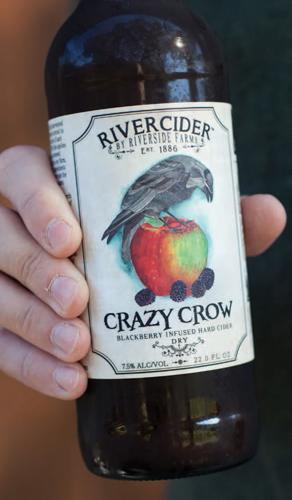
First production: 2013. Construction of the cider barn: 2014. They do everything in-house at the farm. Their ciders ferment for 40 days and then age 6 to 7 months in new American oak wine barrels. The cider goes still into the bottles but the addition of local honey in the bottle sets off a secondary fermentation, giving the cider its elegant and delicate bubbles. Cider bottled in kegs gets its bubbles from the addition of CO2. Last year: under 1,000 gallons total. This year: 1,500 gallons. Currently, they are making and bottling two varieties: Screech Owl, a very dry, pale cider, and Crazy Crow, a blackberry infused dry cider. Why blackberry? “Look around!” laughs Jordan, giving an arm sweep to the forever present, often nuisance, blackberry.
Rivercider is available in Hood River in bottles and on tap at Volcanic Bottle Shoppe and the Moth Lounge, and in bottles at Rosauers.
Next year? “Portland is the biggest U.S. cider market,” says Jordan. With an eye to that market, he has some marketing help.
Enter the capstone to the fifth generation:
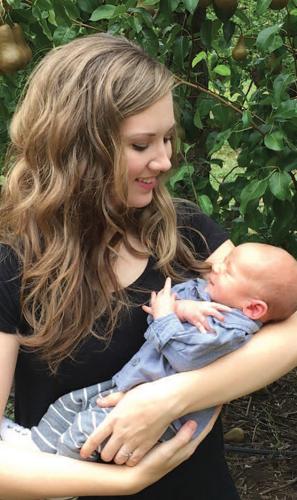
Samantha, Jordan’s wife. A year ago, they made the leap from Portland and moved back to the farm where Jordan grew up, nudging the cider business forward.
Samantha is in charge of marketing and business development.
And she and Jordan are in charge of something else: the sixth generation. Granger Morton Struck was born July 17.


