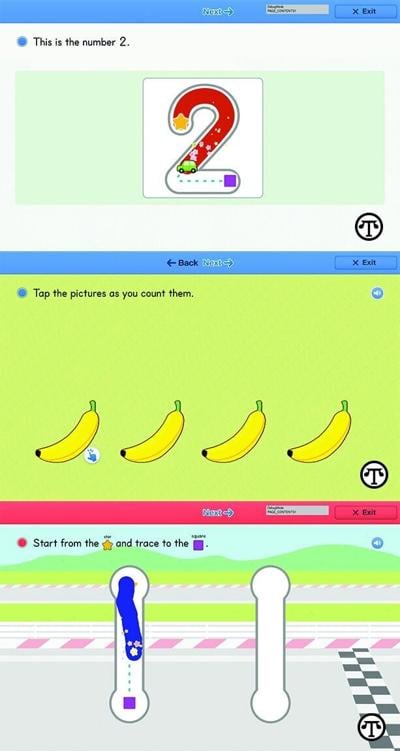
A new tablet-based curriculum targets the critical early years and aims to bring pre-kindergarten children to first-grade level within a year using colorful easy-to-understand concepts.
A new tablet-based curriculum targets the critical early years and aims to bring pre-kindergarten children to first-grade level within a year using colorful easy-to-understand concepts.
(NAPSI)—If any of the nearly 20 million children under 5 in America these days is one you care about, here’s news you may be interested to learn: According to a recent report from the Australian Department of Education, the importance of early childhood education is well established. Conclusive international evidence demonstrates that early childhood is a vital period in children’s learning and development, and that what happens in early childhood affects later development. This can be especially true when it comes to learning to read and do math.
What Parents Can Do
The National Association for the Education of Young Children suggests five steps:
Read Aloud Daily: This is crucial for building vocabulary and understanding narratives. Reread favorite books to build familiarity.
Phonics Fun: Play with sounds, rhyming words or the starting sounds of familiar objects.
Print Awareness: Point out letters and words in the environment, such as on cereal boxes, signs, or books.
Daily Counting: Count objects during daily life—shoes, toys, or snacks.
Shape Hunting: Look for triangles, squares, and rectangles wherever you go.
Parents can get help with all that from a new pre-kindergarten course. A child who starts it at age 3 or 4 could be reading and doing math at a first-grade level before they ever walk into a kindergarten classroom. That’s the premise behind Smile Zemi’s U.S. curriculum, which spans Pre-K through Grade 5, into the earliest years of childhood development, a window researchers widely consider pivotal for establishing long-term academic habits.
The curriculum covers seven subject areas: Alphabet, Math, ELA, Science, Social Skills, Thinking Skills, and Art & Music. In literacy, children start with basic strokes—straight lines, curves—before progressing to full letters, guided by on-screen animations that show proper stroke direction. In math, the focus is number sense: counting, ordering, and writing numerals through hands-on screen interaction meant to build the foundation for later arithmetic.
The course centers on a proprietary tablet and stylus. Rather than tapping or swiping, children write directly on the screen, an approach that can activate deeper cognitive engagement and mirrors the muscle memory development of traditional pencil-and-paper learning.
The program easily adapts to each child’s pace, allowing for review when concepts need reinforcement and automatically unlocking advanced content when a child is ready. The tablet itself operates as a closed system: no social media, no outside websites, no games, which means a distraction-free environment for young learners.
“We developed this interface so that children can navigate it easily and experience success from their very first interactions,” said Kyotaro Sekinada, President and CEO of Justsystems America, Inc., which introduced it to the US. “We want them to build a genuine joy of learning before they ever set foot in a classroom.”
The platform currently serves students from pre-K through elementary school and uses AI-assisted personalization across all grade levels.
Learn More
For further facts, including how to try the system for 21 days at no charge, visit www.smile-zemi.com/pk/.
Word Count: 478
"“We developed this interface so that children can navigate it easily and experience success from their very first interactions,” said Kyotaro Sekinada, President and CEO of Justsystems America, Inc., which introduced a new system for teaching pre-K kids r"