
The “Train of Tears” event starts at noon Saturday at Mt. Hood Railroad, First and Cascade streets. In case of rain, the event will be held inside Springhouse Cellars.
The public, and Mid-Columbia Gorge Nisei in particular, are invited to attend the gathering to honor the memory of what happened on the May 13, 1942, at the Hood River train depot.
That day, authorities forced 503 people onto a train and sent them to Pinedale and other camps, where most would live for the next four years. This was the result of President Franklin Roosevelt’s Executive Order 1066 — that thousands of people of Japanese heritage, most of them U.S. citizens, were to be removed from “military areas” extending 100 or so miles inland and be housed as prisoners in desert detention camps.
“Seventy-five years ago, a total of 503 residents — including 334 American citizens — were forced to leave the Mid-Columbia valley during World War II. They were uprooted simply because of the color of their skin,” said Dr. Linda Tamura, a Pine Grove native who will speak at the event; her parents were among those sent away.
Parking is available at the MHRR and Springhouse lot, and at the Hood River News lot, Sixth and State.
There will be a reading of letters written in the 1940s by Nisei students in the camps to teacher Vienna Annala in Hood River, along with poems and other readings and Kendra Wilkins singing the lament “Manzanar.” County Commission Chairman Ron Rivers and Mayor Paul Blackburn will read resolutions commemorating the evacuation,
Hood River Valley High School students have organized an annual award honoring a high school senior for their activism in work throughout their young lives. The first recipient of this annual award will be announced at the Hood River train station. A stone with their name, class year and word that describes their activism will be placed in the Yasui Legacy garden on the north library lawn.
In addition, the leadership class at HRVHS has been working on the identification and making of the tags which will be flown at the train station on Saturday. Each tag has the name, the identifying number and the age of the person of Japanese ancestry who was forcefully removed from Hood River County 75 years ago.
•
‘He had never seen people so thoroughly forlorn’
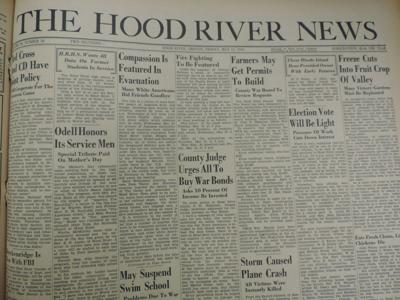
The front-page headline of the May 15, 1942, Hood River News read “Compassion is featured in evacuation; Many White Americans Bid Friends Goodbye.”
See below for that report, in full.
In that edition of the paper, and the following week are other stories that serve as poignant examples of just how tragic was the evacuation for Japanese-American families of the Hood River Valley:
• A page four story of the eighth-grade commencement event (Friday, May 10, 1942) for Odell and Central Vale schools, by W.N. Weber: “Sumio Nakamura of Central Vale had the honor of giving the valedictorian address. Everyone sang ‘God Bless America’ …” Other students receiving diplomas “entitling them to attend high school” included William Norimatsu, Claude Morita, and Fred Takasumi.
• A page one a story reported that citizens at a Mother’s Day graduation signed a letter to Odell-area servicemen stationed overseas or in training — including Settsu Shitara, Harry Tamura, Sho Endow, and Frank Hachiya. The letter read, in part, “You are defenders of us all.”
• On May 22, the front page of the News headline read: “War Cuts List of Graduates At Exercises,” adding, “Americans of Japanese lineage who had been removed, with their parents, to a concentration area as a result of war between Japan and the U.S., and had been given their diplomas before they were called upon to comply with the evacuation order.” They included: Sunae Akiyama, Hifumi Hukui, Robert Kageyama, Masaru Kiyokawa, Mark Namba, Mary Ogawa, Robert Okamura, Dorothy Sumida, Shigo Yamak, Homer Yasui, and Janney Yoshii.
• Another article, “Valley Loses 10 Percent of Its Population,” on May 22 recapped the May 13 evacuation and said the people on the train “had undertaken the trek ordered with the object of eliminating all representatives of an enemy race from what is known as a military area.
“Many, it goes without saying, carrying with them the best wishes of white American friends and neighbors, whom they have known for years.”
May 15, 1942:
The trek of a colony of more than 500 people of Japanese birth and lineage, including men, women and children, started by train at 10 a.m. Wednesday of this week from the Union Pacific depot, under U.S. Army orders, which ordained that, by noon, Wednesday, May 20, all persons of Japanese nationality and their American born children should be entirely evacuated from Hood River Valley, Bingen and White Salmon, Wasco and Sherman counties, all of which are within the designated Military Area No. 1.
The was but one exception to the order, Mrs. Kusachi, who, hospitalized several days ago, will later go to the Portland Assembly center, with her husband, Minoru Yasui, under bond to the U.S. District court at Portland for alleged violation of the curfew order was taken to the Portland on Tuesday, where he will await his hearing.
Early Wednesday morning, evacuees from Wasco and Sherman counties boarded the special train at The Dalles and proceeded to Hood River. Even prior to this arrival, many local evacuees had arrived at the railroad depot, with their packages and baggage, the latter being loaded into baggage cars, a group of solders being on hand to give assistance to all who needed it.
It is definitely to the credit of this community of Hood River Valley that a number of families who were to be evacuated arrived at the depot in cars driven by their white neighbors, and other white American residents came from all sections of the valley to extend their “good-byes” to the Japanese and Japanese-Americans they had long known and respected as hard-working fruit growers.
The several days before the time of departure arrived was spent by old and young evacuees alike in this city, older folks making any purchase of household articles suitable for an assembly center, and the young people buying clothing, notions and enjoying their fill of ice cream. Many visited stores and other places of business to settle accounts, to the end that none could say any went away owing bills.
At the depot Wednesday morning, many hundreds of white residents had assembled, while troops and local and state law enforcement officers were on hand to witness the evacuation. Every detail went through without the slightest unexpected incident, and there was not the least evidence of any hostility towards any of the evacuees. On the contrary, a most friendly spirit was maintained and here were many incidents which conveyed better than words, the spirit of compassion which was largely held for these evacuees who have come under the ban of stern military necessity.
Many groups stood chatting with their American friends till the “All Aboard” signal was given — and then came hasty good-byes and the quick brushing of hands across eyes, as these evacuees faced the ordeal of leaving the valley they had called home for many years — some of them, all their lives.
As the train slowly rolled out of the depot, there were some who are still privileged to stay and live in the beautiful Hood River Valley, who noticed many of the older women who were in the coaches sat with bowed heads, while their men-folk stared straight ahead. And there were plenty of lumps in the throats of many who watched the train head west and who wondered how many other similar scenes are being enacted in many other sections of the world in this time of total war.
These evacuees go to Pinedale, Calif., assembly center, near Fresno.
‘Stubborn Twig’
From “Stubborn Twig: Three Generations of the Life of a Japanese American Family,” Lauren Kessler’s thorough history of Hood River at the time:
In a public statement written just before the evacuation, the Japanese American Citizens League stated, “As we go with heavy hearts, we leave with the hopeful expectations that someday soon we’ll return once again to this land where the rain and the sunshine meet.”
But the Issei (Japanese-born immigrants) nurtured little such hope. They had already endured a lifetime of discrimination; they have labored hard to get where they were. Now everything they had worked for was reduced to the contents of the suitcases they held in their hands. Their families were being ripped from the valley by the roots.
When Issei women came for the last time to Keir Drugs, young Paul Keir saw this sorrow close at hand. Kessler reports that “he had never seen people so thoroughly forlorn.”
“… Ken Abraham, the son of a local doctor who had ministered to the Japanese American community, surveyed the same scene and saw something quite different. One solitary white man walking slowly through crowed of Japanese, stopping to shake a hand, pat a back or say a few words. It was the lawyer E.C. Smith, who had been such a good friend to the Yasui and others. Of all of Homer’s hakujin (Anglo) friends from high school, only one came to the station to say goodbye.”
— “Stubborn Twig,” by Lauren Kessler, OSU Press, 2005


