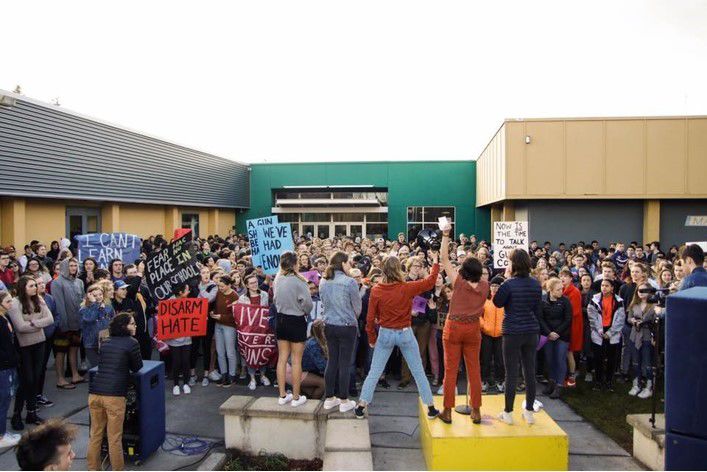
Reading the local newspaper headlines, watching Facebook posts and television coverage of students advocating for change has strengthened my belief that our future is in better hands with this generation than those presently in power. Ironically, it is the adults who are acting in a childish manner while the youth are behaving like responsible, respectful adults.
There was no violence, name calling or fights breaking out at the school walk outs. There was no vandalism or destruction of public property. Different points of view were listened to respectfully regardless of how disparate they were from one’s personal beliefs.
I was incredibly proud of the way Hood River students conducted themselves and their passion to institute change. This is not simply youthful exuberance, it is the birth of political advocacy in this generation.
•
I, too, was engaged in the youth movement on a peripheral level in the late ‘60s and early ‘70s. We marched peacefully, demanding civil rights for all, the end to war, equality for women, the eradication of hate, the power of love. We came out in favor of sexual preference, a cleaner environment, a healthier place to live and work. We devoted our lives to fulfilling the dreams that some adults labeled unachievable fantasies. We were told that when we “grew up,” we would have a better understanding of the reality of life.
At times, adults supported our beliefs; other times, they dismissed our efforts as naïve. Some tried to deter us with threats and violence, intimidation and incarceration. But over time, with a tenacious attention to peaceful protest and service, we began to see positive change. Not as fast as we would have liked, nor sustainable in some instances, but measurable progress, at a slow and steady pace.
Today’s generation of super connectors is active at a younger age, more aware of the inhumane conditions around the world as well as in their own back yard. They are quick to learn and quick to take action. Some are children of aging activists, more attuned to the philosophy espoused by Martin Luther King, the Dalai Lama and Mahatma Gandhi. They are aligned with sanctuary and service. They trust their instincts more than their government, unflinching in the face of seemingly unconquerable issues, unwilling to compromise their beliefs. They are impatient, demanding change now. And because of that impatience, combined with the speed of technology, they will create change more rapidly than ever before.
As Minoru Yasui demonstrated, it may take a lifetime to achieve change while seeking a utopian vision, but each step in the journey is to be celebrated.
We will be celebrating our home town hero, Presidential Medal of Freedom awardee Minoru Yasui, on Wednesday, March 28, learning more about his life journey in seeking “Justice for All.” His journey started right here in Hood River as a young lawyer seeking equality for his Japanese family and community. It continued over the next half century, touching people of every race, ethnicity, gender and faith.
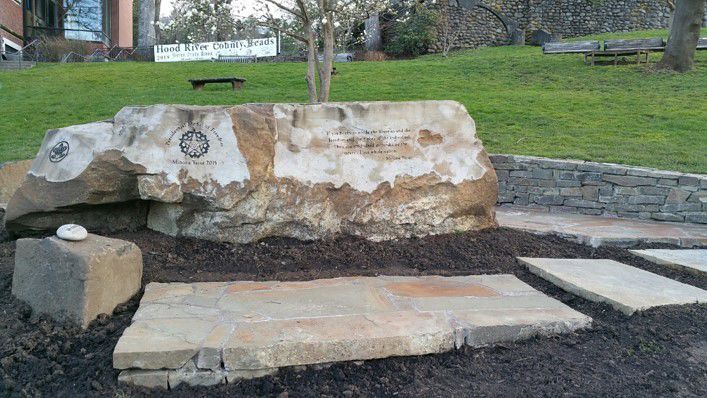
At 11:30 a.m. on March 28, the day the Oregon Legislature designated Minoru Yasui Day in perpetuity, we will reflect on the struggle to achieve civil rights for all and the need for every generation to work towards this monumental goal. We will dedicate the Minoru Yasui Legacy Garden, which now surrounds the legacy stone located on the north library lawn at the top of the “steps to nowhere.” Those historic steps have a new purpose in life, leading to a special place where people can reflect on the need to treat all people with respect and dignity, in perpetuity.
The designer of the garden, Sadafumi Uchiyama, created the unassuming space around the stone to pay respect to the life work of Minoru Yasui and inspire future activists seeking seemingly unachievable goals. It is a place to peacefully raise your voice in opposition to prejudice, violence, hatred and discrimination. It is a place to inspire activists to dream the impossible dream and take their first steps on that life journey.
We will honor youth from our community who are following in the footsteps of Minoru Yasui, becoming active in preserving the rights of others and seeking justice for all. Yasui’s daughter, Holly, will share a few of Minoru’s memorable quotes preserved on the legacy stone:
“What is done to the least of us can be done to all of us.”
“If you begin to erode the liberties, rights and freedom of the individual then you are indeed jeopardizing the safety of our whole nation.”
“I knew we had to protest.”
“We are born into this world for a purpose and that is to make it a better place.”
•
After the ceremony, guests are invited to walk up the lawn to the library’s historic reading room and join George Nakata as he shares his internment experience, his life and friendship with Minoru Yasui and his activism. Mr. Nakata speaks to students and groups throughout the Pacific Northwest in order to keep this shameful part of history alive and prevent it from happening again. His talk is sponsored by the Hood River County Museum which has focused several artifacts, exhibits and events on this particularly painful period of time in our community and the entire country’s history.
It is increasingly important to revisit these lessons in this immensely polarized political climate tearing our country apart. We need to listen to the voice of youth to remind us of the urgency, follow their lead and rededicate ourselves to preserving the principles on which our country was founded.