
By Nathan Wilson
Columbia Gorge News
THE GORGE — “I’ve been an immigrant in this country for 30 years, and I have never seen anything like this,” said White Salmon City Councilor Morella Mora. “The real toll that our community faces, that you’re seeing live right now, is the mental health toll.”
At the tail end of their Nov. 19 meeting, Mora spoke out against the spike in federal immigration enforcement that occurred earlier this month, primarily in Hood River and The Dalles, as previously reported by Columbia Gorge News and Uplift Local. Agents detained at least eight people in the days following Nov. 7, and arrested two more on Nov. 29.
U.S. Customs and Border Protection, which is operating in tandem with Immigration and Customs Enforcement (ICE), has yet to provide more information about those individuals, but a spokesperson separately revealed that both agencies made more than 560 immigration-related arrests throughout Oregon in October, a dramatic increase compared to prior months.
As of Nov. 24, the Portland Immigrant Rights Coalition (PIRC), a nonprofit that provides related education, rapid response and legal services, confirmed at least 304 detentions across the state in November.
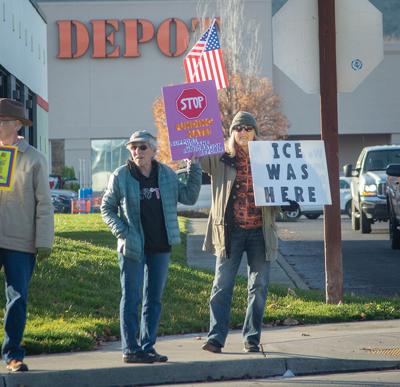
The Hood River Latino Network (HRLN), which shares information with PIRC and coordinates a team of volunteers who monitor enforcement activity in Hood River and Wasco counties, reported that one of the Nov. 29 arrests took place at The Dalles’ Home Depot. Dozens of people protested outside the store a day later, a nationwide phenomenon as organizers call on Home Deport to better protect day laborers that often find contract work by gathering in its parking lots.
Company officials have denied any involvement, according to other news reports. As for Mora, she emphasized that it’s not just undocumented people feeling fearful.
“If you are driving around and you look Latino enough, you can get pulled over,” said Mora. “They are taking people regardless of status. They are taking people without warrants.”
In September, she noted, the U.S. Supreme Court temporarily enabled immigration officers to make arrests based on reasonable suspicion, informed by factors like place of work, language spoken and race. Combined with the increase in local sightings, that’s led to Latino citizens calling Mora and asking whether it’s safe for them to leave their home, she said.
A woman from The Dalles, born in America but raised by her dad who immigrated from Mexico, echoed Mora’s sentiments. Concerned about reprisal, she preferred to go by the pseudonym Andrea and is one of about 30 people part of HRLN’s rapid response team in the city.
“We’re still on edge, and we’re definitely in the unknown,” Andrea said. “Being Hispanic, Latino or brown, we’re seen differently, and sometimes animals are treated better.”
When arrests initially picked up, she said The Dalles was noticeably more empty because many people, despite having bills to pay and kids to feed, opted to stay home from work. Andrea is still grocery shopping for families that don’t feel safe enough to run errands themselves. She also stressed that immigration is often a choice born out of necessity — it’s to escape poverty or dangerous conditions — and one that can’t wait for the years-long naturalization process.
“These people that are coming here and risking their lives, it’s not because they want to be a burden,” said Andrea. “They’re coming here to work. They’re coming here because they want to better themselves. They’re coming here to better their families in Mexico because they know the hard, hard life that’s down there.”
Beyond grocery shopping, Andrea is keeping an eye on school dismissals and consistently driving neighborhood streets. Some days, she’s barely slept because her entire life was on pause, she said, so consumed by trying to inform the Latino community that she regularly forgot to eat.
Being part of a team helps, though, and the thanks she receives from those staying inside keeps her motivated.
“It’s such a small, united community that I feel like we have all of each other’s backs and we take care of one another,” Andrea said. “In a way, I feel like our town is a family.”
Like Andrea, Mora struggles to focus on anything else right now and is working to translate that weight and grief into building out mutual aid networks and pursuing proactive local policy, like regulations against racial profiling, she said after the meeting. In the meantime, she pushed for more listening and solidarity.
“I encourage other city councils, other government officials, other mayors, to talk to their community members, to hear these stories and share these stories. Our community is asking us to do more, as much as we can, to keep our immigrant neighbors safe,” Mora said.




Commented
Sorry, there are no recent results for popular commented articles.