
By Trisha Walker
Columbia Gorge News
THE DALLES — My second time through the Virtual Dementia Tour (VDT) in October was less stressful and more successful than my first eight years ago, but by a margin so thin I can’t even begin to quantify it.
When I took the VDT in May 2017, I became so frustrated with my inability to do anything that I ended up sitting down and giving up. This time, I was prepared for the constant stream of noise and chatter via headphones to mimic the brain’s inability to sort through sounds, two layers of gloves — one set plastic, the other mittens, one of which is purposely inside out — to illustrate reduced coordination, and textured shoe inserts to make walking difficult.
But being prepared does not win the battle. I again grew frustrated — though I refused to sit down this time. Instead, I just stood off in a corner. I did manage to complete more tasks, but I’d forgotten how hard it is not to be able to see, thanks to an altered pair of sunglasses. It was dark, I was afraid of falling (I’d recently managed to twist both of my ankles and they still hurt), and I was in a constant state of alert thanks to alarms and phones going off in my ears — I jumped every single time — on top of various bits of conversation.
Like last time, I came away with an appreciation for how hard dementia is, both physically and mentally. Maybe because I’m eight years older and I’ve been covering dementia issues for many of those years, I also came away with a new perspective: What we think people living with dementia need and what they actually need are often different things.
That’s what is so amazing about Hood River’s Sunshine Club, a program that meets individuals and families affected by dementia where they are. And now, something similar is coming to the Mid-Columbia Senior Center in The Dalles: The Cherry Blossom Adult Day Program will provide high-quality, person-centered, dementia-capable care to support caregivers and their loved ones.
The Dementia Friendly Wasco County steering committee has been working for the past year to bring the program to fruition. And while it’s in its early stages — there was an open house in late October — the program has kept “open house hours” on Wednesdays from 1-5 p.m. while Program Coordinator Danette Utley continues training and preparing for implementation.
The program is free, thanks to a $25 million grant awarded to the Alzheimer’s Association from the Administration for Community Living — a division of the U.S. Department of Health and Human Services — to enhance respite services for dementia caregivers, Utley said.
“This funding established the Center for Dementia Respite Innovation (CDRI) to fund new respite innovation projects nationwide,” she explained. “With this two-year grant opportunity, we are launching Cherry Blossom Adult Day Program.”
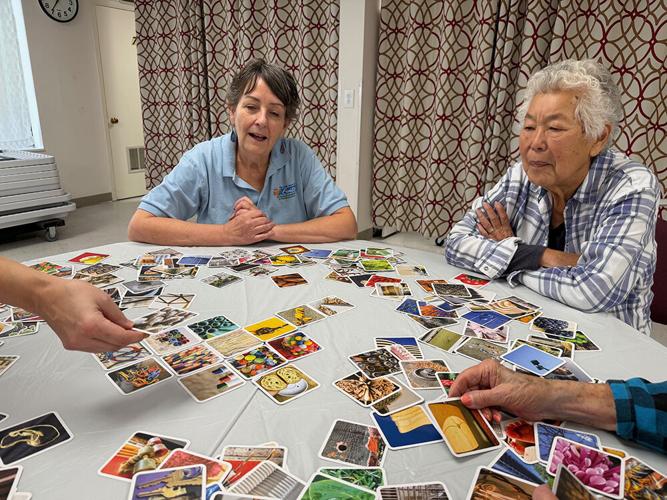
The program is geared towards the needs of participants — snacks, movement, music, games, art, sharing stories, or other activities based on their interests and backgrounds, said Utley, who has 19 years of experience in six different facilities.
“As an activities director, some of my best activity ideas are from the people themselves,” Utley said. “To incorporate a favorite game or music that they recognize can be comforting. It stimulates both cognitive and muscle memory, as well as giving a sense of pride and contribution.”
Knowing the history of each participant is important, she added, including hobbies and interests, past and present. The more background she has, the more meaningful the opportunities.
“It’s important to focus on what they can do, rather than what has changed,” she said. “Adapting and modifying activities becomes an art of inclusion. Everyone can play, you just focus on the process and figure out ‘how’ for each person.”
The program also offers a break for caretakers. Utley said exhaustion and burnout are common in caregiving, and having breaks is critical.
“You have to take care of yourself, to be able to give full attention and the best care to others,” she said. “It’s very easy to fall out of balance, forgetting or neglecting yourself, when you are in a situation where the need is great, or you feel you cannot leave the person living with dementia in the care of others.”
This is where respite comes in: “It’s a block of time where your loved one is in a safe and stimulating environment, so you don’t have to worry,” Utley said. “You can have peace of mind while you rest, manage personal responsibilities and recharge. Respite is a win-win!”
Volunteers are needed — they will undergo training as well and must pass a background check. “Compassion and a heart for helping people are essential; knowledge of dementia and caregiving are helpful, but not required,” Utley said.
For more information on the program or volunteering, contact Utley at 541-288-8315.


Commented
Sorry, there are no recent results for popular commented articles.